
Bust of a Child
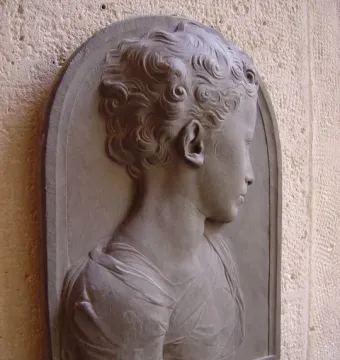
Bust of a Child is a 40 cm high, 30 cm wide bas-relief carved in gray Tuscan sandstone (pietra serena). Acquired by the Louvre in 1859, it is now displayed in the Denon Wing’s Donatello Gallery, among Italian and Spanish sculpture. Long attributed to the French sculptor Jean Goujon and dated to 1571, it is now presented more cautiously as the work of an anonymous Florentine artist from the late 15th or early 16th century. Its provenance was linked to the Cemetery of the Innocents in Paris, and its attribution has been revised by later art historians.
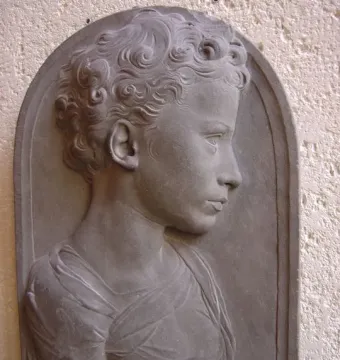
October 2013 © Jospe · CC BY-SA 3.0
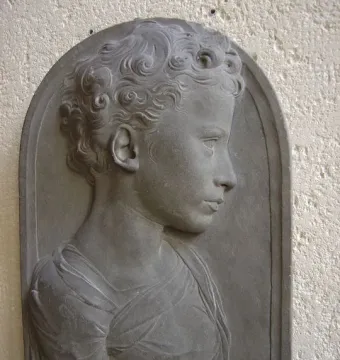
October 2013 © Jospe · CC BY-SA 3.0
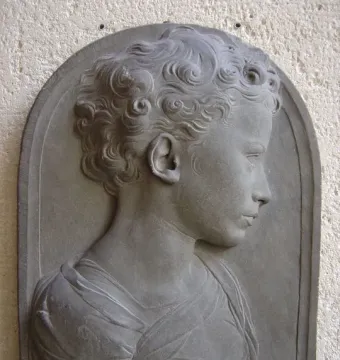
October 2013 © Jospe · CC BY-SA 3.0
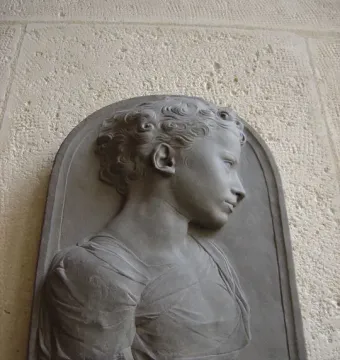
October 2013 © Jospe · CC BY-SA 3.0
October 2013 © Jospe · CC BY-SA 3.0
Identification | |
| Title | Bust of a Child |
| Original title | Buste d'enfant |
Historical context | |
| Art historical context | Italian Renaissance |
| Date | late 16th century or early 17th century; earlier attribution had dated it to 1571 |
Creator | |
| Attribution | cautiously attributed to an anonymous Florentine sculptor; earlier attributed to Jean Goujon, and at the beginning of the 20th century Wilhelm Bode proposed Antonio Rossellino |
| Geographical association of artist | Florentine |
Discovery and provenance | |
| Provenance | Reported by Viel-Castel to have come from a tomb in the Cemetery of the Innocents in Paris |
| Early notice | Noticed there by the engraver Jean-Pierre Droz |
| Acquisition by Jean-Pierre Droz | Acquired after 1785 from workers involved in the destruction of the Cemetery of the Innocents |
| Ownership transfer | Jules-Antoine Droz later gave it to Horace de Viel-Castel |
| Ownership in 1854 | Recently owned by Horace de Viel-Castel |
| Interpretation of origin | Initially believed by Viel-Castel and Droz to be a funerary monument raised by Jean Goujon in memory of his twelve-year-old daughter; the model's identity remains disputed and uncertain |
| Basis for earlier attribution | Droz said he had seen the relief above a funerary slab bearing the name Marie Goujon and the date 1571 in old lettering |
Physical characteristics | |
| Dimensions | 40 cm high, 30 cm wide |
| Shape / framing | The portrait is set within a frame with an arched upper edge, not a circular or oval motif |
| Type | bas-relief |
Materials | |
| Material | gray Tuscan sandstone (pietra serena) |
| Material attribution | Viel-Castel described it as a very fine, very hard gray granite |
Appearance | |
| Subject | Portrait bust of a child |
Location and ownership | |
| Current owner | Louvre Museum |
| Acquisition date | 1859 |
| Current display location | Donatello Gallery, mezzanine level of the Denon Wing, room 160, Louvre |
| Earlier display location | Before 1874 it was moved or stored in reserves; afterward Louis Courajod placed it in a window recess of the new Italian room (room VI of the museum of medieval and Renaissance sculpture) |
| Historical display note | In 1863 it was said to be on display in the section called the museum of the Renaissance |
History and restoration | |
| Attribution history | The attribution to Jean Goujon was widely accepted by many mid-19th-century authors, then later dropped after scholars showed that Goujon had left the Louvre chantier in 1562, moved to Bologna, and died before 1568 |
| Interpretive tradition | Mid-19th-century authors relied on Dezallier d'Argenville's tradition that Goujon died in Paris in 1572 during the St. Bartholomew's Day massacre |
| Curatorial attribution | Louis Courajod attributed the relief to the school of Donatello; the museum sculpture catalogue retained Courajod's conclusion |
| Stylistic comparison | Compared with works by disciples or imitators of Donatello such as Desiderio da Settignano or Mino da Fiesole |
Other | |
| Bibliography | Horace de Viel-Castel, Mémoires sur le règne de Napoléon III 1851-1864, edited and annotated by Éric Anceau, Paris, Robert Laffont, 2005, pp. 381-382 and 386; Theodor Josef Hubert Hoffbauer, Paris à travers les âges, ed. Pascal Payen-Appenzeller, vol. I, Paris, Tchou, 1978, p. 372, fig. 29; Wilhelm Bode, Florentiner Bildhauer der Renaissance, Berlin, Bruno Cassirer, 1911, p. 216; Eugène de Ménorval, Paris depuis ses origines jusqu'à nos jours, vol. II, Paris, Firmin-Didot, 1889, p. 332; Ernest Bosc, Dictionnaire de l'art, de la curiosité et du bibelot, Paris, Firmin-Didot, 1883, pp. 90-92, fig. 78; Louis Auvray, 'Salon de 1867 - VIII', Revue artistique, vol. XIII, p. 86; René, 'Le charnier des Innocents', La Semaine des familles, pp. 103-105; Gilbert, 'Le vieux Paris - VII', La Semaine des familles, p. 406 |