
The Resurrection Pulpit
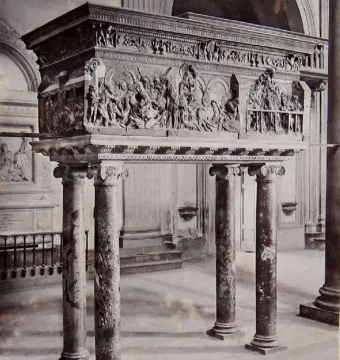
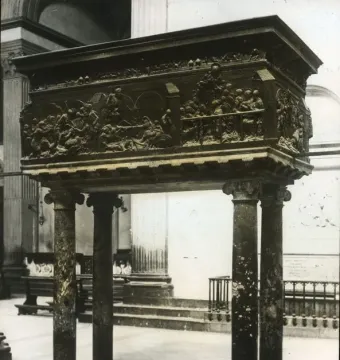
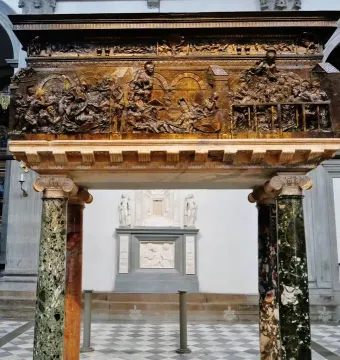
The Resurrection Pulpit is a bronze sculptural work by the Florentine artist Donatello, made after 1460. It is located in the Basilica of San Lorenzo in Florence. The pulpit is one of two bronze pulpits in the basilica, the other being the Pulpit of the Passion, and both are among Donatello’s last works. Donatello is credited with the project and design, while later phases were probably completed by collaborators such as Bartolomeo Bellano and Bertoldo di Giovanni. The Resurrection Pulpit was probably the first of the two to be made.
© Carlo Brogi · Public domain
© Edmund F. Arras · Public domain
April 2023 © Zairon · CC BY 4.0
© Donatello · Public domain
June 2021 © Francesco Bini · CC BY-SA 4.0
Identification | |
| Title | The Resurrection Pulpit |
| Number of works | One of two bronze pulpits of San Lorenzo, Florence |
| Original title | Il pulpito della Resurrezione |
| Type | Bronze pulpit |
Historical context | |
| Patronage | Cosimo de' Medici is reported by Vespasiano da Bisticci to have commissioned the bronze pulpits for San Lorenzo |
| Original function | Unknown; some scholars have suggested an original use as sarcophagi, while a choir loft or cantoria is considered unlikely |
| Date | After 1460; probably after Donatello's return from Siena in 1459–1460 |
Creator | |
| Autograph extent | Generally judged to be largely autograph by Donatello, but some rougher passages may be by Donatello or assistants; the extent of his authorship cannot be established in full |
| Career significance | Among Donatello's last works; considered his last masterpiece and the extreme point of his art |
| Artist's age | Over seventy years old |
| Completion order | Usually considered the first of the two pulpits to be completed; probably the first to be made |
| Collaborators | Bartolomeo Bellano and Bertoldo di Giovanni |
| Design | Donatello designed and drew the work and is credited with the project; he also directly supervised the casting |
| Attribution | Generally attributed to Donatello, though authorship by Donatello and his collaborators is difficult to evaluate |
| Artist nationality | Florentine |
| Artist | Donatello |
| Assistant involvement | Later phases of execution, casting, and finishing were probably carried out by assistants or collaborators, with their role described as marginal in some sections |
Physical characteristics | |
| Size | 292 cm long; 123 cm high excluding the columns; slightly larger than the other pulpit |
| Installation | Set on four columns and preserved in the right nave of San Lorenzo |
| Components | Composed of various panels |
| Number of scenes | Eight scenes in total: three on each long side and one on each short side |
Materials | |
| Material | Bronze |
| Later additions material | Two north-side panels are 17th-century wooden additions; Christ Mocked and Saint Luke the Evangelist are in darkened wood |
Technique | |
| Frieze authorship | Believed to be the work of an assistant and executed after Donatello's death |
| Non-finito | Some parts appear rougher, as if intentionally unfinished; traces of the casting process remain visible |
| Inscription | OPUS DONATELLI FLO[RENTINI] in a medallion, generally considered posthumous |
| Frieze decoration | Putti harvesting grapes, winged children with little amphorae, and opposed horsemen and centaurs |
| Structure | Divided by small buildings arranged in perspective rather than by pilasters |
| Frieze | A continuous frieze runs along the top, with a protruding cyma/cresting above it |
Appearance | |
| Layout | More original than the Passion Pulpit, with an extreme compositional freedom and a highly three-dimensional, architectural conception |
| Setting | The scenes are set within a portico-like structure representing a building, with lateral pediments in perspective and a flat roof |
| Columns | Columns with composite capitals topped by leonine protomes holding garlands |
| Rear treatment | A wicker-like lattice at the back, with tufts of small trees visible beyond and above the ceiling |
Iconography and meaning | |
| Narrative subject | Episodes from Christ's life after death, with the addition of the Martyrdom of Saint Lawrence in honor of the basilica's patron saint |
| Holy Women at the Tomb | The scene is divided by a central transverse pillar; on one side are the opened tomb, the angel, and three sleeping guards, and on the other the three Marys in different emotional states |
| Descent into Limbo | Christ descends immediately after the Resurrection to lead the righteous from Hell to Paradise; the blessed crowd around him is composed and orderly, with a small devil fleeing at lower right |
| Resurrection | Christ rises above the tomb holding the cross-banner and wearing funerary bandages, with his foot on the tomb; the composition is shifted left and the expression is less triumphant than tormented |
| Ascension | Christ ascends above the scene, helped by angels, raising his hand in farewell and holding a book; the apostles and the Madonna are arranged in a semicircle |
| Pentecost | Mary and the apostles are arranged in a semicircle around apostolic symbols, while the dove of the Holy Spirit sends flames down upon them |
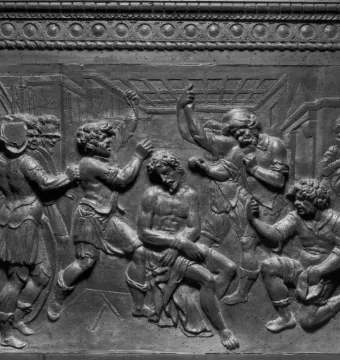
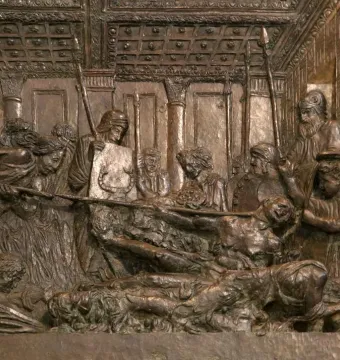
| Martyrdom of Saint Lawrence | Saint Lawrence lies on the grating in agony while the executioner pushes his neck with a forceps-tipped rod; an angel comforts him with the palm of martyrdom, while soldiers and bystanders react in varied ways |
Location and ownership | |
| Associated work | The Pulpit of the Passion |
| Location | Basilica of San Lorenzo, Florence, Italy |
| Placement | In the right nave of the basilica |
History and restoration | |
| Present installation date | Probably mounted provisionally around 1515, possibly at the time of Leo X's visit to Florence, and later reassembled in 1558–1565 |
| Later additions | Completed with two darkened wooden panels in 1616 and 1634 |
| Date on relief | 15 June 1465, carved on the pediment of the right wall of the Martyrdom of Saint Lawrence scene; the only date on the pulpits |
| Meaning of date | It predates Donatello's death, but it is unclear whether it marks completion of the pulpit, the panel, or the wax model |
Significance | |
| Critical assessment | Now regarded very favorably for its expressive intensity and inventive reinterpretation of biblical themes |
| Artistic significance | Seen as the culmination of Donatello's studies of human emotion, spatiality, and compositional freedom |
| Reception history | Criticism improved gradually from the Mannerist period onward; in the 16th century Baccio Bandinelli dismissed the pulpits as the worst works by Donatello's hand, attributing the unfinished aspects to old age and impending blindness |
| Authorship note | The Martyrdom of Saint Lawrence is the only scene of the two pulpits attributed entirely to Donatello in every phase of its making |
Other | |
| Commission source | Reported by Vespasiano da Bisticci in his Vita di Cosimo de' Medici |
| Commission quotation | Cosimo de' Medici 'commissioned certain bronze pulpits for San Lorenzo' |
| Completion status | Impossible to establish how complete the work was at Donatello's death in 1466 |
| Stylistic notes | Strong perspective and low viewpoint, realistic armor and equipment, classical references in the cornice, and highly varied emotional expression |