
Equestrian Statue of Simón Bolívar
The Equestrian Statue of Simón Bolívar is a bronze sculpture of Simón Bolívar by Adamo Tadolini. The equestrian figure shows Bolívar mounted on a rearing horse, dressed in military attire with a decorated cloak, boots, a sash, and a sword sheathed at his left thigh. He is also shown holding his hat at the right side of his body. Models of the work are located in Plaza Bolívar in Caracas, Plaza del Congreso in Lima, and Plaza Naciones Unidas in San Francisco, United States. The San Francisco sculpture was designed by Miriam Gandica Mora and Victor Hugo Barrenchea-Villegas and inaugurated in December 1984.
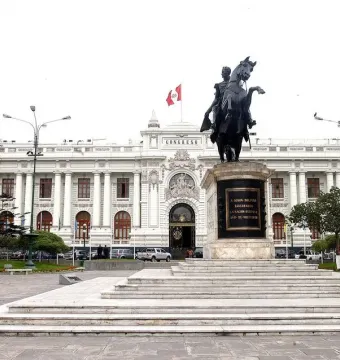
March 2012 © Congreso de la República del Perú · CC BY 2.0
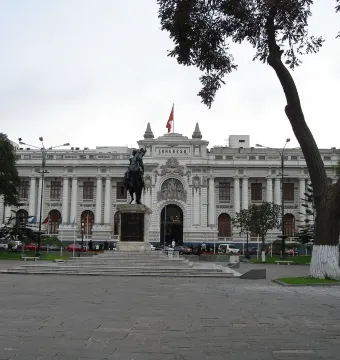
© Manuel González Olaechea · CC BY-SA 3.0
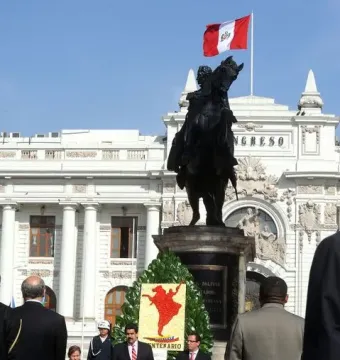
October 2011 © Congreso de la República del Perú · CC BY 2.0
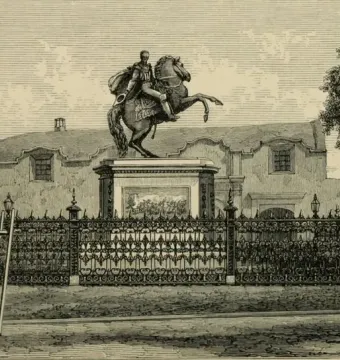
1873 © Hutchinson, Thomas Joseph, b. 1820 · No restrictions
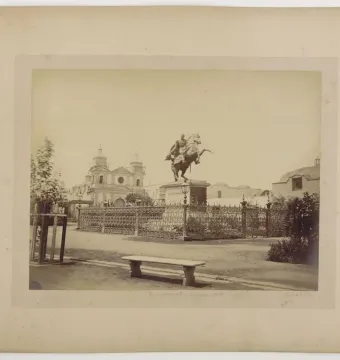
© Sommer, Giorgio (1834-1914). Photographe Courret, Eugenio (1839-1920). Photographe Garreaud, Émile (1835-1875). Photographe Miot, Paul-Émile (1827-1900). Photographe · Public domain
Identification | |
| Title | Equestrian statue of Simón Bolívar |
| Type | equestrian statue; monument |
| Subject | Simón Bolívar |
| Alternative name | Monument to Simón Bolívar |
Historical context | |
| Purpose | To commemorate Bolívar’s role in bringing peace and freedom to Peru and the struggle for independence of the Spanish colonies in South America |
| Legal authorization | Ordered by the Congress of Peru in 1825; legal authorization dated 12 February 1825 |
| First stone laid | 8 December 1825, during a solemn ceremony |
Creator | |
| Teacher | Antonio Canova |
| Pedestal author | Filippo Guaccarini (also given as Felipe Guacarini) |
| Sculptor | Adamo Tadolini |
| Style | Neoclassical |
Discovery and provenance | |
| Arrival in Peru | 1859, via the port of Callao |
| San Francisco version | Designed by Miriam Gandica Mora and Victor Hugo Barrenchea-Villegas; inaugurated in December 1984 at Plaza Naciones Unidas, San Francisco, United States |
| Related versions | Related versions are in Caracas, Lima, and San Francisco; the Caracas version was inaugurated in 1874 using the same mold as the Lima statue |
| Original planned location | Former Plaza de la Constitución, later Congress Square, Lima |
| Installation note | Ceremonially installed on the anniversary of the Battle of Ayacucho |
| Installation date | 8 December 1859 |
| Installation location | Bolívar Square, Lima |
| Completion date | 1858 |
| Casting supervision | Müller, German sculptor and superintendent of the Munich foundry |
| Casting location | Munich Foundry |
| Model price | 4,500 pesos |
| Model material | Plaster |
| Model maker | Adamo Tadolini |
| Commission location | Milan |
| Commissioning | In 1853 the Peruvian government instructed Bartolomé Herrera, plenipotentiary minister of Peru in Rome, to arrange a competition for the statue and pedestal |
Physical characteristics | |
| Pedestal rear | Coat of arms of Peru |
| Pedestal front | Inscription plaque |
| Pedestal reliefs | Marble reliefs of the battles of Junín and Ayacucho on the side faces |
| Pedestal material | Marble |
| Pose | Bolívar mounted on a rearing horse standing on its hind legs |
| Form | Statue on a pedestal with three steps |
| Weight | 23 tons |
| Height | 4 meters |
Materials | |
| Statue material | Bronze |
| Pedestal material | Marble |
Technique | |
| Static design challenge | Tadolini had to solve the stability problem of the heavy bronze horse raised on two legs and a tail |
| Mold reuse | The Caracas replica was made from the same mold used for the Lima statue |
Appearance | |
| Clothing | Military uniform with a decorative cape, high boots, epaulettes, and a sash |
| Accessories | A sword in a scabbard at Bolívar’s left thigh and a hat held on his right side |
Iconography and meaning | |
| Depicted figure | Simón Bolívar, the Venezuelan Liberator |
| Inspiration | Possibly inspired by Jacques-Louis David’s Napoleon Crossing the Alps |
| Precursor | Étienne-Maurice Falconet’s Bronze Horseman |