
David by Gian Lorenzo Bernini
David is a life-size marble statue made by Gian Lorenzo Bernini between 1623 and 1624. Measuring 170 cm, it displays his technical virtuosity and is now part of the collection of his main patron, Cardinal Scipione Borghese, on view at the Galleria Borghese. The sculpture shows the future King David at the instant before he throws the stone with a sling at Goliath. Unlike earlier, more serene versions of the subject, Bernini emphasizes emotion, tension, and physical movement, using a twisting, serpentine pose and a concentrated expression. The work reflects key qualities of Baroque sculpture and the Catholic Baroque context.
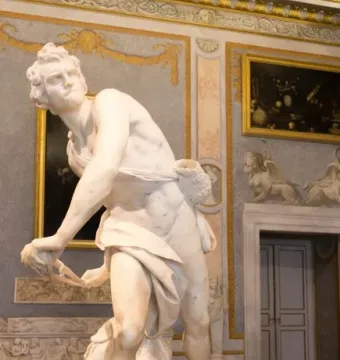
June 2014 © Antoine Taveneaux · CC BY-SA 3.0
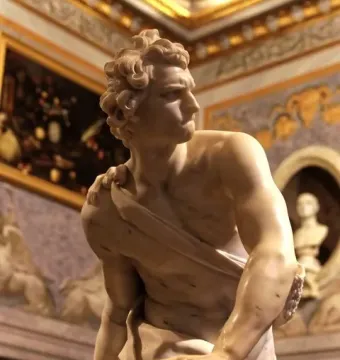
October 2017 © Burkhard Mücke · CC BY-SA 4.0
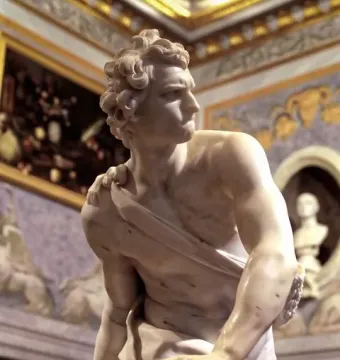
March 2024 © Burkhard Mücke · CC BY-SA 4.0
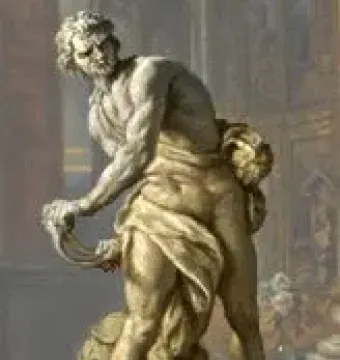
© Bernini and Pannini · Public domain
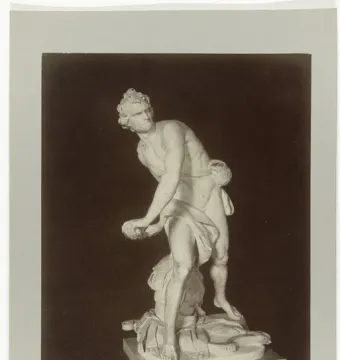
© Rijksmuseum · CC0
Identification | |
| Title | David |
| Type | Marble sculpture |
Historical context | |
| Date of creation | 1623–1624 |
Creator | |
| Artist nationality | Italian |
| Style | Baroque |
| Age of artist at creation | 24 years old |
| Artist | Gian Lorenzo Bernini |
Discovery and provenance | |
| Current location | Galleria Borghese, Rome |
| Early notice | Noted and analyzed by Filippo Baldinucci after completion |
| Source for completion time | Filippo Baldinucci |
| Time to complete | Seven months |
| Later installed at | Ground floor of Cardinal Scipione Borghese's villa near Porta Pinciana |
| Original intended location | Villa Montalto garden |
| Commission context | One of four sculptural groups Bernini made for Cardinal Scipione Borghese's villa |
| Later patron / commissioner | Cardinal Scipione Caffarelli-Borghese |
| Commissioned by | Cardinal Alessandro Peretti de Montalto |
| Collection history | After Cardinal Peretti's death in 1623, the unfinished sculpture passed to Cardinal Scipione Borghese, who had it completed and installed in his villa |
Physical characteristics | |
| Size | Life-size |
| Height | 170 cm |
Materials | |
| Material | Marble |
Technique | |
| Technique | Executed with great technical virtuosity |
Appearance | |
| Characterization | A very human young man rather than an idealized perfect warrior |
| Drapery | Emphasizes the statue's dynamics |
| Clothing | Shepherd's clothing |
| Side view | Reveals instability from the tension of loading the sling |
| Front view | Appears almost frozen, suspended at the moment of aiming |
| Multiple viewpoints | Designed to be seen from multiple viewpoints, each revealing the movement differently |
| Expression | Concentrated and frowning, with the lower lip bitten or tense with effort |
| Anatomy | Shows deep knowledge of anatomy in action |
| Body tension | The figure is tense, with movement and power implied |
| Movement | Strong serpentine, helical movement |
| Pose | Standing with both feet on the ground and the body half-turned |
| Action depicted | David is preparing to tense the sling and hurl the stone at Goliath |
| Depicted moment | The instant before David throws the stone at Goliath |
| Depicted subject | The biblical David, future king of Judah and Israel |
Iconography and meaning | |
| Baroque significance | Capturing the instant and helical movement are characteristic of the Baroque |
| Political / cultural interpretation | Associated with combat and the fire of the Counter-Reformation |
| Religious context | Christian subject that also revives the classical theme of young Greek athletes, the kouroi |
| Objects behind figure | Discarded weapons behind David suggest the battle is won through physical effort rather than superior armament |
| Meaning of the discarded armor | David was not accustomed to armor and intended to fight without it |
| Meaning of the harp | Attribute of David the Psalmist and sign that he will become a poet |
| Objects at feet | Saul's armor and a harp |
| Weapon | Sling |
| Iconographic source | The First Book of Samuel |
| Theme | Biblical David and his victory over Goliath |
Comparison | |
| Comparison with Michelangelo's David | Bernini emphasizes emotion and dynamism rather than classical and Renaissance placidity; Michelangelo shows David before the fight in a calm, focused state of inner tension |
| Comparison with Donatello's David | Donatello's David is a victorious nude youth standing confidently |
| Comparison with Verrocchio's David | Verrocchio's David is a frail but arrogant boy, dressed in slightly classicizing clothing |
| Comparison with Bernini's earlier works | Unlike Bernini's earlier works, the sculpture does not have the same vertical emphasis |
| Comparison with Apollo and Daphne | Unlike Apollo and Daphne, it represents a man rather than a much younger, more delicate model |
Significance | |
| Artistic innovation | Innovative for its implied movement and psychological intensity |
| Style classification | Catholic Baroque |
Other | |
| Anecdotal self-portrait claim | According to period anecdotes and Bernini's son Domenico, the face of David was based on Bernini's own features, apparently studied in a mirror held by Maffeo Barberini |