
Inkpot Madonna
The Inkpot Madonna is a late Gothic wooden sculpture of the Virgin Mary, created around 1430 by a sculptor from Lower Saxony, probably in Lower Saxony. Painted in color and life-sized, it shows the delicate features and flowing drapery of the Soft or Beautiful style. Mary wears a blue, gold-trimmed mantle over a white undergarment and a high golden crown with five fleur-de-lis. The naked Christ Child sits on her left arm, holding a writing feather over a scroll, while Mary offers him an inkwell. Originally in the chapter house of Hildesheim Cathedral, it is now the most important image of the Virgin in the Mariendom.
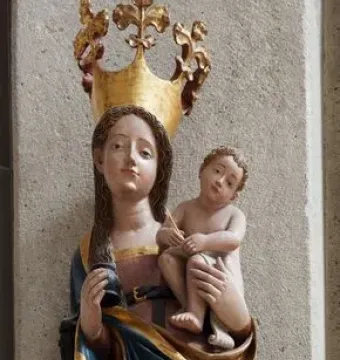
July 2020 © Arnoldius · CC BY-SA 4.0
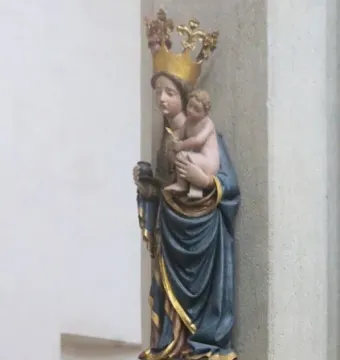
June 2019 © Dguendel · CC BY 4.0
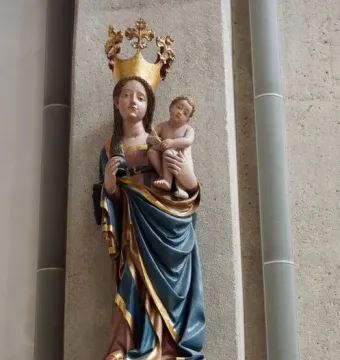
July 2020 © Arnoldius · CC BY-SA 4.0
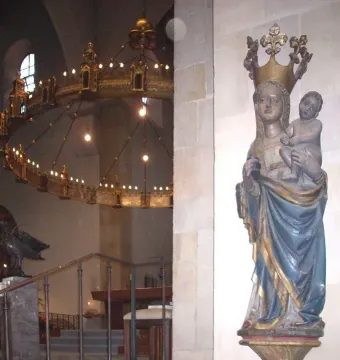
June 2007 © Rabanus Flavus · Public domain
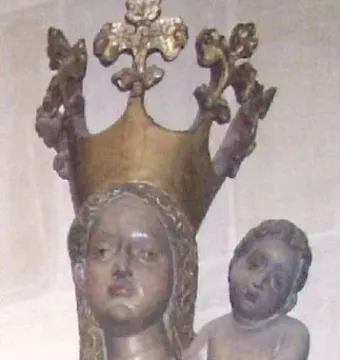
June 2007 © Rabanus Flavus · CC BY-SA 4.0
Identification | |
| Title | Inkpot Madonna |
| Type | Late Gothic wooden statue |
| Subject | Madonna and Child |
| Alternative names | Tintenfassmadonna; Madona del tintero; Virgen del tintero; Madonna del Calamaio |
Historical context | |
| Date | circa 1430 |
| Style | International Gothic; Soft Style / Beautiful Style |
Creator | |
| Creator | An unidentified Lower Saxon sculptor |
Discovery and provenance | |
| Place of creation | Probably Lower Saxony |
| Original location | Chapter house of the cathedral chapter of Hildesheim Cathedral |
Location and ownership | |
| Temporary relocation | Niedersächsisches Landesmuseum Hannover in 2010 during cathedral renovation |
| Current location | Hildesheim Cathedral, Hildesheim, Germany |
| Former position in cathedral | Southwestern pillar of the crossing |
| Current position in cathedral | Northwest pier of the crossing; a prominent position in the church |
Physical characteristics | |
| Height | 180 cm |
| Size | Life-size |
| Mary's clothing | White underdress with a sumptuous blue robe edged in gold, draped from the right shoulder |
| Christ Child's appearance | Naked and held on Mary's left arm; leaning forward away from his mother and looking toward the viewer |
| Mary's crown | Tall gold crown with five three-lobed lilies, interpreted as a symbol of the Trinity |
Materials | |
| Material | Wood, polychromed |
History and restoration | |
| Scientific examination | Computed tomography revealed problems in the wood and paint layers |
| Restoration | Restored in 2012 by Roksana Jachim at the workshop of the Klosterkammer Hannover; returned to the cathedral on 15 August 2014 after restoration of both the sculpture and the cathedral |
| Surface treatment | Painted in color |
Iconography and meaning | |
| Christ Child's attributes | A quill in his right hand and a scroll lying on his knees, unrolled to his feet |
| Mary's attribute | An inkpot held in her right hand for the Child |
| Theme | Writing |
| Iconographic interpretation | The child writing in his mother's arms is a medieval motif of the learning of Jesus, not a biblical motif; it may allude to the Book of Life or the Book of Salvation, with Mary providing the ink as material for Christ's salvific work; another interpretation is that the inkpot signifies the Child's total wisdom from the beginning |
Appearance | |
| Stylistic features | Tender faces, relaxed posture, and flowing drapery |
Significance | |
| Significance | The most important and prominent image of the Mother of God in Hildesheim Cathedral |
Other | |
| Cathedral dedication | Dedicated to the Assumption of Mary |
| World Heritage status | Hildesheim Cathedral was declared a World Heritage Site in 1985 |
| Research reference | Roksana Jachim wrote an academic thesis on the sculpture |