
The Nubian Man
The Nubian Man is a sculpture by Charles Cordier, made in 1848 with several known versions. It represents the bust of a young man from sub-Saharan Africa, more specifically Nubia, and was modeled on Seïd Enkess, also known as Saïd Abdallah. Cordier met him in 1847 and produced a plaster bust in just fifteen days, which he later exhibited at the Salon under a fuller title. One version was shown in Paris and then London at the 1851 Great Exhibition, where it attracted attention and was bought by Queen Victoria. The work reflects Cordier’s interest in abolitionist ideas and in the diversity of the wider world, and versions later entered French collections, including the museum in Le Havre.
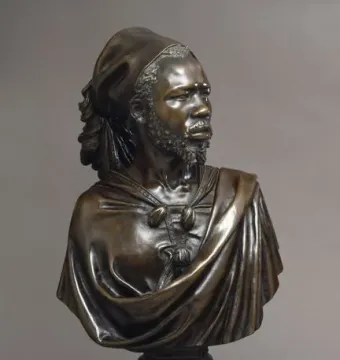
© Charles Henri Joseph Cordier · Public domain
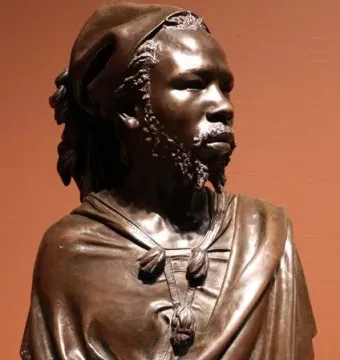
October 2016 © Sailko · CC BY 3.0
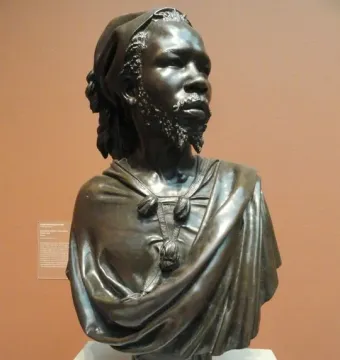
October 2012 © Daderot · CC0
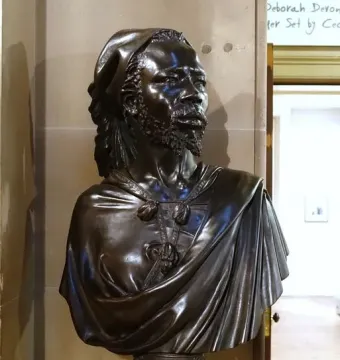
June 2016 © Daderot · Public domain
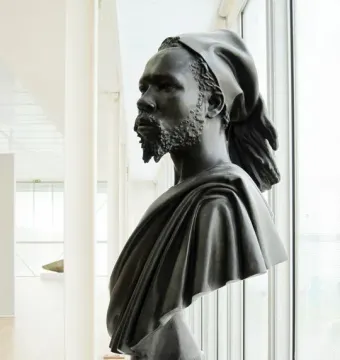
September 2012 © Charles Henri Joseph Cordier · Public domain
Identification | |
| Title | The Nubian |
| Original title | Le Nubien |
| Translated title | Il nubiano |
| Type | Bust |
Creator | |
| Artist | Charles Cordier (1827–1905) |
| Model | Seïd Enkess, also called Saïd Abdallah |
| Model status | Freed Sudanese former slave and professional model in several Paris studios |
| Modeling time | 15 days |
| Related work | La Nubienne, the pendant of this bust |
Historical context | |
| Date of creation | 1847–1848 |
| Context | Created in the context of the 1848 abolition of slavery in the French colonies, abolitionist ideas, and growing European interest in African diversity and colonial exploration |
Physical characteristics | |
| Material | Plaster |
Appearance | |
| Clothing | Draped traditional garment |
| Head covering | Veil covering his hair |
| Facial hair | Short curly beard |
| Pose | His head is slightly turned to his left |
| Depicted subject | A young man from Nubia in sub-Saharan Africa |
History and restoration | |
| Artistic title | Saïd Abdallah, of the Mayac tribe, kingdom of Darfur |
| Versions | Several versions of the bust were made |
| Exhibition | Shown at the Salon of the French Artists a few months after it was sculpted |
| Exhibition | A bronze version was exhibited in Paris in 1851 and later in London at the International Exhibition |
| Reception | The London exhibition impressed Auguste Duméril, who admired "the black man of M. Cordier" |
| Purchase | Queen Victoria purchased one version |
| Acquisition by the French state | The French state acquired one version of the bust and its pendant La Nubienne |
| Gallery context | Placed in the gallery of the principal human types created in 1852 at the request of André Marie Constant Duméril and Étienne Renaud Augustin Serres |
| Later museum collection | From 1858, examples of these two works entered the collections of the Musée d'art moderne André-Malraux in Le Havre after an exhibition organized by the Société des amis des arts |
Location and ownership | |
| Museum location | Anthropology room of the Jardin des Plantes, Paris |
Significance | |
| Artistic impact | The success of the bust enabled Cordier to create other works portraying African subjects |