
Statue of José I of Portugal
The statue of José I of Portugal is a bronze equestrian monument located on Lisbon’s Praça do Comércio. Designed by sculptor Joaquim Machado de Castro, it commemorates King Joseph I, known as “the Reformer.” It was the first equestrian statue created in Portugal and the first sculptural monument in public space dedicated to a living person. The work also marked a technical milestone, as it was the first statue of this size to be cast in a single pour in Portugal and in the world. Its creation was tied to the post-1755 earthquake reconstruction of Lisbon, and it was eventually installed in the square after being transported from the foundry for its inauguration.
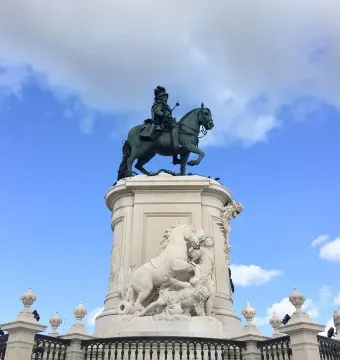
March 2018 © Sambasoccer27 · CC BY-SA 4.0
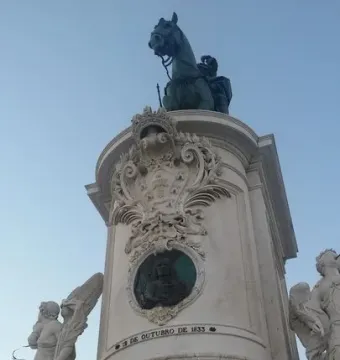
October 2018 © 22860 · CC BY-SA 2.0
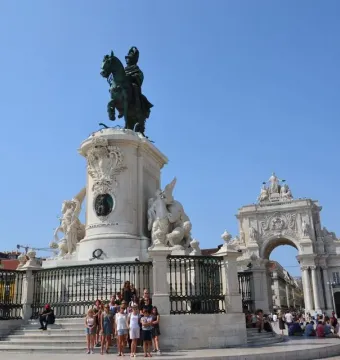
September 2017 © ZSPNrdwa Krosno · CC BY 2.0
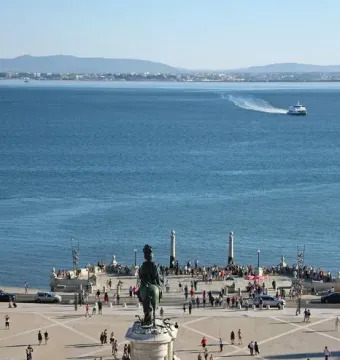
November 2017 © Vitor Oliveira · CC BY-SA 2.0
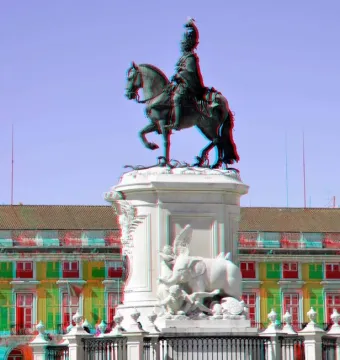
March 2018 © wim hoppenbrouwers · Public domain
Identification | |
| Title | Statue of José I of Portugal |
| Type | Equestrian statue |
| Subject | King Joseph I of Portugal |
Creator | |
| Designer of pedestal | Reinaldo Manuel dos Santos |
| Sculptor | Joaquim Machado de Castro |
Historical context | |
| Significance | First equestrian statue created in Portugal |
| Significance | Described as the first statue of its size cast in a single pour in Portugal and in the world |
| Purpose | Commemorates King Joseph I of Portugal |
| Original plan by | Eugénio dos Santos |
| Historical context | Created as part of the reconstruction of Lisbon after the 1755 earthquake |
| Significance | First sculptural monument in public space in Portugal dedicated to a living person |
Discovery and provenance | |
| Commissioned to | Joaquim Machado de Castro |
| Basis for design | Initial studies by Eugénio dos Santos |
| Sources used by sculptor | Other representations of the king, especially profile images on royal coins |
Physical characteristics | |
| Scale | Monumental |
| Height | 14 meters including the pedestal |
Materials | |
| Statue material | Bronze |
| Pedestal material | Limestone |
Technique | |
| Technical innovation | Military foundry methods were adapted to sculpture |
| Finishing work | Bronze finishing and retouching took 63 days |
| Casting supervision | Directed by Brigadier Bartolomeu da Costa under Machado de Castro |
| Casting method | Cast in a single pour of copper |
| Casting date | 15 October 1774 |
Location and ownership | |
| Current location | Praça do Comércio, Lisbon, Portugal |
| Planned location | Center of Praça do Comércio, on the ruins of the courtyard of the Paço da Ribeira |
| Orientation | Faces the Tagus River |
| Nearby landmark | The Arco da Rua Augusta stands behind the statue |
Appearance | |
| Pedestal decoration | Portuguese royal arms on the front; a bronze medallion with a bust of the Marquis of Pombal |
| Compositional setting | The statue is framed by the Arco da Rua Augusta, intensifying the representation of royal power |
| Side figures | An elephant and the goddess Fama with a trumpet on the left; a horse with an allegorical figure of Triumph on the right |
| Headgear | An ornate plumed helmet |
| Iconographic detail | The horse tramples serpents as it advances |
| Horse pose | The horse raises its front right leg |
| Pose | The king looks to his right, aligned with the direction of the horse |
History and restoration | |
| Work interrupted | Stopped in 1760 after the death of Eugénio dos Santos |
| Foundation for pedestal | Built immediately after the project began |
| Inspection by royals | On 15 May 1775, King Joseph I and Queen Mariana Victoria visited the Casa da Fundição to see the statue |
| Queen's comment | "The face of the figure is horrible" |
| Explanation for the face's appearance | Machado de Castro said it was due to inadequate lighting and the statue not yet having lost its shine |
| Public viewing | The day after the royal visit, the Casa da Fundição opened to people of distinction and civility; large crowds came to see the work over the next four days |
| Transport to installation site | Moved from the foundry to the unfinished Praça do Comércio on 25 May 1775 |
| Inauguration | 6 June 1775, during the celebrations of the king's 61st birthday |
Significance | |
| Artistic significance | Described as a notable sculptural work |
| Public-monument significance | First sculptural monument in public space dedicated to a living person |