
Goethe–Schiller Monument
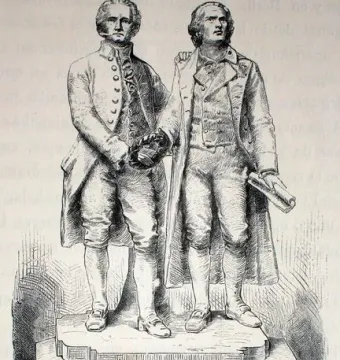
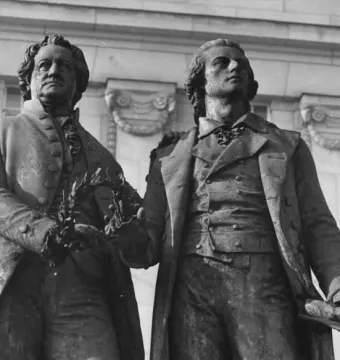
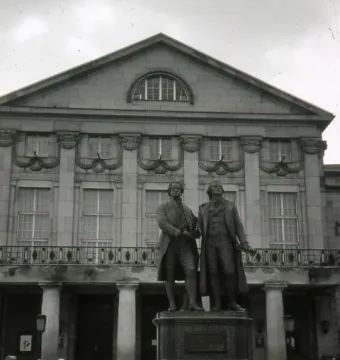
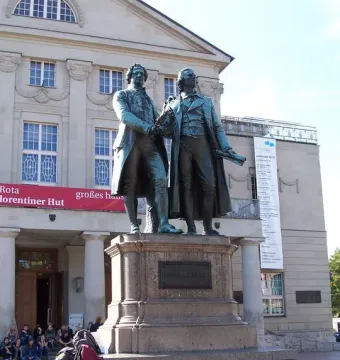
The Goethe–Schiller Monument in Weimar, Germany, contains the bronze double statue by Ernst Rietschel, made in 1857, of Johann Wolfgang Goethe and Friedrich Schiller. The two figures are shown larger than life and given the same height, despite Goethe being nearly 20 cm shorter than Schiller. They stand on a large stone pedestal in front of the Court Theatre, where Goethe had directed and where Schiller’s works were performed. Widely admired, the monument has been described as one of the most famous and beloved in Germany and as the beginning of a true "monument cult." Later copies were commissioned in the United States, and a smaller version was installed in Anting, China, in 2006.
February 2010 © Fondo Antiguo de la Biblioteca de la Universidad de Sevilla · CC BY 2.0
© Link, Hubert · CC BY-SA 3.0 de
May 1990 © Sludge G · CC BY-SA 2.0
© Plastique · CC BY-SA 3.0
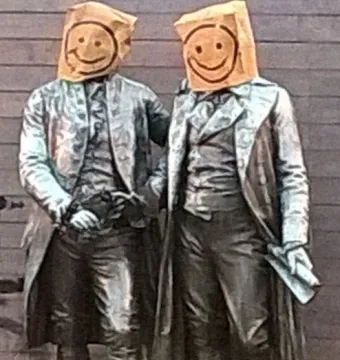
September 2014 © Ludwig, Silvio · CC BY-SA 3.0 de
Identification | |
| Title | Goethe–Schiller Monument |
| Other title | Пам'ятник Гете і Шиллеру |
| Other title | Памятник Иоганну Вольфгангу фон Гёте и Фридриху Шиллеру в Веймаре |
| Type | double bronze statue monument |
| Alternative term | Doppelstandbild |
| German name | Goethe-Schiller-Denkmal |
Creator | |
| Sculptor | Ernst Rietschel |
| Assistant sculptor | Gustav Adolf Kietz |
| Caster | Ferdinand von Miller |
| Foundry | Royal Foundry in Munich |
Historical context | |
| Commission date | December 1852 |
| Inauguration date | 4 September 1857 |
| Unveiling date | 1 September 1857 |
| Subject background | Goethe and Schiller were major figures of Weimar Classicism and lived in Weimar |
| Design history | Christian Daniel Rauch first proposed a design showing the two men in antique dress, but it was rejected; Ernst Rietschel then created the final design with contemporary clothing |
| Theatre connection | The monument was placed by the Court Theatre, which Goethe directed from 1791 to 1815 and where many of Schiller's plays were premiered and performed |
| Commissioning context | Commissioned for the centenary celebrations of the birth of Grand Duke Karl August of Saxe-Weimar-Eisenach, who brought Goethe to Weimar in 1775 |
Discovery and provenance | |
| U.S. copies locations and dates | San Francisco (1901), Cleveland (1907), Milwaukee (1908), Syracuse (1911) |
| Anting context | Anting New Town is a German-themed town near Shanghai developed around 2000 |
| Reduced-size copy | Installed in Anting, China, in 2006 |
| Original location | Theaterplatz, Weimar, Germany, in front of the Court Theatre / German National Theatre |
| Copies commissioned by | German-Americans in the United States |
| Original setting | A city square facing the Court Theatre, later described as standing in front of the Court Theatre building |
| Sponsor of base | Grand Duke Friedrich I of Baden |
| Commissioned by | Grand Duke Carl Alexander of Saxe-Weimar-Eisenach and a city commission |
Physical characteristics | |
| Size | larger than life size |
| Figure height | Both figures are given the same height |
| Actual height difference | Goethe was about 20 cm shorter than Schiller |
| Base | large stone pedestal |
| Base material | polished Baden granite |
Materials | |
| Statue material | bronze |
| Reduced-size copy material | electrotyped copper |
| Pedestal and steps material | granite |
Technique | |
| Model source for U.S. copy molds | Rietschel's original forms at the Albertinum in Dresden |
| Model completion time | four years to complete the life-size model |
| Casting speed | cast very quickly |
| Casting method | bronze casting |
Appearance | |
| Composition | Two full-length figures standing side by side |
| Pose | Goethe stands on the left, leaning against an oak stump, with his left hand on Schiller's shoulder and his right hand offering a laurel wreath; Schiller stands beside him with his right hand reaching toward the wreath and his left hand holding a scroll |
| Costume | Goethe wears formal court dress; Schiller wears ordinary contemporary dress, described in one version as a long frock coat with Schiller collar and open waistcoat |
| Composition detail | The figures are shown as a poet pair with Goethe as the older companion and Schiller as youthful and slender |
| Site features | The Weimar monument stands on a steep slope and is reached by a formal stone stairway |
Iconography and meaning | |
| Subjects' dates | Goethe (1749–1832) and Schiller (1759–1805) |
| Meaning | The monument honors the two poets as national literary figures and was dedicated to the German nation |
| Inscription on back | Ernst Rietschel inv. et fec. Dresden 1856, Ferd. v. Miller fudit München 1857 |
| Inscription on pedestal front | DEM DICHTERPAAR GOETHE UND SCHILLER DAS VATERLAND. |
| Symbolism | The poets are shown at equal height to emphasize their literary equality |
| Iconography | Goethe offers Schiller a laurel wreath |
| Depicted figures | Johann Wolfgang von Goethe and Friedrich Schiller |
Location and ownership | |
| Current location | Weimar, Germany |
| Original location note | Originally installed in front of the German National Theatre / Court Theatre |
History and restoration | |
| Casts for U.S. copies | The San Francisco, Cleveland, and Milwaukee monuments were cast by the Lauchhammer foundry; the Syracuse monument was made of electrotyped copper rather than a bronze casting |
| Schiller Park renaming | Schiller Park in Syracuse was renamed in 1905 to honor the centenary of Schiller's death |
| Dedication attendance response | The Cleveland committee reported 65,000 attendees and thanked the emperor on behalf of German-American citizens of Cleveland |
| Cleveland dedication message | Wilhelm II sent a congratulatory telegram |
| Milwaukee setting | Milwaukee's monument has enlarged stonework with three steps, long side walls, and benches, reducing rear access |
| U.S. monument setting | The U.S. copies are located in city parks |
| San Francisco dedication date | 11 August 1901 |
| Syracuse dedication date | 15 October 1911 |
| Milwaukee dedication attendance | 35,000 people |
| Milwaukee dedication date | 12 June 1908 |
| Cleveland dedication date | 9 June 1907 |
| San Francisco dedication attendance | 30,000 people |
| U.S. dedication attendance | 65,000 people attended the Cleveland dedication |
Significance | |
| Reception | One of the most famous and most beloved monuments in Germany |
| Critical assessment | Widely proclaimed a masterpiece |
| Historical significance | Described as the first double statue on German soil |
| Influence | It helped begin a 'cult of the monument' and inspired dozens of later Goethe and Schiller monuments in Europe and the United States |
| Subjects' importance | Goethe and Schiller are probably the two most revered figures in German literature |