
Perseus and the Gorgon
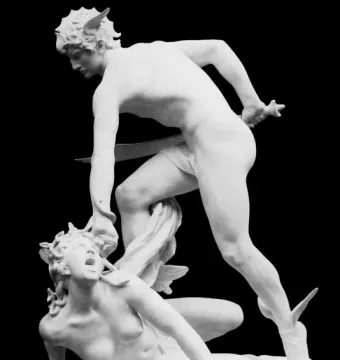
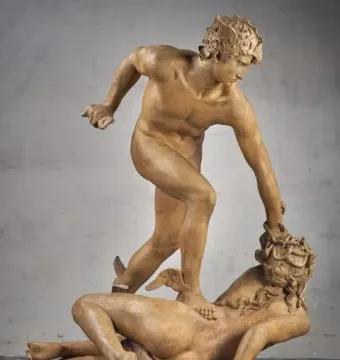
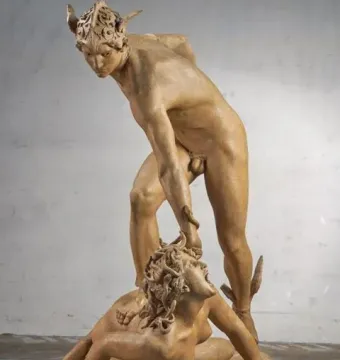
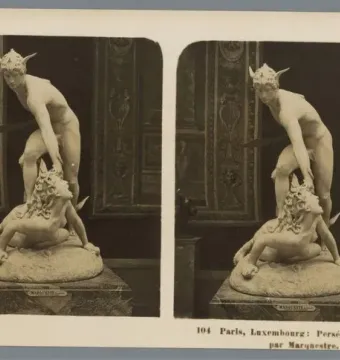
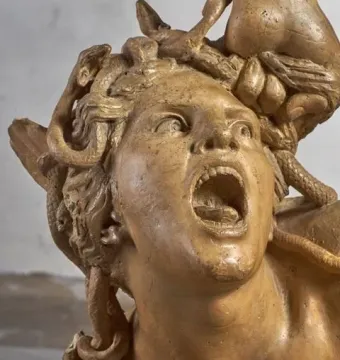
Perseus and the Gorgon is a sculptural group by French artist Laurent Marqueste, created in several versions between 1875 and 1903. Drawing on neo-Baroque spirit, Mannerist composition, and the antique nude, it shows Perseus preparing to cut off Medusa’s head. Marqueste shaped the work around a serpentine figure typical of Mannerism, taking Benvenuto Cellini’s Perseus with the Head of Medusa as a model and also drawing on François Rude’s The Marseillaise for Medusa’s head. First made in plaster in 1875, it was shown at the 1876 Salon, where Marqueste won a first-class medal. Later versions include a second plaster from 1887 and marble versions from 1890 and 1903.
January 2014 © ketrin1407 · CC BY 2.0
June 2016 © Daniel Martin · Licence Ouverte
June 2016 © Daniel Martin · Licence Ouverte
© Rijksmuseum · CC0
June 2016 © Daniel Martin · Licence Ouverte
Identification | |
| Title | Perseus and the Gorgon |
| Original French title | Persée et la Gorgone |
| Alternative title in Italian | Perseo e la Gorgone |
| Type | Sculptural group |
Creator | |
| Sculptor | Laurent Marqueste |
| Nationality | French |
Historical context | |
| Date range of creation | 1875–1903 |
| Style | Neo-Baroque |
| Artistic influences | Mannerism and ancient nude sculpture; Baroque sculpture |
Iconography and meaning | |
| Medusa interpretation | A beautiful young woman transformed into a horrible Gorgon by Athena after being raped by Poseidon |
| Function of Athena's shield | It was used like a mirror to avoid the gaze of the Gorgons |
| Divine equipment given to Perseus | Hades's helmet of invisibility, Hermes's winged sandals, and Hermes's harpe; Athena's shield is absent |
| Mythological context | Perseus is sent by Polydectes to fetch Medusa's head, whose gaze can petrify even after decapitation |
| Scene depicted | Perseus stands over Medusa, grabs her hair, presses her to the ground with his foot, and raises his sword for the killing stroke while Medusa screams in terror |
| Perseus depiction | Fully nude except for winged sandals and a winged helmet; muscular, tense, and shown in motion |
| Model used by the artist | Benvenuto Cellini's Perseus with the Head of Medusa |
| Composition | Built around a serpentine figure, typical of Mannerism |
| Mythological figures depicted | Perseus, Medusa, Hermes, Hades |
| Subject | Perseus preparing to behead Medusa |
| Additional inspiration | François Rude's The Marseillaise for Medusa's head |
Physical characteristics | |
| Lyon marble version size and condition | 1.86 × 1.31 × 1.255 m; the harpe and the sword are missing; base inscribed 'L. MARQUESTE. 1890' |
| Number of extant versions | Three extant examples and additional bronze reductions |
| Variants and copies | Versions differ mainly in Perseus's drapery; some bronze reductions were cast at 46 cm height in Ferdinand Barbedienne's workshop |
Materials | |
| Materials used | Plaster, bronze, and marble |
History and restoration | |
| First version condition after casting | The plaster model was badly damaged by the bronze casting process |
| Bronze version | Bronze cast commissioned in 1877 by the Fine Arts Administration from Thiébaut & Fils; deposited in the former Museum of Fine Arts of Niort; melted down by German troops in 1942 |
| Second plaster version | Made in 1887; deposited at the Musée des Augustins, Toulouse from 1905; size 1.91 × 1.70 × 1.30 m |
| First version | Plaster model made in 1875 and first shown at the 1876 Salon of Painting and Sculpture, where it received a first-class medal; the French state purchased it after the Salon |
| Lyon marble version restoration | Restored in 2000 by Emmanuel Desroches, who cleaned the sculpture and reattached two wing fragments |
Location and ownership | |
| Lyon marble version | Marble version made in 1890; exhibited at the 1890 Salon of the Société des artistes français; purchased by the French state for 18,000 francs; displayed at the Musée du Luxembourg until 4 March 1931, then stored in the Louvre marble depot; deposited in Villeurbanne in 1933; installed in the 1970s at the entrance of the Étienne Gagnaire aquatic center; assigned to the Musée d'Orsay in 1986; transferred to the Museum of Fine Arts of Lyon in 1999; now in the museum's cloister and thematic route of heroic figures |
| Copenhagen marble version | Marble version made in 1903; now at the Ny Carlsberg Glyptotek, Copenhagen; height 1.87 m |