
Lion Monument
Lion Monument is a park memorial in Lucerne, Switzerland, depicting a dying lion. It commemorates the Swiss Guards who were killed defending King Louis XVI during the French attack on the Tuileries Palace in Paris on 10 August 1792, as well as their commander, Major Karl Josef von Bachmann. The design was created by Bertel Thorvaldsen and carved by Lukas Ahorn in 1820–1821. The work is set into a large sandstone rock face with a grotto and pool, in a small wooded park away from the street. Above the lion are the words Helvetiorum Fidei ac Virtuti, meaning the loyalty and courage of the Helvetians.
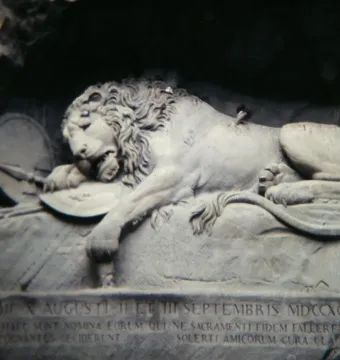
August 1993 © Gary Todd · CC0
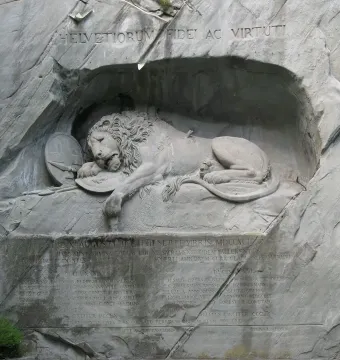
July 2007 © Andrew Bossi · CC BY-SA 2.5
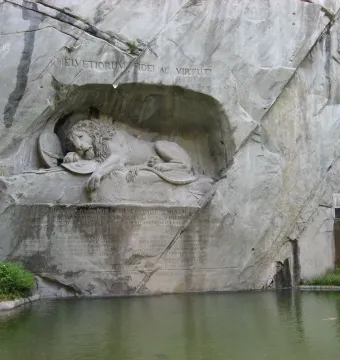
July 2007 © Alankang · CC BY-SA 4.0
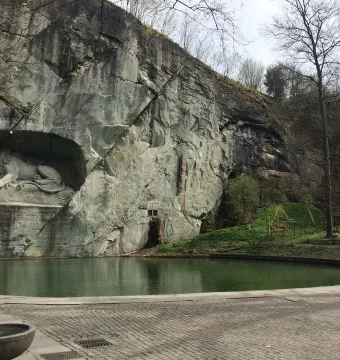
April 2015 © tfbpereira · CC BY 2.0
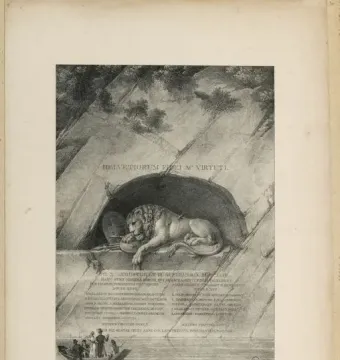
© Mongin, Antoine-Pierre (Paris, en 1761 - Versailles, 18–05–1827), dessinateur · CC0
Identification | |
| Title | Lion Monument |
| Alternative names | Lion of Lucerne; Swiss Guards Monument; Löwendenkmal; Löwendenkmal Luzern; Dying Lion |
| Type | Commemorative monument / rock relief |
Location and ownership | |
| Location | Lucerne, Switzerland |
| Setting | A small park near Löwenplatz, in a small forest park separated from the street |
| Nearby landmarks | Glacier Garden; Alpineum; Bourbaki Panorama |
Historical context | |
| Commemorated event | The storming of the Tuileries Palace in Paris on 10 August 1792 and the killing of the Swiss Guards in the French Revolution |
| Historical background | The Swiss Guards were serving King Louis XVI as part of the French royal household |
| Historical dates shown | 10 August 1792; 3 September 1792 |
Creator | |
| Sculptor | Lukas Ahorn |
| Designer | Bertel Thorvaldsen |
Discovery and provenance | |
| Initiator | Karl Pfyffer von Altishofen |
| Initiator's role | Swiss Guard officer on leave during the massacre |
| Commissioned by | Vincenz Rüttiman, Swiss ambassador in Rome |
| Commission year | 1818 |
| Fundraising date | 1818 |
| Support for project | Supported in Switzerland by subscriptions from private citizens and European monarchs |
| Original planned location | The garden of Major Pfyffer von Altishofen's house near Lucerne |
| Preparatory model | A plaster model was sent to Switzerland in early 1819 |
Physical characteristics | |
| Installation setting | A 10-metre-high niche carved into the rock face |
| Dimensions | About 10 × 6 metres; cave about 6 × 10 metres |
| Form | A large sandstone rock face carved as a cave with a basin below |
Materials | |
| Material | Sandstone |
| Initial material plan | Bronze |
| Executed model material | Marble |
Technique | |
| Technique | Carved into a rock wall |
| Construction dates | March 1820 to August 1821 |
History and restoration | |
| Unveiling date | 1821, on the anniversary of the event commemorated |
Appearance | |
| Historical information on monument | The monument includes a brief account of the commemorated events in bullet points below the cave |
| Inscription placement | Above the cave |
| Inscription | Helvetiorum Fidei ac Virtuti |
| Inscription meaning | To the loyalty and courage of the Swiss / Helvetians |
| Additional iconography | The lion's head rests on a shield with the French fleur-de-lis; above it is a shield with the Swiss cross; weapons are placed beside it; a broken arrow appears in the initial design |
| Depicted figure | A wounded, dying lion pierced by a spear |
Significance | |
| Visitor count | About 1.4 million visitors annually |
| Recognition | One of the best-known monuments in Switzerland |
| Heritage protection | Placed under Swiss monument protection in 2006 and listed as nationally significant in the List of Cultural Properties in Lucerne |
| Literary reception | Mark Twain called it 'the most mournful and moving piece of stone in the world' and 'the saddest, most moving and most powerful piece of stone in the world' |
Other | |
| Related monument | The Confederate Lion / Lion of Atlanta at Oakland Cemetery in Atlanta, Georgia, copied the Swiss lion; artist Thomas Brady; dated 1894; commemorates tragic events of the American Civil War |
| Commemorative medal | In 1817, the Swiss Federal Diet awarded the medal Treue und Ehre ('Loyalty and Honor') to 389 survivors of the regiment |