
Chollima Statue
The Chollima Statue is a monument in Pyongyang, North Korea, located between Moran Hill and Mansu Hill on Chilsongmun Street. It was inaugurated on 15 April 1961 to mark Kim Il-sung’s 49th birthday. The monument stands on a 5,000-square-meter site and consists of a 34-meter-high slanted granite pedestal topped by a 16-meter-high bronze statue. It depicts Chollima, the winged horse from Korean mythology, which became a symbol of reconstruction and industrialization in North Korea after the Korean War. On the horse are an worker holding a letter from the Party Central Committee and a farmer with a sheaf of rice, riding toward the sky.
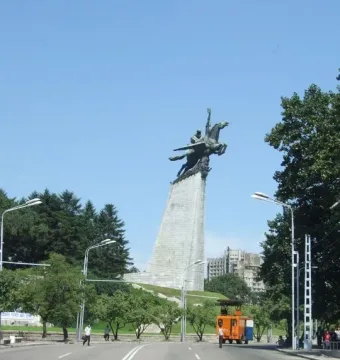
August 2012 © Nicor · CC BY-SA 3.0
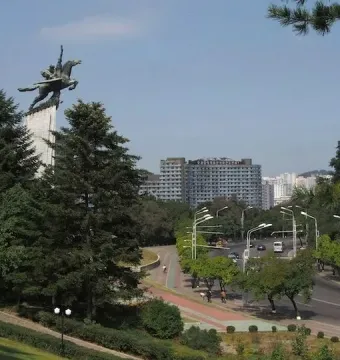
October 2013 © Clay Gilliland · CC BY-SA 2.0
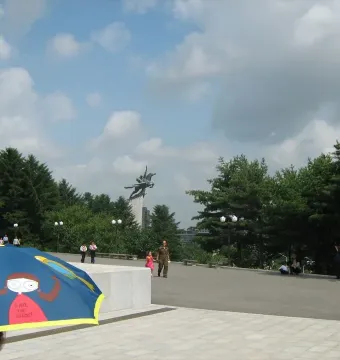
July 2012 © Jack Upland · CC BY-SA 3.0
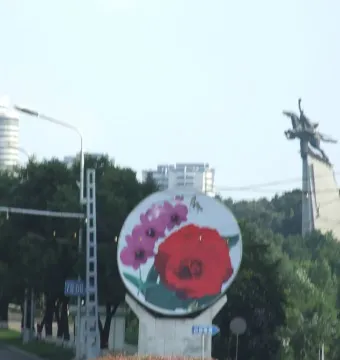
August 2012 © Nicor · CC BY-SA 3.0
December 2012 © Fioshin · Public domain
Identification | |
| Title | Chollima Statue |
| Original name | Ch’ŏllima Dongsang (천리마동상); also given as Monument Chollima (Chollima Tonsan) |
| Type | monument / statue |
Historical context | |
| Date unveiled | 15 April 1961 |
| Unveiling occasion | Kim Il Sung's 49th birthday |
| Historical context | Built in the post-Korean War reconstruction period and during the consolidation era of Kim Il-sung's regime |
Creator | |
| Creators | Artists from the Mansudae Art Studio and the Federation of Korean Artists; constructed by the Merited Sculpture Production Company of the Mansudae Art Studio |
Discovery and provenance | |
| Dedication | Conceived as a gift to Kim Il-sung |
| Inspiration | Kim Il-sung's speech of 7 March 1961, variously translated as 'Let Us Further Develop Folk Art,' 'Let Us Further Develop Popular Art,' or 'Let Us Develop Popular Art' |
Physical characteristics | |
| Site area | 5,000 square meters |
| Total height | 46 meters |
| Sculpture height | 14 meters |
| Sculpture length | 16 meters |
| Worker figure height | 7 meters |
| Peasant woman figure height | 6.5 meters |
| Pedestal height | 34-meter-high inclined granite pedestal |
Materials | |
| Main material | Bronze |
| Pedestal material | Granite |
Appearance | |
| Depicted subject | The mythical winged horse Chollima carrying a worker and a peasant woman |
| Worker figure | A worker holding up a document of the Central Committee of the Workers' Party of Korea in his raised hand |
| Peasant woman figure | A peasant woman seated behind the worker, holding a sheaf of ripe rice |
| Pose | The horse is shown rising or soaring upward toward the sky, with wings extended forward |
Iconography and meaning | |
| Name origin | Refers to the mythical winged horse Chollima |
| Legend | According to tradition, Chollima could travel 1,000 ri per day (about 4,000 km) and was difficult to ride |
| Symbolism | Symbol of the Chollima movement, speed, reconstruction, industrialization, collective labor, and the regime's ideals of forward momentum |
| Intended message | To inspire the North Korean people to rebuild the country after the Korean War at the speed of the legendary horse |
Location and ownership | |
| Location | Pyongyang, North Korea |
| Specific location | Victory Square / Mansu Hill, between Moran Hill and Mansu Hill, on Chilsongmun Street |
History and restoration | |
| Awards | People's Prize (DPRK) |
| Preservation | Restored and maintained over the years |
Significance | |
| Significance | One of Pyongyang's main landmarks and a central symbol of North Korean ideology and identity |
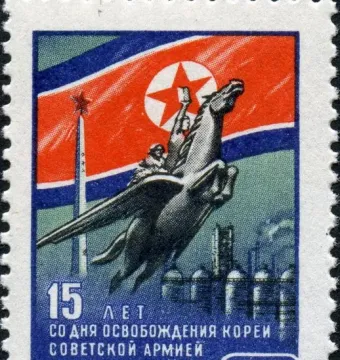
| Depictions and uses | Featured on North Korean, East German, Soviet, and other postage stamps; on 10-won banknotes (1978) and 200-won banknotes (2009); used in the logo of the North Korean pavilion at the 2015 Milan World Expo |
| Cultural role | Used as a gathering and honor site during national celebrations such as the Day of the Foundation of the Party |