
Equestrian Statue of Francisco Franco
The equestrian statue of Francisco Franco was a public artwork in Madrid by José Capuz. Cast in bronze in 1956, it appears to have been inspired by Donatello’s equestrian statue of Gattamelata. Intended for the top of the Victory Arch, it was instead placed in San Juan de la Cruz Square, near Nuevos Ministerios, and unveiled on 18 July 1959. Including the pedestal, the monument reached a total height of 7.5 meters. After years as a site of both Francoist pilgrimages and anti-Franco vandalism, the statue was removed in March 2005 and stored in a Ministry of Public Works warehouse.
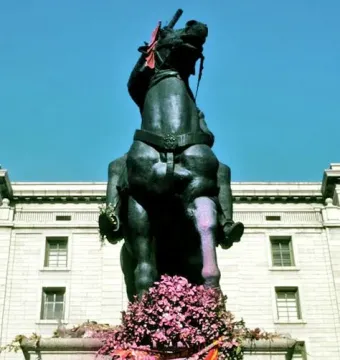
December 1988 © LBM1948 · CC BY-SA 4.0
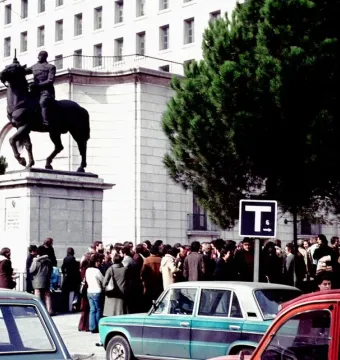
© LBM1948 · CC BY-SA 4.0
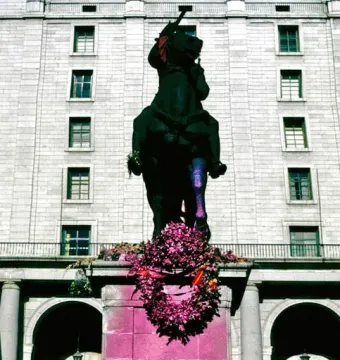
December 1988 © LBM1948 · CC BY-SA 4.0
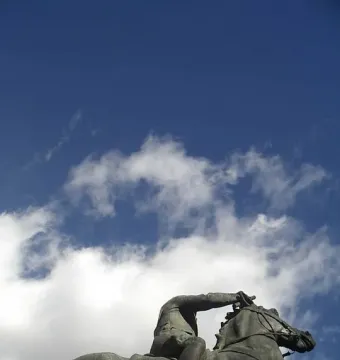
October 2016 © Luis Pita Moreno · CC BY-SA 4.0
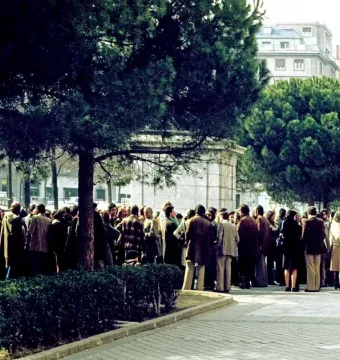
February 1976 © LBM1948 · CC BY-SA 4.0
Identification | |
| Title | Equestrian statue of Francisco Franco |
| Type | Equestrian statue; public art; monument |
Iconography and meaning | |
| Inspiration | Apparently inspired by Donatello's equestrian statue of Gattamelata |
| Depicted person | Francisco Franco |
| Depiction | Francisco Franco mounted on horseback |
| Subject role | Dictator |
Historical context | |
| Reason for not placing it there | Franco refused to allow it to be placed there |
| Original intended location | The Arco de la Victoria |
| Social/political use | Meeting place for Francoists every 20 November |
| Date cast | 1956 |
Creator | |
| Sculptor | José Capuz |
Materials | |
| Material | Bronze |
| Pedestal material | Stone |
Discovery and provenance | |
| Received by | Ministry of Housing |
| Unveiling date | 18 July 1959 |
| Replicas | Two replicas were made and sent to Santander and Valencia, respectively, to the Plazas del Generalísimo |
| Donated by | Complutense University of Madrid |
Location and ownership | |
| Ownership situation | Various public administrations denied ownership and avoided responsibility for its removal |
| Original location | Beside Nuevos Ministerios, Madrid, Spain |
| Former site | Nuevos Ministerios district |
| Transferred to | Plaza de San Juan de la Cruz, near the Nuevos Ministerios district, Madrid |
| Post-removal storage location | Ministry warehouses on Gregorio Benítez Street |
Physical characteristics | |
| Total height | 7.5 m including pedestal |
| Pedestal height | 3 m |
History and restoration | |
| Vandalism history | Frequently targeted with graffiti by left-wing sympathizers |
| Removal date | 17 March 2005, early morning |
| Removal method | Removed from its plinth in an operation that lasted several hours |
| Removed by | Workers from Tragsa, commissioned by the Undersecretariat of the Ministry of Public Works |
| Removal decision attributed to | Apparently Minister Magdalena Álvarez |
| Mayor's reaction | Madrid mayor Alberto Ruiz-Gallardón said he was unaware of the ministry's intentions regarding the statue's fate |
| Public reaction after removal | About 700 far-right militants, including Blas Piñar, gathered at the empty pedestal the next day, prayed, sang 'Cara al Sol', denounced the Government of Spain, the Popular Party, José Luis Rodríguez Zapatero, and Santiago Carrillo, and tried to vandalize nearby statues of Indalecio Prieto and Largo Caballero |
| Police response | Police dispersed the rally |
| Pedestal removal date | August 2006 |
| Pedestal removal | The remaining 3 m stone pedestal was removed, leaving no part of the monument in the square |
| Legal challenge | An individual and the Fundación Nacional Francisco Franco filed an administrative lawsuit seeking to reverse the removal |
| Court ruling | In 2009 the Madrid High Court of Justice ruled that the Ministry of Public Works had ignored heritage law, but refused restoration because it would violate the Historical Memory Law |
Significance | |
| Press reaction | ABC published an editorial warning that socialism would be dangerous if it tried to reclaim part of a concession made thirty years earlier; José Utrera Molina wrote against removing statues, saying 'Franco still rides serene and majestic in the air of history' |