
Liver of Piacenza
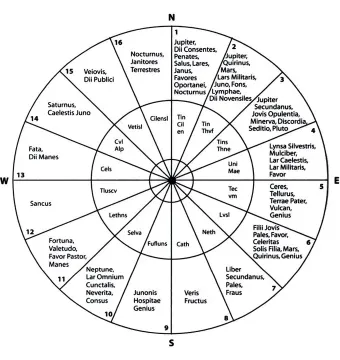
The Liver of Piacenza is an Etruscan bronze model of a liver used for haruspicy, dated to the 2nd century BC. It was found on 26 September 1877 near Gossolengo during plowing and is now displayed in the Piacenza Municipal Museum. The object is a life-size bronze model of a sheep's liver, measuring 126 x 76 x 60 mm, with a sky model engraved on it and forty inscriptions arranged in sixteen sectors. These sectors correspond to sixteen Etruscan deities, eleven of whom have parallels in the Roman pantheon. The remaining five divine names have no Roman equivalents.
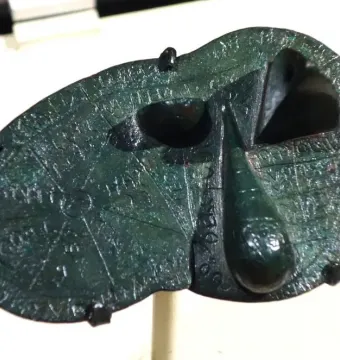
May 2026 © Daderot · Public domain
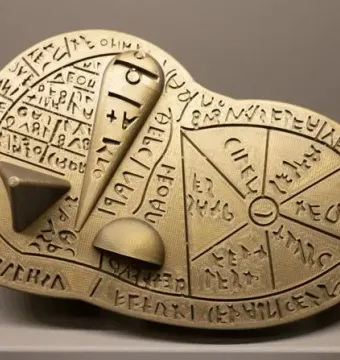
April 2026 © PMRMaeyaert · CC BY-SA 4.0
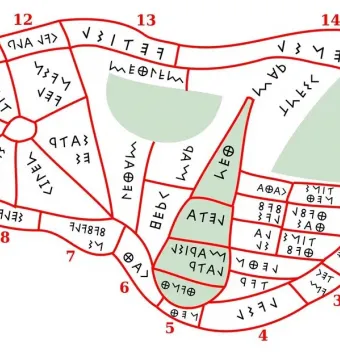
© Dbachmann · CC BY-SA 4.0
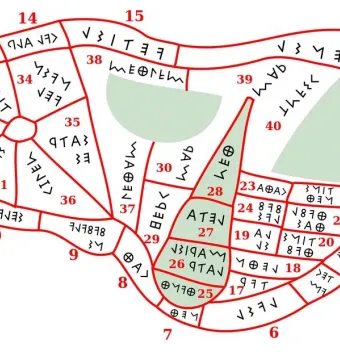
© Dbachmann · CC BY-SA 4.0
© Unknown authorUnknown author · Public domain
Identification | |
| Title | Liver of Piacenza |
| Catalog numbers | NRIE 31; TLE 719; REE 49,37; ET Pa 4.2 |
| Type | Etruscan bronze model of a sheep's liver used for haruspicy (hepatoscopy) |
| Original title | Печень из Пьяченцы; Печінка з П'яченци; Wątroba z Piacenzy |
Historical context | |
| Date | 2nd century BC; late 2nd or early 1st century BC; about 100 BC |
| Cultural context | Etruscan |
| Artifact type | Epigraphic artifact in the Etruscan language |
Creator | |
| Probable place of manufacture | Probably near Chiusi or Cortona |
Discovery and provenance | |
| Post-discovery investigation | The farmer carried out further digging at the findspot for a few days at Caracciolo's request, but without success |
| Publication | Di un bronzo Piacentino con leggende Etrusche (summer 1878), 26 pages, three illustrations, published in Deputazioni di Storia Patria dell’Emilia and also as a separate offprint |
| Early interpretation by Poggi | Poggi recognized the object as Etruscan, considered it an amulet, and agreed to publish on it |
| Scholar involved | Vittorio Poggi (1833–1914) |
| First scholarly presentation | In spring 1878, Gaetano Tononi showed a photograph to Giovanni Mariotti, director of the Royal Museum in Parma |
| Documentation made | The bronze liver was drawn, photographed, and cast in plaster |
| Next informed | Count Giuseppe Gazzola |
| Acquisition | Count Caracciolo acquired the object and paid the farmer about 60 lire |
| Shown to | Count Francesco Caracciolo |
| First intermediary | Priest Luigi Fulcini |
| Initial handling after discovery | The farmer placed the find under a tree, continued working, later cleaned it, and took it home |
| Discovery context | Found while a farmer was ploughing; the field had previously yielded ancient objects |
| Discovery location | A field near Gossolengo, in the province of Piacenza, Emilia-Romagna, Italy |
| Discovery date | 26 September 1877 |
Physical characteristics | |
| Form | Life-size model of a sheep's liver |
| Dimensions | 126 × 76 × 60 mm (5 × 3 × 2.4 inches) |
| Weight | 636 grams |
| Anatomical features represented | Gallbladder, caudate lobe, and posterior vena cava represented as sculpted protrusions |
Materials | |
| Material | Bronze |
Technique | |
| Inscription system | Forty engraved inscriptions arranged across 52 fields; readings are disputed in many cases |
| Surface | Covered with Etruscan inscriptions |
Appearance | |
| Outer division | 16 sections around the outer edge corresponding to 16 regions of the sky |
| Inner division | 24 fields |
| Underside division | 2 fields |
| Total number of fields | 52 fields |
| Organization of inscriptions | 16 outer sectors, 24 interior fields, and 2 underside fields |
Iconography and meaning | |
| Lightning interpretation | Used in divination by the direction of lightning; east lightning was auspicious and west lightning inauspicious |
| Priestly use | Priests were supposed to know the divine regions on the liver and correctly interpret notable signs |
| Historical significance | In antiquity, the liver was regarded as the main part of the entrails and, alongside the heart, as the central organ of life |
| Religious use | Used for divination by examining the liver and to teach haruspices the art of liver divination |
| Religious interpretation | The will of the gods shaping the macrocosm was believed to be reflected in the microcosm of the liver |
| Deity-house interpretation | The 16 sectors may correspond to the 16 astrological houses of the heavens, each as the dwelling place of an individual deity |
| Etruscan cosmology | The Etruscans divided the sky into sixteen sectors, each inhabited by a particular deity |
| Cosmological interpretation | Suggested to be a model of the cosmos, with its parts corresponding to constellations or astrological signs |
| Named deities mentioned | Tin (Jupiter), Uni (Juno?), Catha (sun god), Cel (mother earth), Fufluns (Bacchus), Hercle (Heracles), Selvan (Silvanus), Usil (sun), and Tivr (moon) |
| Inscriptions | The fields are inscribed with abbreviated theonyms, usually in abbreviated form, some readings disputed |
Location and ownership | |
| Current location | Museo Civico di Piacenza, Palazzo Farnese, Piacenza, Italy |
| Current display location | The basement of a small tower in the Cittadella Viscontea |
History and restoration | |
| Dating note | The fragment says it was dated, but no secure date is preserved in the supplied text |
| Basis of rejected medical astrology theory | An interpretation of fragments of Publius Nigidius Figulus as reported by Cicero |
| Scholarly analysis | Antonio Gottarelli's 2017 and 2018 monographs provided the most complete analysis and argued that it functioned as a hand instrument for calculating a liturgical-ritual calendar |
| Current scholarly view on medical astrology theory | Suggestions that the Liver of Piacenza is connected to medical astrology are now considered false |
Other | |
| Comparable objects | Analogous and similar liver models from Falerii Veteres, Volterra, the Mirror of Calchas from Vulci, and Ancient Near Eastern terracotta liver models from the 2nd millennium BC, including a Babylonian clay model in the British Museum |
| Interpretive basis for Near Eastern comparison | The Near Eastern parallels are taken as evidence of a connection, either by migration or cultural contact, between the Etruscans and the Anatolian cultural sphere |
| Ancient authors cited | Pliny and Cicero; Servius ad. Aen. 2.693 |
| Reading authority | Readings follow Morandi (1991) unless otherwise indicated |
| Deity names identified with some certainty | Uni (Juno?), Neptunus, Luna?, Bacchus, Silvanus, Venus, Lares?, Hercules, Mars, Saturn, and Veiovis?; several others remain uncertain |
| Inscription details | Circumference 1: tin[ia] /cil/en; 2: tin[ia]/θvf[vlθas]; 3: tins/θ neθ[uns]; 4: uni/mae uni/ea; 5: tec/vm; 6: lvsl; 7: neθ[uns]; 8: caθ[a]; 9: fuflu/ns; 10: selva; 11: leθns; 12: tluscv; 13: celsc; 14: cvl alp; 15: vetisl; 16: cilensl; underside: tivs/tivr and usils |