
Knife Angel
Knife Angel, also known as the National Monument Against Violence & Aggression, is a sculpture made from 100,000 knives by artist Alfie Bradley and the British Ironworks Centre in Oswestry, England. Work on the 27-foot-tall monument began in 2015 and was completed three years later. The knives came from police confiscations and from people responding to the campaign "Save a live, surrender your knife." Forty-one police forces across England took part. According to the British Ironworks Centre, 30% of the knives came from police, while the rest were made at the centre. The wings include engraved information about victims of knife crime. The sculpture has no permanent home and has been shown in several English cities.
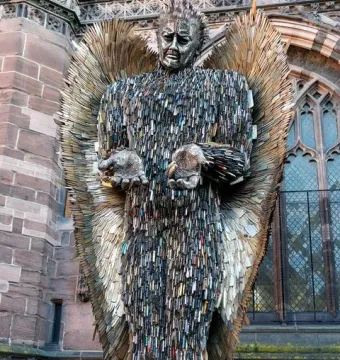
November 2019 © Jeff Buck · CC BY-SA 2.0
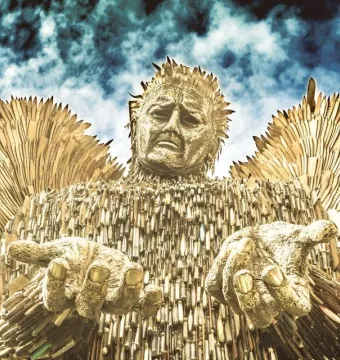
September 2022 © JOHN K THORNE · CC0
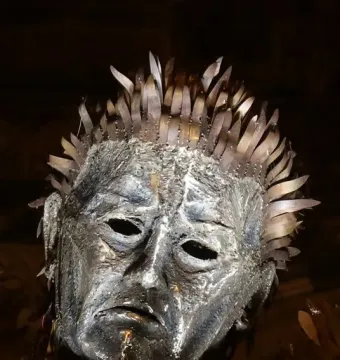
November 2019 © John S Turner · CC BY-SA 2.0
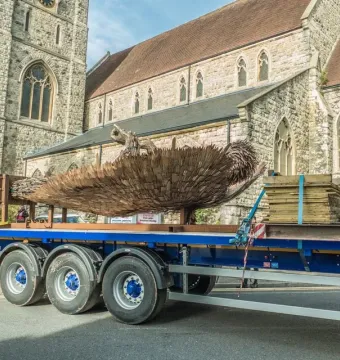
October 2022 © JOHN K THORNE · CC0
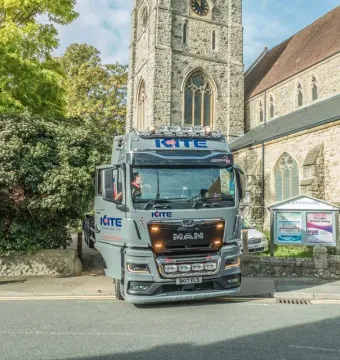
October 2022 © JOHN K THORNE · CC0
Identification | |
| Title | Knife Angel |
| Polish name | Nożowy Anioł |
| Type | Sculpture |
| Alternative name | National Monument Against Violence and Aggression |
Creator | |
| Artist | Alfie Bradley |
| Collaborating organization | British Ironworks Centre |
| Artist nationality | London-based |
Discovery and provenance | |
| Completion date | 2018; some sources say 2017 |
| Reported cost | £500,000 |
| Production time | More than two years |
| Work start date | 2015–2016 |
| Location of creation | Oswestry, England |
| Commissioned by | British Ironwork Centre |
Physical characteristics | |
| Height | 27 feet (823 cm) / 27 feet (8.2 m) |
| Weight | More than three tonnes |
| Form | Angel figure |
| Structure | A central steel body clad in blades |
Materials | |
| Primary material | About 100,000 knives and other bladed weapons |
| Structural materials | Steel frame and steel plates |
| Additional material | A World War II bayonet |
| Included but not used | Incorrectly packaged explosives in one consignment |
Technique | |
| Knife amnesty | An amnesty was announced for anonymous knife donations |
| Condition of some items | Some police-seized knives arrived in evidence bags or tubes with bodily fluids on their surface |
| Construction method | Each knife and weapon was cleaned and disinfected, then blunted and welded onto a steel frame or steel plates; the wings were given a feather-like appearance |
| Police contribution | 41 police units from across England contributed; according to British Ironworks Centre, 30% of the knives came from police and the rest were made at the centre |
| Material sourcing | Knives and other weapons were donated anonymously, confiscated by police, or collected in special bins; 200 knives were produced at the ironworks |
Appearance | |
| Inscription | Information about victims of knife crime on the wings |
| Engravings | Some blades were engraved with victims' names or messages from their families; over 80 families requested personal messages |
Iconography and meaning | |
| Purpose | A memorial for people affected by knife crime and a reflection on violence; created to highlight knife crime in the United Kingdom and educate young people about the harmful effects of violent behaviour on their communities |
| Theme | Violence, especially knife crime |
| Artist's personal connection | Alfie Bradley was himself a victim of knife crime |
Location and ownership | |
| Announced destination | Royal Armouries Museum in Leeds (announced 25 January 2024) |
| Exhibition history | Displayed in multiple cities across England, Wales, and Scotland, including Coventry, Birmingham, Hull, Leeds, Bristol, Liverpool, Middlesbrough, Southend-on-Sea, Corby, Aberystwyth, Birkenhead Park, Kirkleatham Museum, Milton Keynes, Newport, Slough, Gloucester Cathedral, Guildford Cathedral, Crewe, Nuneaton, Lichfield, Colchester, Bolton, Walsall, Bury, Taunton, Weston-super-Mare, Sunderland, Haverhill, Perth, Newton Aycliffe, Welwyn Garden City, Plymouth, and Newark-on-Trent |
| Display status | No permanent display location; on nationwide tour |
| Current location | British Ironwork Centre, Oswestry, United Kingdom |
History and restoration | |
| Public reaction | Controversial; some victims' families and relatives protested or opposed its display, while others supported it |
| Reception by critics | Criticized by Paddy Tipping and refused for exhibition by Nottingham City Council; Jon Collins said it was beautiful but there were other priorities |
| Interpretations | David Whitfield questioned its artistic nature but saw it as effective as a memorial; Roger Henry said it is more than a simple monument |
| Exhibition-related events | Early design stages were shown on Escape to the Country in 2014; Jules Hudson welded a World War II bayonet onto a metal plate as part of the project |
| Exhibition-related events | The sculpture's visit to Newark-on-Trent coincided with the first anniversary of the murder of local man James Cook (Cookie) on Castlegate on 1 May 2026 |
Significance | |
| Status | Considered the main attraction of the British Ironwork Centre |
| Inspiration | Created after the success of Spoon Gorilla, a monkey covered in spoons |