
The Meeting Place
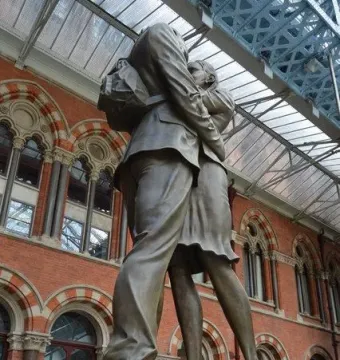
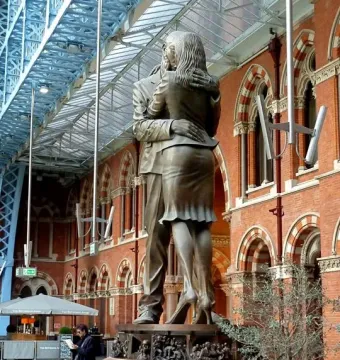
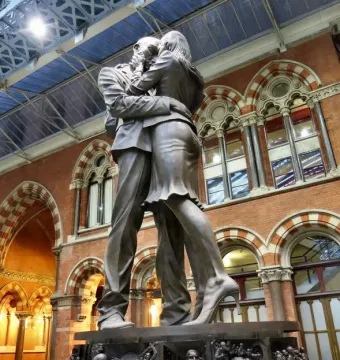
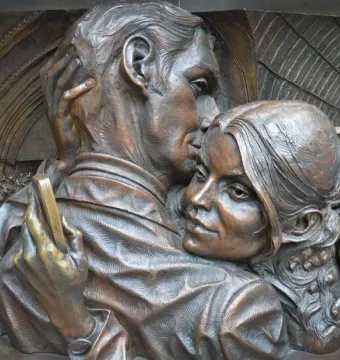
The Meeting Place is a bronze sculpture at the south end of the upper level of St Pancras railway station, in the Eurostar terminal. Designed by British artist Paul Day and unveiled in November 2007, it was installed as the centrepiece of the refurbished station. The work is intended to evoke the romance of travel through the depiction of a couple locked in an amorous embrace. It was commissioned by London and Continental Railways and is reported to have cost £1 million. The sculpture is modelled on the artist and his wife.
August 2015 © N Chadwick · CC BY-SA 2.0
February 2011 © Anthony O'Neil · CC BY-SA 2.0
July 2016 © Alan Stanton · CC BY-SA 2.0
March 2015 © Matt Brown · CC0
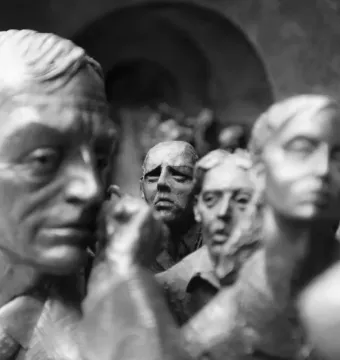
© Robert Dimov · CC BY-SA 3.0
Identification | |
| Title | The Meeting Place |
| Alternative name | The Lovers; Liebespaar ("lovers") |
Historical context | |
| Type | Monument |
| Year created | 2007 |
| Commissioned as part of | the reconstruction and refurbishment of St Pancras station |
Creator | |
| Artist | Paul Day |
| Artist nationality | British |
Discovery and provenance | |
| Station reconstruction cost | about £800 million |
| Cost | reported to have cost £1 million |
| Working location | a studio in Chichester, West Sussex |
| Commissioned by | London and Continental Railways |
| Model | Paul Day and his wife Catherine |
Technique | |
| Production process | first a small clay model, then a full-size polystyrene replica, which was cast in plaster and then in bronze |
Physical characteristics | |
| Height | 9 metres |
| Weight | 20 tonnes |
| Clock above the sculpture | a replica of a 10-metre original by Dent Clocks |
| Frieze | A bronze frieze surrounds the pedestal |
Materials | |
| Material | bronze |
| Model material | clay; polystyrene; plaster |
Appearance | |
| Frieze scenes | A train driven by a skeletal Grim Reaper-like figure; a bearded drunk staggering with a bottle beside a passing train; a man about to throw himself in front of a train in a love-related suicide attempt, reflected in a fellow passenger's sunglasses; a woman in a short skirt sitting on her lover's lap while waiting for the next train; soldiers going by train to the front during World War I; evacuation from London Underground stations after the 7 July 2005 terrorist attacks |
| Depicted man | Wearing a business suit and carrying a backpack |
| Frieze theme | Transport-themed scenes from the history of the station |
| Description | Two connected statues of a man and a woman reunited in an amorous embrace |
| Depicted woman | Wearing high heels and a knee-length dress |
Iconography and meaning | |
| Symbolism | Represents the union of an Englishman and a Frenchwoman and the meeting of Great Britain and France |
| Intended theme | To evoke the romance of travel |
Location and ownership | |
| Installation context | Installed as the centrepiece of the refurbished station |
| Location | Under the clock at the southern end of the upper level of St Pancras station, by the Eurostar terminal, London, United Kingdom |
History and restoration | |
| Opened with | the reconstructed St Pancras station |
| Related clock history | the original clock broke in the 1970s, was later rebuilt by a former railway worker, and attached to the front of his house in Thurgarton, Nottinghamshire |
| Unveiled by | Queen Elizabeth II |
| Unveiled | 7 November 2007 |
| Installed | October 2007 |
| Completed | July 2007 |
| Frieze added | 2008 |
| Frieze revision | The frieze was revised before the final version was installed |
Significance | |
| Public reception | Poorly received by much of the UK artistic community, though it became popular with the public |
| Public reaction to frieze | The 2008 frieze addition drew a new wave of criticism, though one critic described it as a satirical look at London |
| Critical comments | Anthony Gormley called it "shit" and also "a very good example of the crap out there"; Joan Bakewell called it "kitsch" and "banal"; Giles Waterfield called it "the worst" he had ever seen; Jeremy Deller dismissed it as "barely a work of art"; Will Self called it "shit kitsch" and "kitsch-mist"; Jonathan Jones called it "idiotic in its scale" and "without artistic feeling"; Stephen Bailey called it "unproportionate and crudely shaped"; Tim Marlow called it "a terrible, saccharine, sentimental piece of kitsch"; other descriptions included "vulgar", "exaggerated", "truly horrifying", "dreary and mournful", and "dreary and sad" |
| Comparison by journalists | Compared with Rodin's The Kiss and the Statue of Liberty as a future landmark |
Other | |
| Artist response to criticism | Paul Day said the criticism directed at the monument was "shit" and that many people would detest it because it is not violent or controversial |
| Location context | Associated with St Pancras station; image captions also place it at St Pancras |