
America's Response Monument
America's Response Monument, subtitled De Oppresso Liber, is a life-and-a-half scale bronze statue in Liberty Park overlooking the National September 11 Memorial & Museum in New York City. Also known unofficially as the Horse Soldier Statue, it was the first publicly accessible monument dedicated to the United States Army Special Forces and the first near Ground Zero to honor heroes of the September 11 terrorist attacks. Conceived by sculptor Douwe Blumberg, the statue was first sold in 2003 as a small-scale version. A larger version was commissioned in April 2011 and dedicated on Veterans Day, November 11, 2011. It commemorates the service members of America’s Special Operations forces and their response to 9/11, including those involved in the early stages of the Afghanistan war.
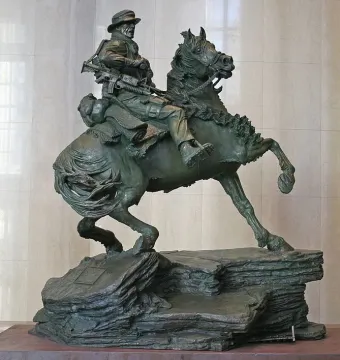
© Douwe Blumberg · CC BY-SA 3.0
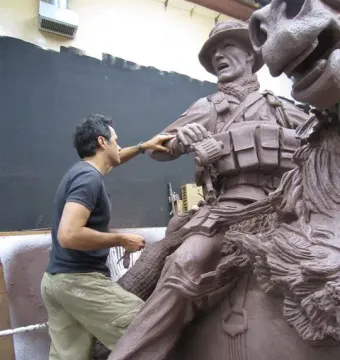
August 2012 © Douwe Blumberg · CC BY-SA 3.0
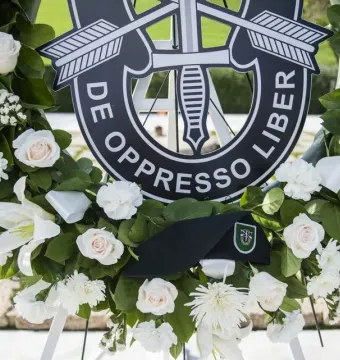
October 2017 © Arlington National Cemetery · Public domain
Identification | |
| Title | America's Response Monument |
| Type | Bronze statue |
| Subtitle | De Oppresso Liber |
| Alternative name | Horse Soldier Statue |
Physical characteristics | |
| Left hand detail | An outline of a wedding band visible under the glove |
| Embedded material | A piece of steel recovered from the rubble of the World Trade Center, visible under the plinth and embedded in the base |
| Base imagery | Steep, precipitous slopes |
| Scale | Life-and-a-half scale |
| Horse depiction | Rearing back |
| Horse type | Small Afghan Lokai horse with Tersk breeding |
| Horse tack | Traditional Afghan tack with a tasseled breast collar |
| Weapon carry method | Slung under his right shoulder on a sling |
| Pose | Right hand holding field glasses |
| Depicted figure | A male Green Beret operator wearing a boonie hat on horseback, leading the invasion into Afghanistan |
| Base material | Granite plinth |
| Material | Bronze |
| Weapon depicted | M4A1 carbine with Picatinny rails, ACOG, AN/PEQ-2 laser sight, 30-round STANAG magazine, and M203 grenade launcher |
Creator | |
| Sculptor | Douwe Blumberg |
Historical context | |
| Battle outcome | Supported by American air power and precision-guided munitions, the Taliban were successfully attacked and many fled after abandoning their weapons |
| Allied forces at Bishqab | About 1,500 cavalry and 1,500 light infantry, supported by the 12-man ODA 595 team and American air support |
| Battle terrain | A mile-wide open plain cut by seven ridges |
| Battle comparison | Compared to the Charge of the Light Brigade, the Battle of Fredericksburg, and Pickett's Charge at Gettysburg |
| Triggering image source | A photograph of ODA 595 riding across a field on Afghan horses shown by Donald Rumsfeld at a news conference |
| Second battle referenced | The attack on Cōbaki in Balkh Province, south of Mazar-e-Sharif, the next day |
| Role in second battle | ODA 595 members used SOFLAM laser target designators for air strikes on enemy armor and artillery, then rode into action and helped win the battle |
| Triggering image date | 15 November 2001 |
| Artist background | Horse trainer for 18 years and military history enthusiast |
| Battle referenced | The attack on the fortified village of Bishqab on 21 October 2001 |
| Enemy equipment at Bishqab | T-54/T-55 tanks, BMP armored personnel carriers, and ZSU-23 anti-aircraft artillery vehicles |
| Quotation associated with the scene | "It was as if The Jetsons had met The Flintstones" |
| Replacement saddles | Lightweight Australian-style saddles airdropped in mid-November |
| Referenced military branches | Green Berets from the 5th Special Forces Group, members of the 160th Special Operations Aviation Regiment, and Air Force Combat Controllers |
| Inspiration | A photograph of ODA 595 riding Afghan horses, shown by Donald Rumsfeld at a press conference in November 2001 |
| Subject | American soldiers on horseback in Afghanistan during the opening phase of Operation Enduring Freedom |
| Commemorates | The service members of America's Special Operations forces who responded to the September 11 attacks, especially those who fought in the early stages of Operation Enduring Freedom |
| Historical context | Linked to the U.S. special operations campaign in Afghanistan after the September 11 attacks; Operation Enduring Freedom helped lead to the initial defeat of the Taliban in Afghanistan |
| Historical subject | The actions of Task Force Dagger and ODA 595 in Afghanistan during Operation Enduring Freedom |
| Historical subject represented | The U.S. Special Forces horse soldiers of ODA 595 during Operation Enduring Freedom in Afghanistan |
| Mounted troops nickname | Horse soldiers |
| Related operation | Operation Enduring Freedom |
| Related task force | Task Force Dagger |
| Referenced team | Operational Detachment Alpha (ODA) 595 |
| Referenced vehicle | MH-47E Chinook helicopter |
| Initial saddles used | Traditional small, hard, wooden Afghan riding saddles |
| Referenced base | Karshi-Khanabad Air Base, a former Soviet airbase in Uzbekistan |
| Referenced mountain range | Hindu Kush |
| Referenced battle area | Dari-a-Souf Valley, about 80 km south of Mazar-e Sharif |
| Landing date | 19 October 2001 |
| Flight distance | More than 300 kilometers |
| Mountain elevation | Up to 4,900 meters |
| Visibility conditions | Zero visibility |
| Transportation method | Horses provided by allied Afghan tribes |
| Mounted warfare theme | U.S. soldiers mounted on Afghan mountain horses in modern warfare |
Discovery and provenance | |
| Supporting organizations | The Gary Sinise Foundation and the Green Beret Foundation |
| Commission amount | $500,000 |
| Revision trigger | A Vietnam-era Green Beret noticed the work in progress and Lt. Col. Frank Hudson of the 5th Special Forces Group at Fort Campbell contacted Blumberg after seeing inconsistencies with the real events |
| Commissioned by | A group of New York City Wall Street bankers who had lost friends and co-workers in the 9/11 attacks |
| Special forces edition size | Another 120 pieces for members of the special forces |
| Initial conception | Created after seeing a photo of modern soldiers on horseback |
| Renewed commission effort | March 2011 |
| Initial completion context | Made on Blumberg's own initiative and expense |
| First shown in progress | 2002 in Louisville, Kentucky |
| Refinement process | Blumberg collaborated with soldiers who had returned from Afghanistan, including Capt. Mark Nutsch, and invited some to his studio; additional research materials included indigenous horse tack made of dried sinew |
| Resculpting time | Another three months |
| Public edition size | 120 18-inch pieces |
| Initial scale model | 1:6 scale bronze sculpture of a Green Beret riding an Afghan horse |
| Copy presented to museum | March 5, 2004, to the John F. Kennedy Special Warfare Museum at Fort Bragg |
| Foundation formed | Foundation for US Historical Monuments |
| Foundation year | 2003 |
| Foundation outcome | Its efforts came to nothing |
Location and ownership | |
| Dedication ceremony led by | Vice President Joe Biden and Lt. Gen. John Mulholland, commander of the U.S. Army Special Operations Command |
| Dedication date | November 11, 2011 |
| Dedication | First public monument dedicated to the United States Army Special Forces |
| Status | Publicly accessible monument |
| Location | Liberty Park, in front of One World Trade Center and opposite the National September 11 Memorial & Museum, New York City |
Iconography and meaning | |
| Wedding band tribute | A tribute to wives, marriages, and the strain on families caused by multiple deployments |
| Artist's theme | Despite high-tech military gear, Afghan horses were essential to the campaign's success |
| Artist's interpretation | The visual irony of a 21st-century high-tech soldier riding a rugged Afghan mountain horse in a centuries-old form of combat |
| Symbolic meaning | Honors the mounted troops known as the horse soldiers and symbolizes the connection between 9/11 and the special operations heroes honored by the monument |
| Subtitle meaning | Latin for 'to liberate the oppressed' |
Significance | |
| Significance | The first monument near Ground Zero to recognize heroes of the September 11 terrorist attacks; it was also the first public monument dedicated to the United States Army Special Forces |
History and restoration | |
| Burial practice | Each Green Beret team member carried a piece of World Trade Center steel and later buried it at a significant battlefield location |
| Specific burial location | Mazar-e Sharif, chosen by Bowers |
| Burial significance | One of their toughest battles and the place where CIA officer Mike Spann became the first American killed in combat in Afghanistan |
Other | |
| Related book | Horse Soldiers: The Extraordinary Story of a Band of US Soldiers Who Rode to Victory in Afghanistan |
| Book author | Doug Stanton |
| Book inspiration | The events following the World Trade Center attacks |
| Book content summary | It documents the victory of 350 Special Forces soldiers, 100 CIA officers, and about 15,000 Northern Alliance troops over roughly 50,000 Taliban fighters |
| Film adaptation rights purchaser | Jerry Bruckheimer |
| Film adaptation | 12 Strong |