
The Kiss
The Kiss, originally titled Francesca da Rimini, is a sculpture of an embracing couple created around 1881 by Auguste Rodin, with the participation of Camille Claudel. It was first conceived as a motif for The Gates of Hell. The first large marble version dates from 1889, made for a commission from the French state for the Exposition Universelle. Rodin, who did not carve marble himself, supervised three marble versions after making a clay model. Smaller versions also exist in plaster, terracotta, and bronze.
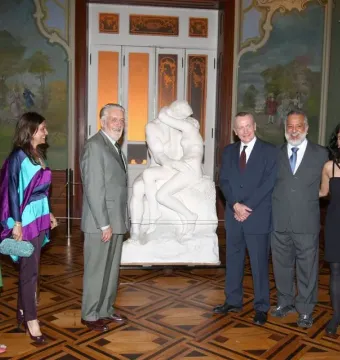
October 2009 © Jaques Wagner Governador · CC BY 2.0

© François-Auguste-René Rodin · Public domain

December 2014 © daryl_mitchell · CC BY-SA 2.0
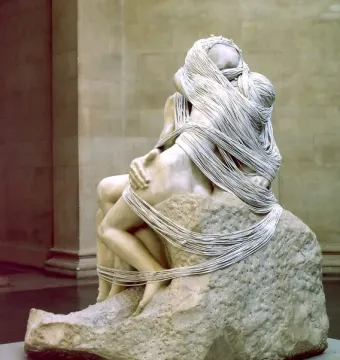
December 2006 © Cornelia Parker · CC BY-SA 3.0

April 2017 © Adoc · CC BY-SA 4.0
Identification | |
| Title | The Kiss |
| Type | Sculpture |
| Original title | Francesca da Rimini; later renamed Le Baiser (The Kiss) |
Historical context | |
| Commission context | Commissioned by the French state for a planned museum of art in Paris |
| Development history | First shown publicly in 1887; Rodin decided in 1886 to make it an independent work |
| Relation to The Gates of Hell | Originally part of the relief group on the monumental bronze portal; later removed and replaced by another pair of lovers on the right column |
| Exhibition context | First large marble version made for the 1889 Paris World Exhibition / Exposition Universelle |
| Date | c. 1881; first large marble version 1889 |
| Initial purpose | Motif for The Gates of Hell |
| Exhibition history | Shown at the Salon de la Société Nationale des Beaux-Arts, at Georges Petit gallery in Paris, in Brussels, at the 1893 World's Columbian Exposition in Chicago, and at the Salon de Mai in Paris in 1898 |
Creator | |
| Assistant sculptors | Camille Claudel; Jean Turcan; Rigaud; Emmanuel Dolivet |
| Artist nationality | French |
| Artist | Auguste Rodin |
Discovery and provenance | |
| Inspiration | Dante Alighieri's Divine Comedy, especially Inferno, Canto V; also inspired by Rodin's relationship with Camille Claudel |
| Subject | Francesca da Rimini and Paolo Malatesta, embracing and kissing |
| Narrative source | The lovers are figures from Dante's account of forbidden love in Inferno, Canto V |
| How the figures are portrayed | They are shown nude, without their usual attributes, as a couple in the act of kissing |
| Background story | Francesca and Paolo fell in love while reading the story of Lancelot and Guinevere; they were later discovered and killed by Francesca's husband, Giovanni Malatesta (also called Gian Ciotto Malatesta) |
| Interpretation | The work evokes doomed love, lust, and the moment before or at the edge of tragedy |
Physical characteristics | |
| Original size | About 85-86 cm high |
| Scale of marble version | The enlarged marble version was made at about twice the size of the plaster model |
Materials | |
| Other materials and versions | Models and versions also exist in clay, plaster, terracotta, bronze, and enlarged copies in different materials |
| Primary material | Marble |
Technique | |
| Production method | Rodin made a clay model and supervised the carving of multiple marble versions rather than carving marble himself |
| Preparatory work | Rodin made many preliminary studies, models, drawings, and photographs |
| Casting/carving assistants | The first large marble version was carved by Jean Turcan; the second by Rigaud; the third by Emmanuel Dolivet |
Location and ownership | |
| Current location | Musée Rodin, Paris, France |
| Other locations and holdings | The first marble version is at Musée Rodin, Paris; the second marble version is at Tate Gallery, London; the third marble version is at Ny Carlsberg Glyptotek, Copenhagen; copies are also held by museums in London and Copenhagen |
| Museum inventory numbers | Musée du Luxembourg: Lux. 132; Musée Rodin: S. 1002 |
History and restoration | |
| Marble version status | The first large marble version was left unfinished by Turcan; reference marks are visible on the marble block and the sculpture is unsigned |
| Public reception | The work caused scandal and was considered offensive or unsuitable for general display when first exhibited, but later became highly successful |
| Museum history | The work entered the Musée du Luxembourg on 18 February 1901 and the Musée Rodin in 1918 |
Appearance | |
| Composition | The lovers are shown in a non-frontal composition meant to be viewed from multiple angles |
| Gesture and detail | Paolo is shown holding a book; the lovers' lips do not touch |
| Anatomical treatment | Rodin sacrificed anatomical accuracy for expressive force; Francesca's arm appears elongated |
| Expressive effect | The lovers' feelings are conveyed through movement and body language, with a strong erotic tension |
Significance | |
| Art-historical significance | One of the works that contributed most to Rodin's recognition as an artist |
| Critical interpretation | Critics interpreted the title change to The Kiss and the non-touching lips as emphasizing abstraction, eroticism, and tragic suspension |