
The Great God Pan
The Great God Pan is a bronze sculpture by American artist George Gray Barnard, cast between 1898 and 1899. Barnard conceived the work in 1894, originally imagining it as a fountain sculpture for The Dakota in Manhattan. After several rejected proposals for Central Park, the bronze was eventually donated to Columbia College and installed in 1907 on a redesigned fountain setting by Charles Follen McKim. The sculpture has been moved several times on campus, but it remains at Columbia University in New York City. At the time of its casting, it was the largest single-piece bronze sculpture cast in the United States.
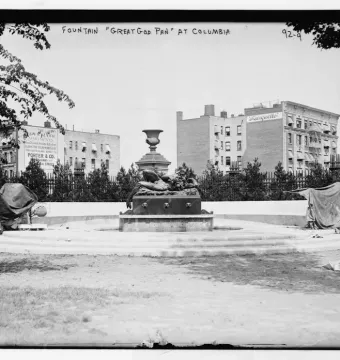
© Bain News Service, publisher · Public domain
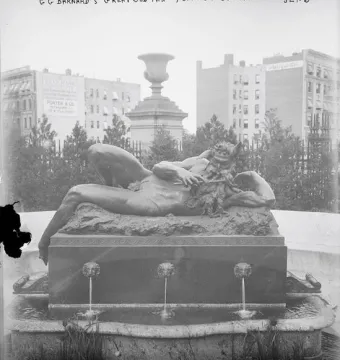
1900 © George Grantham Bain · Public domain
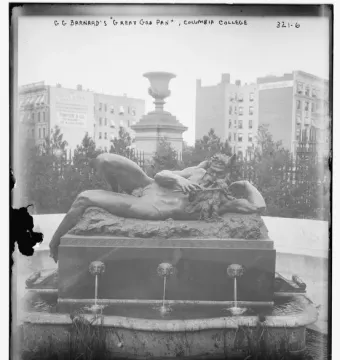
© Bain News Service, publisher · Public domain
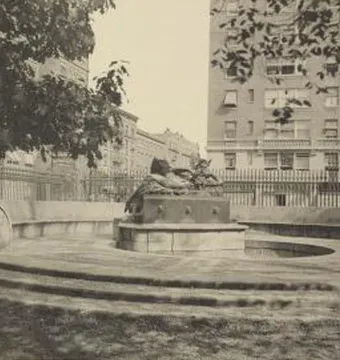
1918 © George Grey Barnard (1863-1938), sculptorCharles Follen McKim (1847-1909), architectunidentified phototgrapher · Public domain
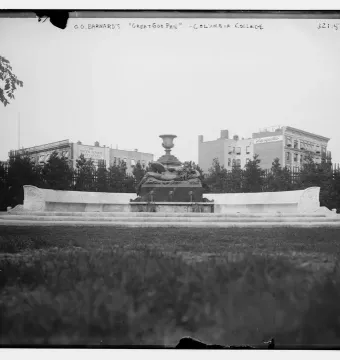
© Bain News Service, publisher · Public domain
Identification | |
| Title | The Great God Pan |
| Common name | Pan |
| Type | bronze sculpture |
Creator | |
| Artist | George Gray Barnard |
| Artist nationality | American |
Historical context | |
| Conceived | 1894 |
| Original purpose | a fountain sculpture |
| Original intended location | the courtyard of The Dakota, Manhattan's Upper West Side |
| Original patron | Alfred Corning Clark |
| Commissioned by | Alfred Corning Clark in 1895 |
| Scale | larger than life-size |
| Never installed at original location | The sculpture was never installed at The Dakota |
Discovery and provenance | |
| Bronze cast loaned to | the Metropolitan Museum of Art and international exhibitions |
| Bronze casting funded by | Edward Severin Clark |
| Related rejected companion work | Frederick William MacMonnies's Bacchante and Infant Faun |
| Related cartoon | The Two Orphans, published by the New York Evening Telegram on June 10, 1897 |
| Alternative proposed site | a boulder fronting on Central Park Lake |
| City acceptance and rejection | The New York City Art Commission approved the gift, but the Parks Commission debated it for six months and ultimately rejected it |
| Proposed donation to New York City | In November 1896, Clark's family offered the sculpture as the centerpiece of a fountain in Central Park, with the Clark estate paying all casting and erection costs |
Materials | |
| Main material | bronze |
| Base material | green granite |
| Stone material | Pompton pink granite |
| Stone source | quarried in Pompton Lakes and Riverdale, New Jersey |
Technique | |
| Model form | plaster model |
| Casting method | cast in a single piece rather than assembled from separately cast parts |
| Foundry | Henry-Bonnard Bronze Company, Mount Vernon, New York |
| Foundry manager | Eugene F. Aucaigne |
| Casting date | August 1898 |
| Casting significance | At the time, it was the largest bronze sculpture cast in a single piece in the United States |
Appearance | |
| Additional modeled element | Laughing Faun, a small mask intended to cover the water spouts around the sculpture's base |
| Base design | a rock surrounded by reeds and cattails, with a standing crane to visually balance Pan's head |
| Pose | reclining lazily on his side atop a rock |
| Action | playing a reed flute and dangling one hoof over the edge of the rock |
| Subject | the Greek god Pan, a half-man, half-goat deity associated with pastoral life, rustic music, and carnality |
| Figure appearance | a mature, strongly muscled figure with a long tangled beard, goat ears, and cloven hooves, but no horns or tail |
Location and ownership | |
| Architectural setting designer | Charles Follen McKim of McKim, Mead & White |
| Relocation history | Moved in 1959 to Amsterdam Avenue and 119th Street, moved again in 1963 to a courtyard between Fayerweather and Avery Halls, and relocated to its current site in 1975 |
| Architectural setting | a D-shaped granite fountain basin, circular pool, stepped platform, and exedra (curved stone bench) |
| Current site | north of West 116th Street, between Lewisohn Hall and Low Memorial Library |
| Original Columbia installation site | The Green at Amsterdam Avenue and 120th Street, then the northeast corner of the campus |
| Original Columbia installation date | 1907 |
| Fountain name | Pan Fountain |
| Donated to | Columbia College (now Columbia University) by Edward Clark and his mother |
History and restoration | |
| Buffalo exhibition | Pan-American Exposition in Buffalo, New York, May to November 1901 |
| Boston exhibition | Museum of Fine Arts, Boston, November–December 1908, in Barnard's solo exhibition |
| St. Louis World's Fair recognition | Barnard was not recognized for the artistic merit of Pan |
| St. Louis World's Fair award | Henry-Bonnard Bronze Company received a gold medal for casting the sculpture |
| St. Louis World's Fair display | Exhibited in 1904 in St. Louis, Missouri, as part of an industrial display inside the Palace of Manufactures |
| National Sculpture Society exhibition | Madison Square Garden, New York City, November 1902 |
| Buffalo award | gold medal for Pan and The Struggle of the Two Natures in Man |
| Buffalo display location | in front of the art gallery |
| Plaster exhibition | Barnard's first one-man exhibition, November 1898, under the glass roof of the Logerot Hotel winter garden, Fifth Avenue and 18th Street, New York City |
| Paris award | gold medal for Pan and The Struggle of the Two Natures in Man |
| Paris display location | along the Champs-Élysées |
| Paris exhibition | Exposition Universelle in Paris, April to November 1900 |
| Loan to the Metropolitan Museum of Art | for a year beginning in spring 1899 |
| Faun masks used | no |
| Base cast in bronze | no |
| Fountain idea | abandoned after the Parks Commission rejected the Central Park proposal |
| Base used as fountain | Placed on a neoclassical green-granite base with three bronze lion-head water spouts |
Significance | |
| Contemporary significance | It was the largest bronze sculpture cast in one piece in the United States at the time |
| Inspired poem | To the Great God Pan by Ralph Perry, editor of the 1916 yearbook The Columbian |