
Charlemagne and His Leudes
Charlemagne and His Leudes is a monumental sculptural group located on the parvis Notre-Dame, Place Jean-Paul-II, in Paris. Created by the French sculptor brothers Charles and Louis Rochet, with casting by Thiébaut Frères, it depicts Charlemagne on horseback accompanied by his leudes Roland and Olivier. The work was first shown at the 1878 Universal Exhibition, though it had earlier been presented in plaster in 1867. After a long and contested public history, it was installed near Notre-Dame and later acquired by the city of Paris. The statue survived the Second World War, reportedly because of Charlemagne’s importance in German history.
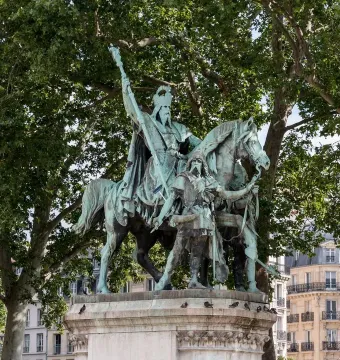
© Dietmar Rabich · CC BY-SA 4.0
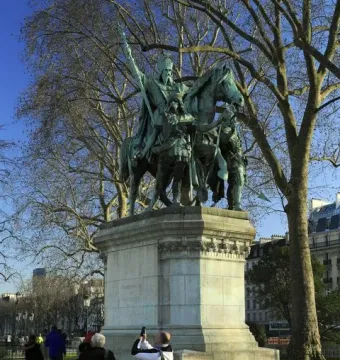
February 2016 © Falk2 · CC BY-SA 4.0
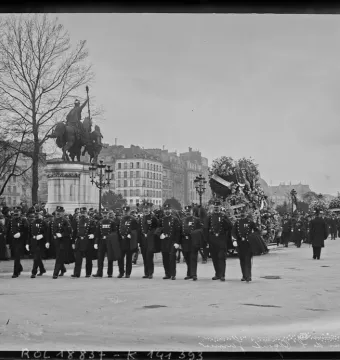
© Agence Rol. Agence photographique (commanditaire) · Public domain
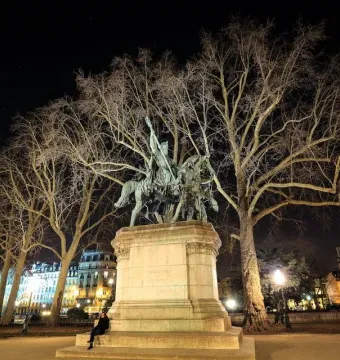
January 2013 © Roberto Taddeo · CC BY 2.0
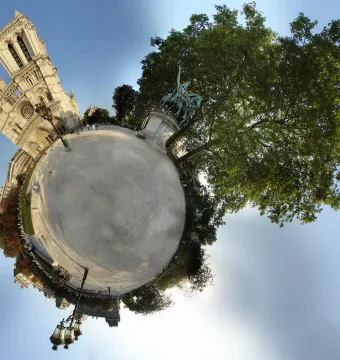
© Alexandre Duret-Lutz · CC BY-SA 2.0
Identification | |
| Title | Charlemagne et ses Leudes |
| Subject | Charlemagne with his leudes Roland and Olivier |
| Alternative title | Karl der Große und seine Wachen; Charlemagne and His Guards; Charlemagne and His Paladins |
| Type | Monumental bronze equestrian statue group |
Historical context | |
| Date created | 1878 |
| Original conception date | 1853 |
| Initial intended location | Aachen |
| First exhibited | Exposition universelle of 1878 |
| Earlier version exhibited | Plaster version at the Universal Exposition of 1867 |
Creator | |
| Foundry | Thiébaut Frères |
| Creators' relationship | Brothers |
| Creator nationality | French |
| Sculptors | Charles Rochet and Louis Rochet |
Discovery and provenance | |
| Purchase by the city of Paris | 1895 |
| Purchase price | 30,000 francs |
Location and ownership | |
| Current location | Parvis Notre-Dame – Place Jean-Paul-II, Paris, France |
| Initial installation site | Forecourt of Notre-Dame Cathedral, Paris |
| Provisional location status | Originally installed provisionally on the forecourt of Notre-Dame Cathedral |
| Ownership | City of Paris |
Physical characteristics | |
| Base | Stone pedestal |
| Pedestal inscription | "CHARLEMAGNE / ET / SES LEVDES" on one side of the pedestal, on the left side when viewed from the front |
| Weight | approximately 15 tons |
| Height | about 7 meters |
Materials | |
| Main material | Bronze |
| Pedestal material | Stone |
| Earlier pedestal material | Wooden base covered with tarred canvas |
Technique | |
| Casting | Cast by Thiébaut Frères |
Appearance | |
| Depicted figures | Charlemagne mounted on a horse, with Roland and Olivier standing beside the horse's neck and holding its bridle |
| Charlemagne depiction | Shown as an elderly man with a split beard, wearing an imperial crown and holding the scepter of Charles V |
| Roland depiction | Armed and helmeted, wearing chain mail, looking to the right, with the sword Durendal, an olifant, and a labrys; the sword is modeled on the one kept at the Royal Armoury of Madrid |
| Olivier depiction | Armed and helmeted, wearing chain mail, looking to the left, with a dagger, a lance, a Frankish scramasax, and a pike |
| Horse handler | Olivier |
Iconography and meaning | |
| Historical inconsistencies | The Imperial Crown postdates Charlemagne by more than a century, the scepter dates from the 14th century, and the leudes are shown with clothing and hairstyles associated with Gauls or Merovingians rather than late-8th-century Franks |
| Iconographic note | The monument contains anachronisms and is deliberately fictional and allegorical |
| National claim | Roland and Olivier anchor Charlemagne in French tradition against competing Belgian and German claims |
| Political symbolism | It reflects Second French Empire ideology and claims Charlemagne's legacy for France and Napoleon III |
History and restoration | |
| World War II survival | The statue was spared during the German occupation while many other bronze statues in France were melted down |
| Reason spared in World War II | Charlemagne was regarded as important in German nationalist ideology and as a symbol of a Greater German Reich |
| Relocation proposals | In 1973 Paris proposed replacing the statue with the Pillar of the Boatmen and offered it to Metz, but Metz declined the transport costs and the relocation did not happen |
| Proposed replacement | The Pillar of the Boatmen |
| Later base history | The original wooden base burned in 1906; it was replaced by a new stone base in 1908 |
| New base dimensions | 3 meters high and 7.30 meters wide |
| Pedestal designer | Eugène Viollet-le-Duc |
Significance | |
| Early reception | Initially little public interest, then heated debate over cost and symbolism followed by strong press and popular support |