
The Eternal Springtime by Auguste Rodin
The Eternal Springtime is a sculpture by French artist Auguste Rodin, created alongside the project The Gates of Hell. It was originally conceived as one of the representations of Paolo Malatesta and Francesca da Polenta, but was never included because the lovers’ feeling of happiness did not suit the theme. The woman’s torso was based on the arched pose of the Torso of Adele, modeled on the Italian model Adele Abruzzesi. The work is often associated with Rodin’s relationship with Camille Claudel. In contrast to The Kiss, the man dominates the composition, holding his arched lover in a passionate embrace. The sculpture was reproduced several times in bronze and marble, and one marble version later set an auction record of $20 million. A marble version with a tree trunk for the man’s arm rests is in the Museo Soumaya.
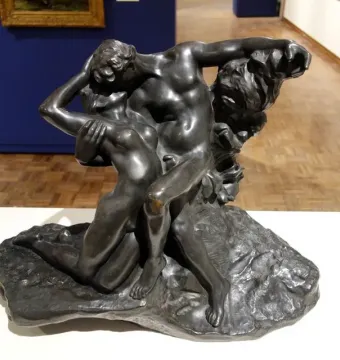
May 2013 © Daderot · CC0
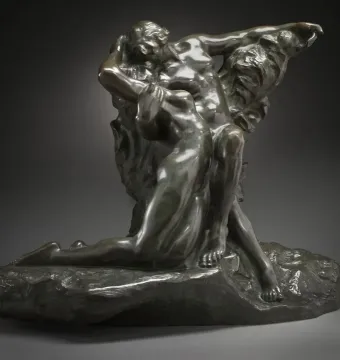
© Auguste Rodin (France, 1840-1917) · Public domain
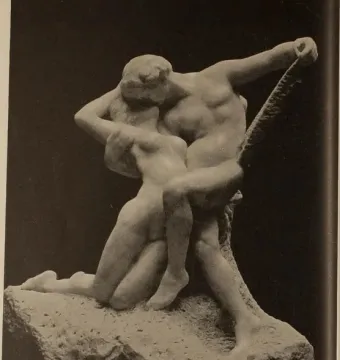
1915 © Internet Archive Book Images · No restrictions
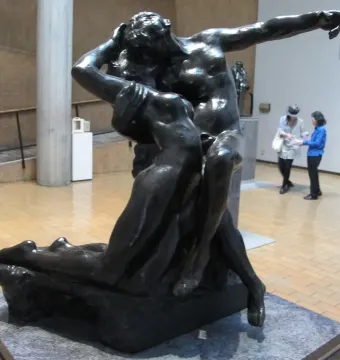
May 2012 © sailko · CC BY-SA 3.0
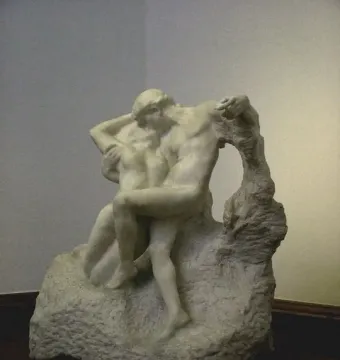
© Auguste Rodin · Public domain
Identification | |
| Title | The Eternal Springtime |
| Original title | L'Éternel Printemps |
| Alternative titles | La Eterna Primavera; A Eterna Primavera; L'eterna primavera; Céfiro y la tierra; Juventud; Ideal |
| Type | Sculpture |
Historical context | |
| Date | c. 1884 |
| Created in context of | The Gates of Hell |
| Original intended subject | Paolo Malatesta and Francesca da Polenta |
| Reason not included in The Gates of Hell | The happiness expressed by the lovers was considered unsuitable for the theme of Dante's Inferno |
Creator | |
| Artist nationality | French |
| Artist | Auguste Rodin |
Discovery and provenance | |
| Subject | A couple of lovers kissing |
| Model for female figure | Adele Abruzzesi |
| Model for male figure | Lou Tellegen |
| Source of female torso | The Torso of Adele (1882), shown in the upper left corner of the tympanum of The Gates of Hell |
| Relationship to Camille Claudel | The sculpture's creation coincided with Rodin's romantic relationship with Camille Claudel; Reine-Marie Paris suggested that traces of Claudel may be discernible in the female figure |
Physical characteristics | |
| Composition | The man dominates the composition by supporting his lover's arched body |
| Appearance | The figures are shown as if seen through twilight or insufficient evening light |
| Surface treatment | The marble figures are not polished, and the marble block is left rough and unworked at the bottom and on the sides |
Materials | |
| Material | Bronze; marble |
| Patina | Black patina |
Technique | |
| Marble version modifications | Rodin added a trunk for the man's arm to rest on, and the man's right foot rests on a rock |
| Versioning | Produced in multiple bronze casts in four sizes and in six marble versions, with authorial copies also made in plaster |
Location and ownership | |
| Original cast status | Rare 19th-century original cast in the permanent collection of the Calouste Gulbenkian Museum |
| Foundry | Alexis Rudier Foundry |
| Notable example version | A marble version, cast in 1898 at the Alexis Rudier Foundry, is in the Calouste Gulbenkian Museum and is one of Rodin's few originals probably produced directly by him |
| Other owners/provenance | One marble version came from the Eliseevs' nationalized collection and was transferred to the museum in 1923 |
| Original cast acquisition | Purchased by Calouste Gulbenkian in Paris in 1913 from the sale of Paul Arthur Chéramy's personal collection |
| Current museum holding another version | Museum of Art, Besançon |
| Current museum holding a version with trunk | Museo Soumaya, Mexico City |
| Current museum holding a marble version | Hermitage Museum |
| Current museum holding a marble version | National Museum of Decorative Arts, Buenos Aires, Argentina |
| Current museum holding an original cast | Calouste Gulbenkian Museum, Lisbon |
History and restoration | |
| Exhibition | The Salon of the Société des Artistes Français in 1898 |
| Reception | The work was a major success |
| Auction record | A marble version sold at auction in May 2016 for US$20 million, then a record price |
| Related versions | A version at the Hermitage is marble and was bought when the palace was a private residence around 1911 |
Significance | |
| Interpretive note | The work is associated with love and springtime and was probably inspired by Rodin's passionate relationship with Camille Claudel, which began in 1883 and lasted about ten years |