
Saint Matthew
Saint Matthew is an unfinished marble sculpture by Michelangelo, measuring 2.61 meters high. It is housed in the Galleria dell'Accademia in Florence. On 24 April 1503, Michelangelo signed a contract with the Wool Guild to create twelve apostle figures for Santa Maria del Fiore, but he only began Saint Matthew. When Giuliano della Rovere became Pope Julius II, he summoned Michelangelo to Rome to work on his tomb, and the Florence project was abandoned. The contract was annulled on 18 December 1505. The sculpture is related to the later slaves made for the tomb of Julius II and appears to emerge from the stone with great emotion, in the spirit of terribilitá.
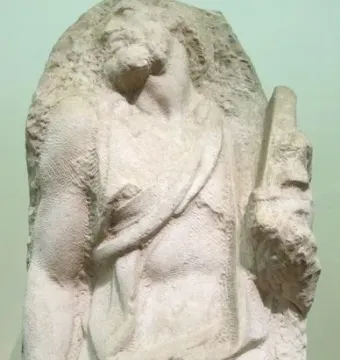
January 2014 © Francesco Bini · CC BY-SA 4.0
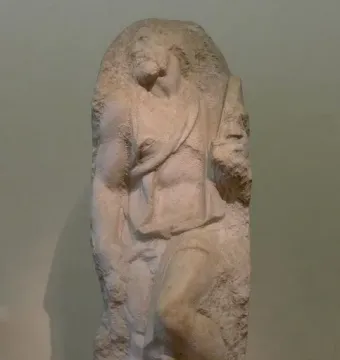
August 2011 © Jörg Bittner Unna · CC BY-SA 3.0
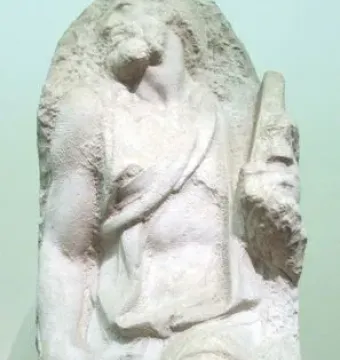
© Sailko · CC BY 3.0
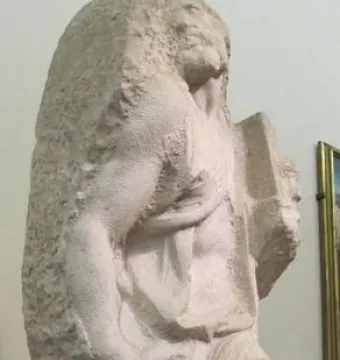
January 2014 © Francesco Bini · CC BY-SA 4.0
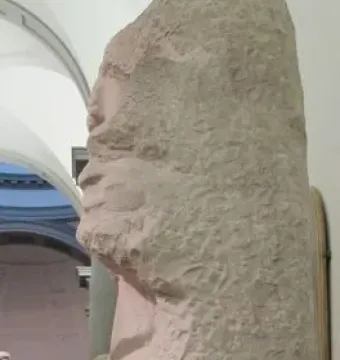
January 2014 © Francesco Bini · CC BY-SA 4.0
Identification | |
| Title | Saint Matthew |
| Type | unfinished marble statue |
| Subject | Saint Matthew the Apostle |
| Original title | San Matteo |
Historical context | |
| Date | circa 1505–1506 |
| Artistic period | High Renaissance |
Creator | |
| Artist | Michelangelo Buonarroti |
| Artist description | Italian Renaissance painter and sculptor |
Discovery and provenance | |
| Work begun | probably after completion of David in April 1504; at least five marble blocks had arrived in Florence by 1504 |
| Attributed working period | 1504–1506 |
| Contract annulled | 18 December 1505 |
| Reason the commission was abandoned | Michelangelo was called to Rome by Giuliano della Rovere, later Pope Julius II, to work on his tomb |
| Only started work | Saint Matthew |
| Original commission | twelve marble statues of the apostles for Santa Maria del Fiore Cathedral |
| Material selection requirement | Michelangelo was to travel to Carrara himself to choose the marble |
| Production schedule | one statue per year |
| Intended placement | the choir niches of Florence Cathedral |
| Commission date | 24 April 1503 |
| Commissioned by | the Arte della Lana and the Opera del Duomo of Florence |
| Disputed dating | Goldscheider (1964) proposed circa 1512, but Vasari and a letter by Michelangelo dated 27 January 1524 indicate the apostle was already sketched before Michelangelo left for Rome |
Physical characteristics | |
| Height | 216 cm |
Materials | |
| Material | marble |
| Block shape | the marble block retained its rectangular original form |
Technique | |
| Technique | carved from a marble block; non-finito |
Appearance | |
| Pose | strong contrapposto with vigorous twisting motion; left leg raised and resting on a stone, right leg extended; head turned to the left and upward; left arm relaxed along the body; right hand presses a book against the body |
| Composition | the body is tense and turned by an inner force, with a shift between pelvis and shoulders and a strong S-shaped line |
| Visible form | the figure seems to emerge from the stone and was intended for a niche, essentially visible from the front |
| Attribute | a book |
| Condition | unfinished; partly visible marble block remains |
Iconography and meaning | |
| Stylistic comparison | resembling Michelangelo's later Slaves and showing a figure trying to free itself from the stone |
| Possible influence | Laocoön and His Sons, Donatello's Sacrifice of Isaac, and Pasquino |
| Visual impression | charged with great emotion and seems to emerge with difficulty from the stone |
| Interpretation | the unfinished figure suggests a heroic primordial gesture of victory over chaos and the triumph of thought over chaos |
| Subject meaning | Matthew is depicted as writing not his own words but those spoken to him by an angel |
History and restoration | |
| Current location | Galleria dell'Accademia, Florence |
| Earlier locations | rooms of the Opera del Duomo in Florence; later the atrium of the Accademia delle Arti del Disegno; moved to the gallery in the early 20th century |
| Acquisition date by current museum | 1909 |
| Preparatory drawing | Cabinet des Dessins, Louvre, inventory no. 1068 |
Significance | |
| Historical significance | one of the first conspicuous examples of non-finito and possibly one of the first documented recognitions of an unfinished work of art |
| Critical reception | considered by Giorgio Vasari a preliminary model (modello) and praised for Michelangelo's mastery |
| Influence | significant influence on Michelangelo's contemporaries, including Raphael and Jacopo Sansovino |