
Moses by Michelangelo
Moses is a marble sculpture by the Renaissance artist Michelangelo, located in the Basilica of Saint Peter in Chains in Rome. It is thought to be an idealized portrait of Pope Julius II and was intended as one of six figures for Julius II’s tomb in the second project. The sculpture is 235 cm high and shows Moses as a bearded elder holding the Tablets of the Law. In line with 16th-century iconography, he wears the traditional “horns of wisdom.” The work is known for its strong expression, detailed drapery, and intense sense of inner tension. Giorgio Vasari praised its craftsmanship, and Sigmund Freud later wrote an essay about it in 1914.
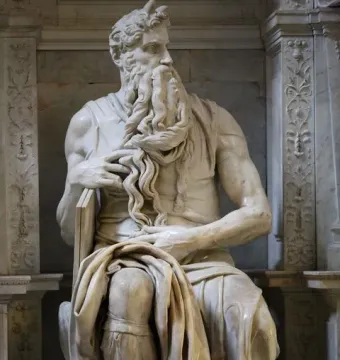
May 2008 © Dino Quinzani · CC BY-SA 2.0
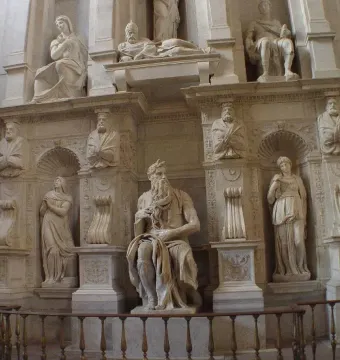
August 2004 © Serge Melki · CC BY 2.0
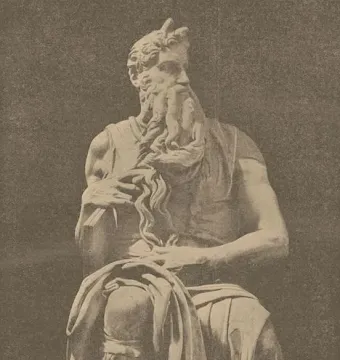
© Unknown authorUnknown author · Public domain
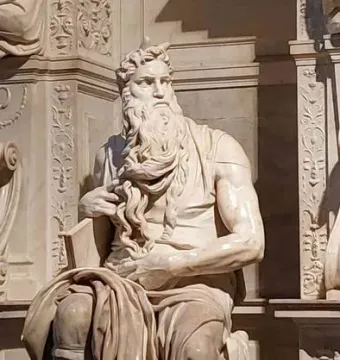
May 2022 © Lszilagyi · CC BY-SA 4.0
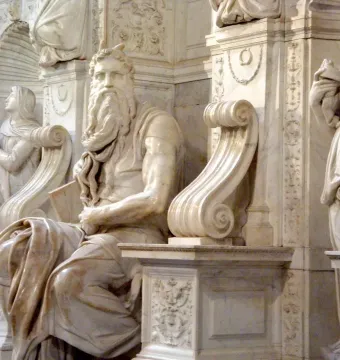
© Jorge Cortell · CC BY 3.0
Identification | |
| Title | Moses |
| Original Italian title | Mose |
| Original title in Ukrainian | Мойсей |
| Type | Marble sculpture |
| Original title | Moisés (Mosè) |
Creator | |
| Artist | Michelangelo Buonarroti |
| Artist nationality | Italian |
| Art period | High Renaissance |
| Work period | 1513–1516 |
Historical context | |
| Role in later tomb scheme | Became the centerpiece of the reduced final composition |
| Interpretation of related drawing | The acorns may allude to the heraldic symbol of the Della Rovere family |
| Related drawing | A drawing for a large bronze relief of the Miracle of the Manna, probably dated 1505–1506, now in New York |
| Associated works | The sculptures Rebellious Slave and Dying Slave |
| Original planned companions | Moses, Saint Paul, and the personifications of Active Life and Contemplative Life |
| Allegorical figures | The Active Life and the Contemplative Life were personified by Leah and Rachel |
| Placement in tomb scheme | Intended for the upper register of the tomb, at the center of the first order |
| Original tomb design | A rectangular mausoleum measuring 10.8 × 7.2 m, with three tiers narrowing upward like a pyramid and surrounded by about forty statues |
| Original tomb location | The choir of the main nave of St. Peter's Basilica, Rome |
| Original tomb project | Part of the tomb of Pope Julius II |
| Commissioned by | Pope Julius II |
| Commission date | 1505 |
| Date | c. 1513–1516 |
| Later tomb revision | The tomb project was repeatedly reduced; by the 1542 contract it had become a simple wall tomb with less than one-third of the original figures |
Location and ownership | |
| Current location | Basilica of San Pietro in Vincoli, Rome |
| Church patronage | Patronized by the della Rovere family |
| Julius II's burial | Julius II was buried in St. Peter's Basilica |
History and restoration | |
| Anecdote | After finishing the statue, Michelangelo reportedly struck it with a hammer and said, 'Why don't you speak?' |
| Completion date | Completed during one of the resumptions of work in 1513 |
| Retouching | Retouched in 1542 |
| Later modification theory | After March 1542, Michelangelo may have rotated the head and added a dynamic twist to the body |
Discovery and provenance | |
| Copy made | A copy was made in 1900, financed by businessman Helmut Toepfer |
| Copy's first museum | Museum of the City in Szczecin |
| Copy transfer | Transferred to Warsaw in 1948 as a gift for the rebuilding capital |
| Copy's later location | Academy of Fine Arts, Warsaw |
| Copy's return | Returned to the museum in Szczecin in 2016 |
Physical characteristics | |
| Depicted moment | Shortly after descending from Mount Sinai, in anger over the Golden Calf |
| Depicted figure | The biblical prophet Moses |
| Composition | Full-round figure |
| Pose | Seated, with the body turning to the left |
| Scale | Larger than life-size because of the elevated placement |
| Height | 235 cm |
Materials | |
| Material | White marble |
| Material of related relief | Bronze |
Technique | |
| Viewing angle | Designed to be viewed from below |
Appearance | |
| Attributes | The Tablets of the Law under one arm; the other hand stroking the beard |
| Body and drapery | Powerful, tense figure with protruding muscles, swollen veins, large heavy-looking legs, and detailed folds in a tunic |
| Head and hair | Flowing hair and a powerful grim expression |
| Horns | Two horns above the eyes, emerging from beneath the hair |
| Clothing | Tunic |
| Hand position | Right hand on the Tablets of the Law; with three fingers the middle of the beard is grasped, and the left hand touches the end of the beard |
| Facial expression | A grim look with tremendous anger |
Iconography and meaning | |
| Western tradition | Moses is shown with horns according to Western iconographic tradition |
| Michelangelo's temperament | The anger is associated with Michelangelo's explosive temperament |
| Relation to David | Like David, the statue creates inner tension through different treatment of the two sides |
| Sistine Chapel resemblance | The face of Moses resembles God in the Sistine Chapel ceiling frescoes |
| Frommel interpretation | Moses averts his gaze from the altars in the apse and transept where the chains of Saint Peter were venerated and indulgences granted to pilgrims, as if he had seen a new golden calf |
| Psychological interpretation | A highly studied psychological work, revealing thought through gesture and gaze |
| Freud interpretation | Freud read the statue as charged with emotional intensity and possibly demonic force; he also argued that Moses is dropping the tablets in front of the people who worshipped the golden calf |
| Alternative interpretation | The sculpture may allude to the medieval concept of man as a microcosm, with the beard symbolizing water, the hair fire, and the drapery earth |
| Biblical association | Moses bringing the tablets of the Law to reform his people |
| Alternative horn explanation | Some scholars see the horns as a possible antisemitic implication, while others treat them as a conventional translation-based motif |
| Narrative interpretation | Moses is often read as reacting to the Israelites worshipping the Golden Calf and preparing to smash the tablets of the Law |
| Horn interpretation | Derived from the Vulgate translation of Exodus 34, where qāran was rendered as cornuta; in the Hebrew context it probably means 'radiant' or 'emitting rays' |
| Neoplatonic symbolism | The right side is associated with stability and divinity, and the left side with danger and evil |
| Four elements interpretation | Earth: the leg and cave-like folds of the robe; Air: the flaring nostrils; Water: the beard like a waterfall; Fire: the horns |
| Interpretation as portrait | Seen as an idealized portrait of Pope Julius II |
| Relation to Julius II | The work compares the pope to the prince of the Hebrews and replaces the pope with the biblical figure that best represented him |
Significance | |
| Art historical significance | One of Michelangelo's main works and one of the most important monumental statues of the High Renaissance |
| Technical achievement | The delicacy of features such as the flowing hair is considered a remarkable technical achievement |
| Reception by Roman Jews | According to Vasari, Rome's Jewish population came every Saturday to admire the statue |
| Vasari's comments | Giorgio Vasari praised the drapery, the muscles of the arms, the bone structure, veins, and nerves |
| Freud article | Sigmund Freud wrote an article about the work in 1914 |
| Interpretive significance | According to Ernesto Fischer, the work embodied the Renaissance ideal of man and challenged society to embody that ideal |
Other | |
| Related source theory | In a 2008 book, Benjamin Blech hypothesized that in the original placement the horns would have reflected light and made Moses' face seem to emit a supernatural glow |
| Associated sculptor | Leonardo Sormani, with collaboration from Prospero Antichi |