
The Sacrifice of Isaac
The Sacrifice of Isaac is a marble sculpture by Donatello and Nanni di Bartolo, dating to 1421. It originally came from the niches of the third tier of Giotto’s Campanile and was made to fit the standard shape of that niche, with two figures occupying the space of one. The life-size white marble group measures 188 x 56 cm and is now preserved in the Museo dell’Opera del Duomo in Florence. The subject is the only one clearly identified among the statues on this side. The figures are arranged with strong dynamism, and Abraham is shown at the moment he seems to have received the angel’s command to stop, while Isaac recoils to the right.
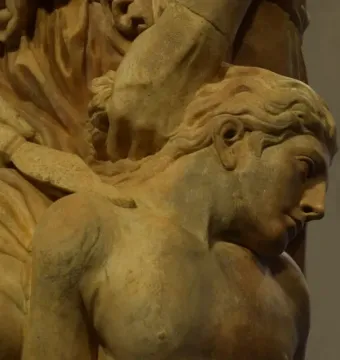
June 2019 © George M. Groutas · CC BY 2.0
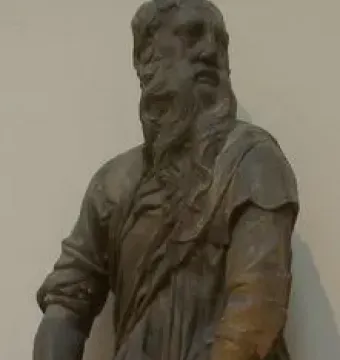
July 2007 © sailko · CC BY 2.5
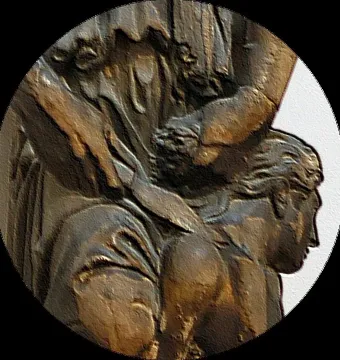
© Carulmare · CC BY 3.0
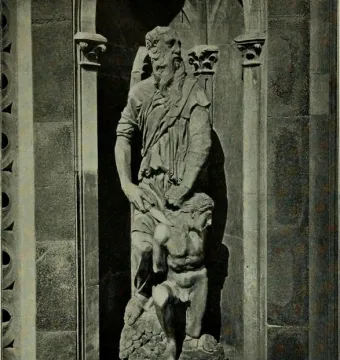
1904 © Internet Archive Book Images · No restrictions
June 2019 © George M. Groutas · CC BY 2.0
Identification | |
| Title | The Sacrifice of Isaac |
| Type | sculpture |
| Identification status | Among the statues on this side of the campanile, this is the only subject that is clearly identified. |
| Original title | Il Sacrificio di Isacco |
Historical context | |
| Date | 1421 |
| Subject | The biblical episode of the sacrifice of Isaac |
| Biblical source | Genesis |
| Narrative summary | God orders Abraham to sacrifice his son Isaac in Moriah; as Abraham is about to comply, the Angel of the Lord stops him and a ram is sacrificed in Isaac's place. |
Creator | |
| Artists | Donatello and Nanni di Bartolo |
| Attribution | Modern critics tend to attribute the work predominantly, if not exclusively, to Donatello. |
| Collaboration | The commission suggests collaboration between Donatello and Nanni di Bartolo, but this is not certain. |
| Commission date | 10 March 1421 |
| Workshop context | Donatello accepted the commission for both himself and his assistant, following common workshop practice. |
Discovery and provenance | |
| Museum transfer | Transferred to the museum in 1937; copies were placed outdoors in its former location. |
| Current location | Museo dell'Opera del Duomo, Florence |
| Associated ensemble | One of the statues on the east side of the campanile, alongside the Beardless Prophet by Donatello, the Bearded Prophet by Nanni di Bartolo, and the Thoughtful Prophet by Donatello. |
| Intended location | The third level of Giotto's Campanile for Santa Maria del Fiore, on the east side, within the bell tower's niche sculpture system. |
| Original location | A niche on the east side of Giotto's Campanile in Florence, third from the left, facing Brunelleschi's dome. |
Physical characteristics | |
| Dimensions | Life-size; 188 x 56 cm |
| Composition | Group of two figures |
| Spatial design | The two figures occupy the space of a single figure, fitting the standard shape of the niche it originally occupied. |
| Stylistic feature | Movement is conveyed through the torsion and anatomy of the bodies rather than through drapery. |
| Stylistic feature | Despite being a two-figure group, it occupies the space of one figure. |
| Spatial interaction | Abraham's outer foot extends beyond the niche, projecting into external space toward the viewer. |
Materials | |
| Material | White marble |
Appearance | |
| Isaac's pose | Isaac draws back calmly, leaning to the right. |
| Depicted moment | The moment when Abraham has just received the angel's instruction to stop the sacrifice. |
| Isaac's appearance | Isaac is nude and quite muscular. |
| Abraham's action | Abraham holds a knife near Isaac's neck and grips Isaac by the hair with his other hand. |
| Abraham's pose | Abraham has one leg resting on a bundle of wood. |
Significance | |
| Subject choice | The choice of subject was not unprecedented; it had already been central to the 1401 competition for the north door of the Florence Baptistery. |
History and restoration | |
| Condition before restoration | Darkened by atmospheric agents. |
| Restoration | Restored and cleaned in 2009. |