
Bernward Column
The Bernward Column, also known as the Christ Column, is an elaborately worked bronze column made around 1020 for the Church of St. Michael in Hildesheim, Germany. Commissioned by Bernward, the thirteenth bishop of Hildesheim, it is regarded as a masterpiece of Ottonian art. Its spiral reliefs show scenes from the life of Jesus, modeled on Trajan’s Column, and it was originally topped by a cross or crucifix. The column was later moved to a courtyard and then to Hildesheim Cathedral. During the cathedral restoration from 2010 to 2014, it was returned to its original location at St. Michael before being placed back in the cathedral in 2014.
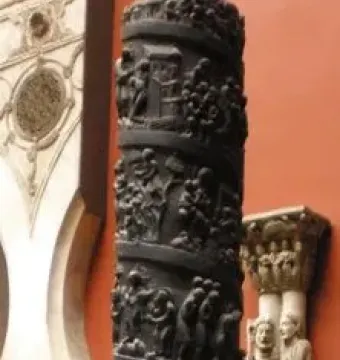
© va_va_val · CC BY-SA 2.5
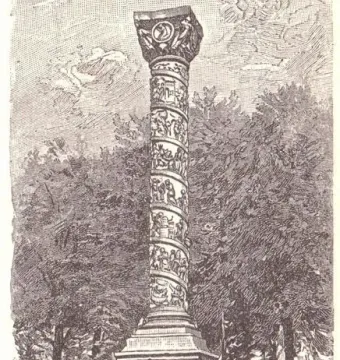
© Unknown authorUnknown author · Public domain
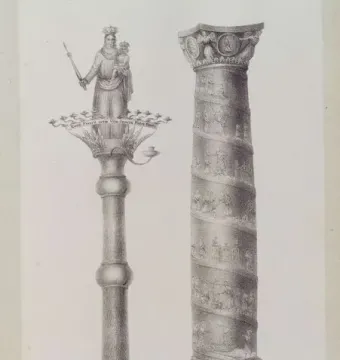
January 2020 © Original creator (printer) unknown; scanned print from Europeana (providing institution: Herzog August Bibliothek Wolfenbüttel) · CC BY-SA 4.0
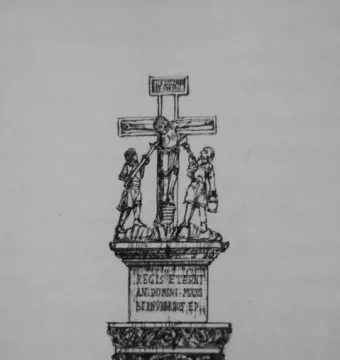
May 2015 © Gallistl/Carpiceci · CC BY-SA 4.0
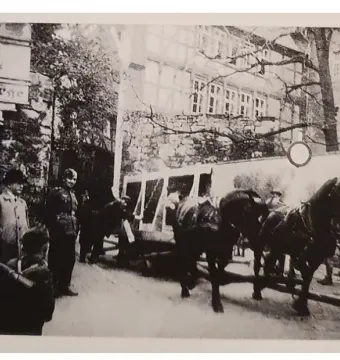
June 1942 © Bistumsarchiv Hildesheim, Nachlaß Sendker · CC BY-SA 4.0
Identification | |
| Name | Bernward Column |
| Type | Free-standing bronze column with relief bands |
| Other names | Christ Column; Christ Column (German: Christussäule, Bernwardssäule); Christussäule; Bernwardssäule; Colonna di Bernoardo |
Historical context | |
| Date | circa 1020 |
| Artistic style | Ottonian art; early Romanesque |
Creator | |
| Patron | Bernward, 13th Bishop of Hildesheim |
| Attribution | Believed to have been made personally by Saint Bernward |
Discovery and provenance | |
| Commissioned for | Church of St. Michael, Hildesheim, Germany |
| Original location | St. Michael's Church (Church of Saint Michael, Michaeliskirche), Hildesheim, Germany, in the east choir under the triumphal arch behind the altar |
| Original setting | A triumphal cross on top, an altar in front, and a wheel chandelier above; the arrangement was modelled on the Church of the Holy Sepulchre and the forehall of Solomon's Temple |
| Current location | Hildesheim Cathedral, Hildesheim, Lower Saxony, Germany |
| Location history | Moved to the cathedral square in 1810; transferred into Hildesheim Cathedral in 1893; returned to St. Michael's from 30 September 2009 to August 2014 during cathedral restoration; now back in Hildesheim Cathedral |
| Relocation and preservation history | Saved from planned destruction in 1723, 1760, and 1810; conserved in 1871; evacuated in 1942 for wartime storage and survived the destruction of the cathedral in 1945 |
| Inspiration | Trajan's Column; also the Column of Marcus Aurelius in Rome |
Physical characteristics | |
| Original top element | A triumphal cross / crucifixion group on a capital |
| Capital | Original capital lost; later replaced by a wooden imitation and then by a bronze capital in 1871; original appearance uncertain, though figural decoration is indicated by a 1730 engraving |
| Relief zone height | About 45 cm each |
| Original height | More than 6 m; about 2.5 m taller than today |
| Diameter | 58 cm |
| Height | 379 cm |
Materials | |
| Material | Bronze |
Technique | |
| Manufacturing technique | Lost-wax casting |
Appearance | |
| Form | Ascending spiral frieze; spiral arrangement similar to Trajan's Column |
Iconography and meaning | |
| Subject matter | Scenes from the life of Jesus, beginning with the Baptism in the Jordan and ending with the Entry into Jerusalem |
| Specific emphasis | Christ as a model of just and pious kingship; the execution of John the Baptist by King Herod Antipas is given unusual prominence |
| Symbolic context | Part of Bernward's artistic and architectural program to present Hildesheim as a 'Northern Rome' and reflect a renewed Christian Roman Empire under the Ottonian dynasty |
Location and ownership | |
| Associated works | Complements the Bernward Doors in Hildesheim Cathedral |
Significance | |
| Art historical significance | Considered a masterpiece of Ottonian art |
| Historical importance | The earliest known representation of a biblical narrative in sculpture; the earliest free-standing bronze sculpture in Western Europe |
| World Heritage significance | Part of the ensemble of artworks whose outstanding importance contributed to UNESCO World Heritage status for Hildesheim |
Other | |
| Associated persons | Bernward of Hildesheim; Otto III; Anton Blum; Friedrich Küsthardt; Hermann Deckert |