
Querini Diptych in the Museo di Santa Giulia
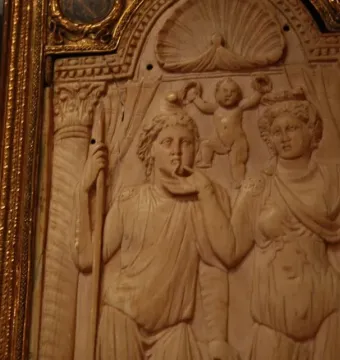
The Queriniano diptych is a Late Antique ivory diptych, probably made in the 5th century and likely created to celebrate a wedding. Known in Italian as the Dittico Queriniano, it was acquired by Cardinal Angelo Maria Querini, who left it to the city for public display. The work later entered the Museo dell'Era Cristiana in the 19th century and is now part of the collections of the Museo di Santa Giulia in Brescia. One wing bears an engraving suggesting earlier ownership by the 15th-century nobleman Pietro Barbo, and part of one cornice was restored in the 19th century. The panels are interpreted as depicting two mythological couples, possibly Diana and Endymion and Phaedra and Hippolytus.
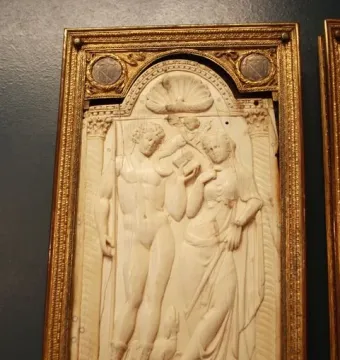
June 2011 © Giovanni Dall'Orto · Attribution
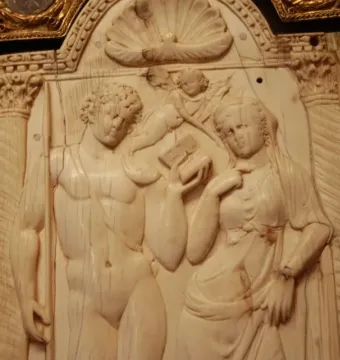
June 2011 © Giovanni Dall'Orto · Attribution
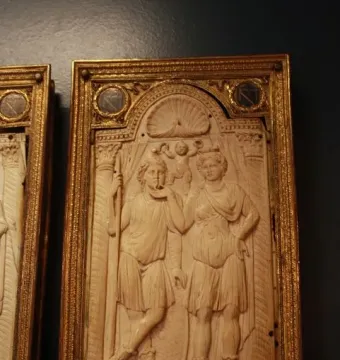
June 2011 © Giovanni Dall'Orto · Attribution
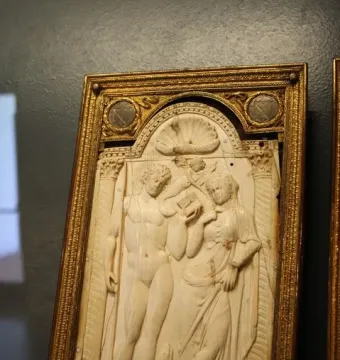
June 2011 © Giovanni Dall'Orto · Attribution
June 2011 © Giovanni Dall'Orto · Attribution
Identification | |
| Title | Querini diptych |
| Object type | Late Antique ivory diptych |
| Number of panels | Two |
| Alternative title | Dittico Queriniano |
Historical context | |
| Date | 5th century |
| Original function | Possibly made to celebrate a wedding |
Creator | |
| Attribution | Probably made by two different artists |
| Style of right panel | More closely linked to classical art |
| Style of left panel | Later, more rigid style, characteristic of the 5th century |
Discovery and provenance | |
| Collection history | Exhibited in the Museo dell'Era Cristiana in the early 19th century, later became part of the Museo di Santa Giulia collection |
| Art-historical status | Unknown in early art-historical literature |
| Provenance note | One wing bears an engraved name identifying Pietro Barbo, a 15th-century previous owner |
| Bequest | Bequeathed by Querini to the municipality of Brescia in 1755 |
| Acquisition date | First half of the 18th century |
| Acquired by | Cardinal Angelo Maria Querini |
Physical characteristics | |
| Dimensions | 25.5 × 26.8 × 26 cm |
Materials | |
| Material | Ivory |
| Frame | The left panel is in a gilded copper frame; Querini had a matching frame made for the right panel |
History and restoration | |
| Alteration | Part of the cornice of one wing was made in the 19th century |
Appearance | |
| Left panel depiction | Traditionally identified as Diana and Endymion, but more plausibly Venus and Aeneas |
| Cupid's attributes | The front-facing Cupid carries two myrtle crowns |
| Aeneas depiction | Shown with a Phrygian cap, lance, and shield |
| Venus depiction | Shown as a huntress with a short tunic and cothurni, but with the hairstyle in the typical Venus knot |
| Central figure | A winged Cupid stands between the two couples |
| Phaedra depiction | Leaning slightly back in attentive expectation |
| Hippolytus depiction | Shown nude except for a lance and cothurni, with a hunting dog at his feet, reading Phaedra's love letter |
| Architectural setting | Each scene is framed by columns with Corinthian capitals and an arch topped by a shell |
| Composition | The two panels share a closely related figural and architectural composition, suggesting they belonged to one work |
Iconography and meaning | |
| Identification uncertainty | The left scene is uncertain because Endymion is usually shown nude and asleep, while Diana-Selene usually wears a long draped garment |
| Possible historical reference | They may allude to an ovation celebrated in the 5th century |
| Myrtle crowns meaning | Roman ovation crowns |
| Cupid meaning | Cupid crowns the left pair and pierces Phaedra, suggesting prosperity and Venus's gift to her son |
| Iconographic interpretation | The composition contrasts Venus and Aeneas as legitimate, fruitful love with Phaedra and Hippolytus as illicit, disastrous love |
| Iconographic source | The encounter of Venus and Aeneas in Book I of Virgil's Aeneid |
| Left panel subject | Traditionally Diana and Endymion; alternatively Venus and Aeneas |
| Right panel subject | Phaedra and Hippolytus |
| Subject matter | Mythological love scenes |
Location and ownership | |
| Current location | Museo di Santa Giulia, Brescia, Italy |
| Collection association | Querini Collection |
| Display location | Collecting and Applied Arts section, in the cases dedicated to the Querini Collection |
| Museum history | First displayed in the Museo dell'Era Cristiana in rooms of the former monastery of Santa Giulia after the museum opened in the early 19th century; permanently placed in the Museo di Santa Giulia after its opening in 1998 |
Significance | |
| Commentary history | Commentaries on the diptych are known from the 18th century |