
Bull Palette (E11255)
Bull Palette (E11255) is a fragment of an Ancient Egyptian greywacke palette carved in low relief and used, at least in principle, as a cosmetic palette for grinding cosmetics. It dates to Naqada III, the final two centuries of the fourth millennium BC, immediately before the Early Dynastic Period. Only part of the original object survives, and both sides are carved with different figures. The obverse shows a large circular fortified city identified by an interior hieroglyphic sign, while the reverse includes imagery that later became hieroglyphs, including a clenched fist, five standards, and figures such as hippopotamuses, the Sacred Ibis, the Horus-Falcon, and the thunderbolt of Min. It is in the collection of the Louvre, inventory no. E11255.
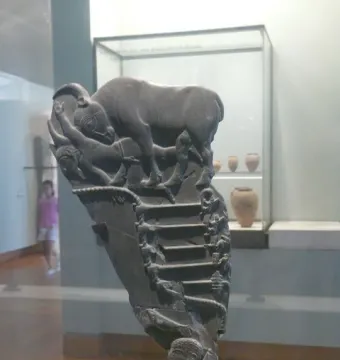
© Kurohito · CC BY-SA 3.0
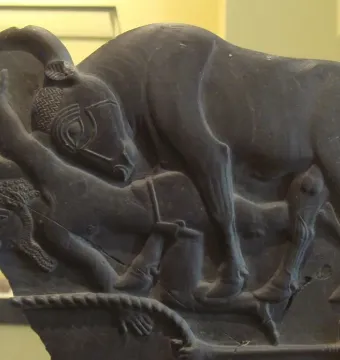
January 2006 © ALFGRN · CC BY-SA 2.0
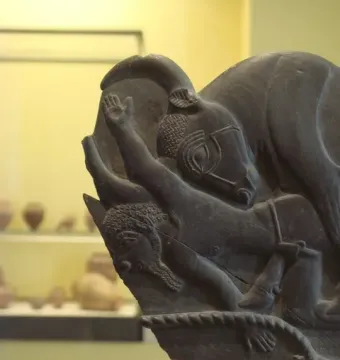
January 2006 © ALFGRN · CC BY-SA 2.0
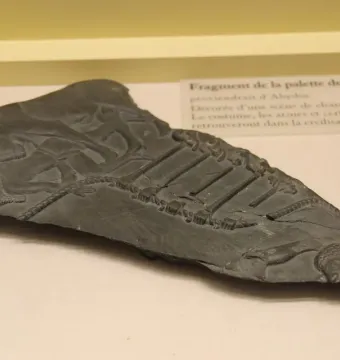
July 2016 © Gary Todd · CC0
January 2006 © ALFGRN · CC BY-SA 2.0
Identification | |
| Title | Bull Palette |
| Alternative title | Palette celebrating a victory |
| Alternative title | Palette of the Celebration of Victory |
| Inventory number | E11255 |
| Object type | Ancient Egyptian cosmetic palette fragment |
Historical context | |
| Culture | Ancient Egypt |
| Period | Naqada III (late Predynastic period, circa 3300–3100 BC; the final two centuries of the 4th millennium BC, immediately before the Early Dynastic/Thinite Period) |
Creator | |
| Artist | Unknown |
Discovery and provenance | |
| Museum collection | Louvre Museum |
Location and ownership | |
| Current location | Louvre Museum, Paris; Sully Wing, 2nd floor, Room 20, Showcase 2 |
| Museum section | Sully Wing, 2nd floor, Room 20, Showcase 2 |
Physical characteristics | |
| Decoration | Decorated on both sides |
| Dimensions | 26.5 cm high; 14.5 cm wide |
| Condition | Broken fragment; only part of the upper half survives, with major losses and fractures; the right half is missing |
Materials | |
| Material | Greywacke (Ancient Egyptian greywacke / grauwacke; possibly mudstone or schist according to one source) |
Technique | |
| Technique | Carved and relief-decorated, with etched details; the relief is described as low relief / medium-low relief |
Appearance | |
| General composition | Fragment of a palette with a ruler-bull motif, fortified cities, standards, and war imagery |
| Obverse imagery | A bull representing the ruler crushes a warrior; beneath it are five nome standards ending in clenched hands holding a rope, and a partially preserved captive head at the bottom |
| Reverse imagery | A similar ruler-bull motif appears at the top; below are two fortified cities shown as schematic plan-like enclosures with walls and buttresses, one larger than the other, containing a lion with a vessel, a bird, and related details; standards and an encircling rope also appear on this side |
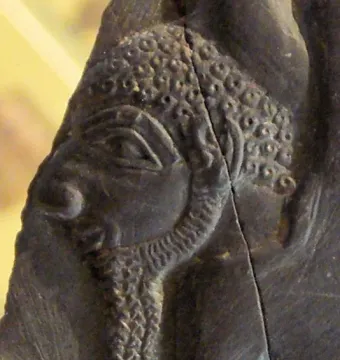
| Preserved details | Preserved fragments include a warrior’s head with eye, ear, beard, necklace cord, and stylized close-cropped hair, plus part of a leg with the knee broken away |
Iconography and meaning | |
| Main subject | Bull overpowering a warrior, commonly interpreted as the ruler or king |
| Secondary motifs | Fortified city enclosures, a lion and vessel motif, a wading bird, five standards, and clenched hands or fists holding a rope |
| Interpretation | The imagery is probably war-related and may commemorate a military victory and the struggle for the unification of Upper Egypt or all Egypt by people from Nekhen (Hierakonpolis) and their allies |
| Hieroglyphic interpretation | The city-name motif has been read as archaic hieroglyphic writing; Schott read the "pot and lion" as "Ma - Nu" ("Lion Mountain") |
| Scholarly notes | Several identifications are tentative or disputed, including the obverse/reverse assignment, the interpretation of the bull as a king, the captive’s identity, and the reading of the city signs |
History and restoration | |
| Preservation status | Only the upper portion survives; both front and reverse are incompletely preserved |
Other | |
| Related object | Narmer Palette used for comparison |
Significance | |
| Importance | Considered one of the more important motifs in the palette corpus and part of the group of Predynastic palettes that anticipate hieroglyphic writing |