
Alexander Sarcophagus
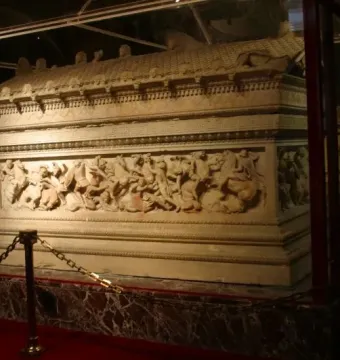
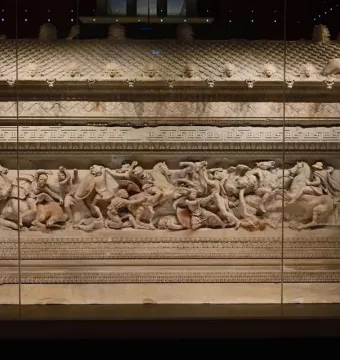
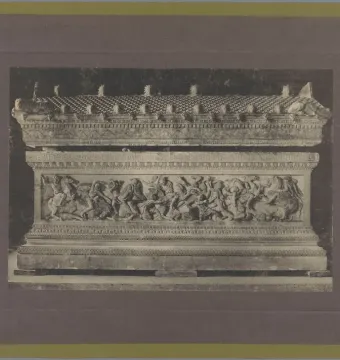
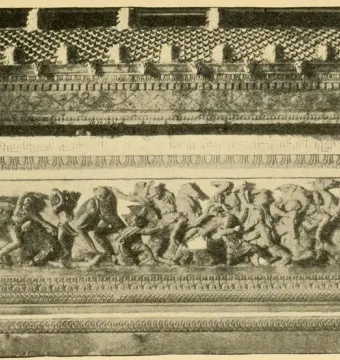
Alexander Sarcophagus is an ancient marble sarcophagus found in Sidon in 1887 by the Ottoman archaeological expedition of Hamdi Bey. It probably belonged to King Abdalonymos of Sidon and is now kept in the Istanbul Archaeological Museum. Dating to 312–310 BCE, it is a rectangular marble chest 3.12 meters long, set on a tall, richly decorated pedestal and topped with a gabled lid and cornice. The surface is covered with figural reliefs, and traces of polychromy have survived. Its long sides show battle and hunting scenes, including Alexander the Great, while the narrow sides depict further combat scenes.
© Nina · CC BY-SA 3.0
April 2023 © Dosseman · CC BY-SA 4.0
1898 © Rijksmuseum · CC0
1899 © Internet Archive Book Images · No restrictions
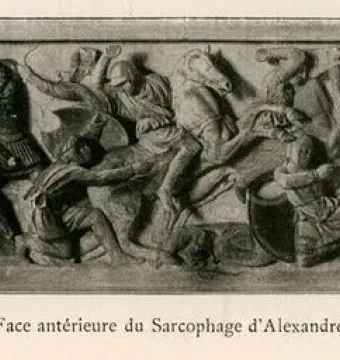
1913 © Hermann Barth · Public domain
Identification | |
| Title | Alexander Sarcophagus |
| Type | Figured Hellenistic marble sarcophagus |
| Alternative names | Sarkofag Aleksandra; Sidon Sarcophagus; Le sarcophage d'Alexandre; Il sarcofago di Alessandro |
Historical context | |
| Date | Late 4th century BC, probably between 325 and 311 BC |
| Origin | Sidon, probably the royal necropolis of Ayaa near Sidon, Lebanon |
Creator | |
| Workshop attribution | Probably made in an Attic or Rhodian workshop; attribution remains debated, with some scholars proposing a Phoenician origin or the workshop of Praxiteles |
Discovery and provenance | |
| Discovery date | 1887 |
| Discoverers | Osman Hamdi Bey and Yervant Voskan |
| Discovery site | Royal necropolis of Ayaa near Sidon, Lebanon |
| Discovery context | Found in a subterranean necropolis divided into two hypogea, probably used as a royal necropolis; one of four large figured sarcophagi found in pairs |
| Probable original owner | Probably commissioned for Abdalonymus, king of Sidon; another hypothesis attributes it to Mazaeus, Persian governor of Babylon |
| Current attribution | Widely accepted not to be Alexander the Great's personal sarcophagus; some scholars identify it with Abdalonymus, others with Mazaeus |
Location and ownership | |
| Current location | Istanbul Archaeological Museum |
Physical characteristics | |
| Support and lid | Set on a high, richly decorated pedestal with a cornice and a gabled lid with pediments |
| Polychromy | Original polychromy survives in traces and was almost completely preserved at discovery; the colors have been fading since then |
| Dimensions | Length 3.12 m |
| Form | Rectangular marble chest in the form of a Greek temple with a gabled roof, pediment, and tiled roof |
Materials | |
| Material | Marble; often identified as Pentelic marble, though this attribution is disputed |
Technique | |
| Decoration technique | High-relief figurative carving |
History and restoration | |
| Restoration | Restored by Osgan Efendi |
| Documentation | The reliefs were documented in color watercolors in 1912 |
| Ancient disturbance | The tomb had already been disturbed by grave robbers in antiquity, who damaged the sarcophagus and removed small silver weapons from the figures |
| Archaeological evidence of disturbance | A 3rd-century BC coin found on the chamber floor was probably lost by the grave robbers |
Appearance | |
| Side 4 scene | Panther hunt, sometimes interpreted as the Battle of Gaza in 312 BC |
| Pediment scene | Murder scene, with Philip III Arrhidaeus killing a kneeling man |
| Narrow side scene | Battle scene interpreted as the death of Perdiccas |
| Long side 2 figures | Alexander the Great, bareheaded and wearing a royal headband, prepares to kill a wounded lion with a spear; Abdalonymus is shown on the left; Hephaestion rides to the right of Abdalonymus; a wounded deer flees on the right |
| Long side 2 scene | Lion and deer hunt, possibly symbolizing Greek-Persian reconciliation |
| Long side 1 figures | Alexander the Great, wearing a lion skin and mounted on a rearing horse, aiming a sarissa at a Persian; Hephaestion in the center; Perdiccas on the right; a Persian soldier collapsing from the king's blow |
| Long side 1 scene | Battle between Greeks and Persians, probably the Battle of Issus |
Iconography and meaning | |
| Name origin | Named after the mounted warrior in a lion helmet, usually identified with Alexander the Great |
| Iconography | The conqueror is shown with a lion skin like Heracles, emphasizing his divinity; the work also includes Persian, Asian, and mythological motifs, including lions with Asian attributes and creatures with three ram horns on feline heads |
| Historical interpretation | The relationship between the historical authenticity of the scenes and their general representation of rulership is disputed; the sculpture is also associated with Greek-Persian reconciliation |
Significance | |
| Stylistic significance | The reliefs combine late Classical and early Hellenistic traits, are often described as largely Greek in style, and show strong cross-cultural mixing |
| Scholarly style views | Karl Schefold described the work as still-classical and not influenced by Lysippos; other scholars have associated it with Attic sculpture, six Ionian sculptors working in an Attic idiom, or a workshop of at least four sculptors |
| Scholarly dating views | The exact date is uncertain; the continuous depiction of Abdalonymus is used to argue for a date before his death, and some scholars place the work after 332 BC or before roughly 311 BC |
| Related archaeological comparison | Decorative elements of a coffin from the Tomb in Amphipolis were noted to resemble the Alexander Sarcophagus |