
Bull of Osuna
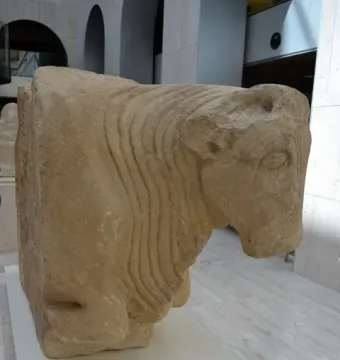
Bull of Osuna is an Iberian sculpture carved by the Turdetani and found in Osuna, Seville, at the archaeological site of the ancient Iberian city of Urso. Dating from the late Iberian period, it is a bas-relief of a reclining bull carved into a stone block and originally formed part of a funerary monument, where it would have had a protective function. The sculpture is displayed in the National Archaeological Museum of Spain in Madrid, alongside other Iberian works, under inventory number 38416. It presents a standing bull treated in a realistic yet rigid manner, with deeply incised eyes, an open mouth, and a slender body with pronounced hips.
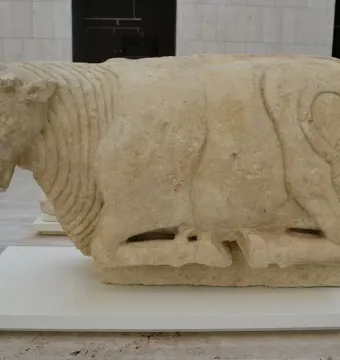
· CC BY-SA 4.0
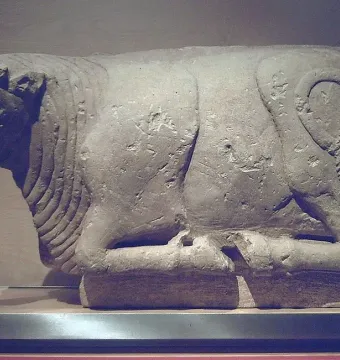
· CC BY-SA 2.0
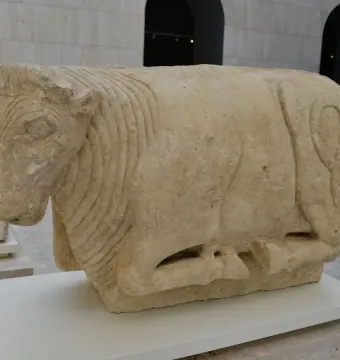
· CC BY-SA 4.0
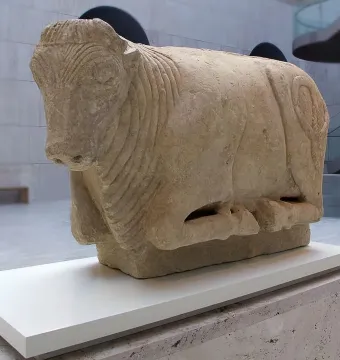
August 2014 © jacinta lluch valero · CC BY-SA 2.0
· CC BY-SA 4.0
Identification | |
| Title | Bull of Osuna |
| Subject | A reclining bull |
| Original name | El Toro de Osuna |
| Type | Sculpture |
Historical context | |
| Date | End of the 2nd century BCE |
| Cultural period | Iberian period |
Creator | |
| Attributed maker | The Turdetani people |
| Workshop | Probably a Turdetani workshop |
Discovery and provenance | |
| Discovery site | Archaeological site of the ancient Iberian city of Urso (Osuna), Seville, Spain |
| Historical origin | Remnant of the ancient Iberian city of Urso |
| Location | Near Seville, Spain |
| Discovery location | Osuna, Seville, Spain |
Physical characteristics | |
| Hips | Pronounced |
| Dimensions | 56 cm high, 121 cm long, 31 cm thick |
| Condition of the horns | Broken |
| Condition of the ear tips | Broken |
| Condition of the tail | Broken |
| Condition of the legs | Broken above the knee |
| Mouth | Slightly open |
| Body | Slender |
| Throat dewlap | Rendered with curved and parallel incisions |
| Eyes | Surrounded by deep incisions that extend above the nose |
| Description | A bull sculpture |
| Style | Realistic and rigid |
| Sculpture type | Standing bull |
| Form | Low relief in an ashlar block |
Materials | |
| Material | Limestone |
| Support material | Stone ashlar block |
Technique | |
| Technique | Carved in stone / ashlar |
Iconography and meaning | |
| Function | Part of a funerary monument |
| Interpreted function | Protective function within the funerary monument |
Location and ownership | |
| Current location | National Archaeological Museum of Spain, Madrid |
| Inventory number | 38416 |
| Museum context | Exhibited together with various sculptures from the Iberian period |