
Ferdinando I de' Medici Equestrian Statue
The equestrian statue of Ferdinando I de’ Medici stands in Piazza della Santissima Annunziata in Florence, aligned with Via dei Servi and visible from Piazza del Duomo through the basilica’s central portico arch. It is one of the last works of Giambologna, begun as his international fame grew for equestrian monuments and completed after his death by his assistant and successor Pietro Tacca. The full-scale model was defined in 1602 and cast in bronze that autumn, but the monument was not finished until 1607 and installed in October 1608 for the wedding of Cosimo II and Maria Magdalena of Austria. The bronze came from Turkish galley cannons captured by the Knights of the Military Order of Saint Stephen. Restored around 1995, the statue remains a notable Florentine landmark.
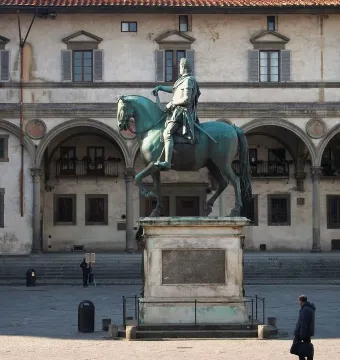
February 2011 © Joanbanjo · CC BY-SA 3.0
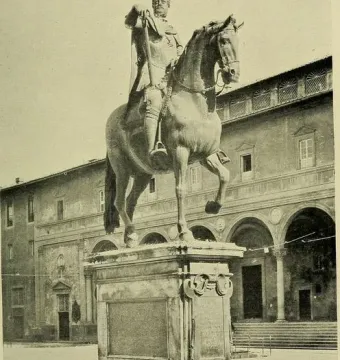
1919 © Internet Archive Book Images · No restrictions
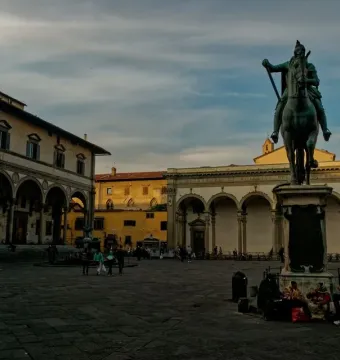
April 2010 © Txllxt TxllxT · CC BY-SA 4.0
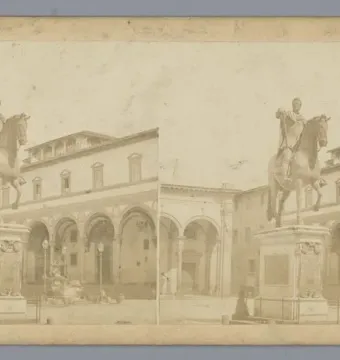
© Rijksmuseum · CC0
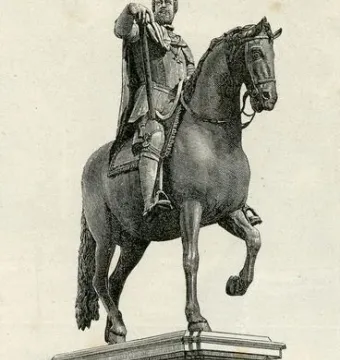
1894 © Incisore anonimo · Public domain
Identification | |
| Title | Equestrian statue of Ferdinando I de' Medici |
| Subject | Ferdinando I de' Medici, Grand Duke of Tuscany |
| Type | Equestrian statue |
Creator | |
| Artist | Giambologna |
| Assistant / finisher | Pietro Tacca |
Historical context | |
| Scale model finalized | 1602 |
| Installation occasion | Wedding festivities for Prince Cosimo II and Maria Maddalena of Austria |
| Installation date | October 1608 |
| Completion date | 1607 |
| Cast date | Autumn 1602 |
| Design collaboration | Giambologna relied on Pietro Tacca from the design stage |
| Commissioned by | Cosimo II de' Medici |
| Connection to earlier work | The commission is linked to Ferdinando I de' Medici's earlier commission of the equestrian statue of Cosimo I in Piazza della Signoria |
| Commission context | Commissioned after Giambologna had gained great international popularity with his equestrian statues, which were in demand by major European rulers |
| Status in artist's career | One of Giambologna's last works |
Materials | |
| Material | Bronze |
| Bronze source | Cannons from Turkish galleys defeated by the Knights of the Military Order of Saint Stephen |
| Commemorated event | The bronze source commemorates the victory over the Turkish galleys |
Appearance | |
| Inscription | "De' metalli rapiti al fero Trace" |
| Satirical meaning | A reminder of the dukes' heavy taxation |
| Satirical inscription | "De' denari rubati in guerra e in pace" |
| Inscription location | On the horse's girth strap |
| Depicted figure | Ferdinando I de' Medici shown mounted on horseback |
| Bee symbolism | 91 bees in total: 90 worker bees and one queen bee, arranged in five concentric staggered circles |
| Heraldic device | A swarm of bees with the motto MAIESTATE TANTUM |
| Base | Designed and executed by Pietro Tacca; marked by two large red granite panels |
| Chest emblem | Cross of Saint Stephen on the chest |
| Clothing | Armor, including a cuirass |
Location and ownership | |
| Location | Piazza della Santissima Annunziata, Florence |
| Placement | Placed scenographically on the axis of Via dei Servi, in the center of the piazza |
| Visibility | Visible from Piazza del Duomo and framed by the central arch of the portico of the Basilica of the Santissima Annunziata |
| Symbolic reference | Its placement refers to the devotion of the Grand Duke and the Medici family to the Basilica of the Santissima Annunziata |
| Urban role | Landmark and focal point of the square |
History and restoration | |
| Pedestal plaques date | 1640 |
| Restoration date | Around 1995 |
| Restoration project | Project by Carlo Francini |
Significance | |
| Stylistic contrast | The horseman differs from the heroic classical-style image developed by Bandinelli for Cosimo I |