
Emerald Buddha
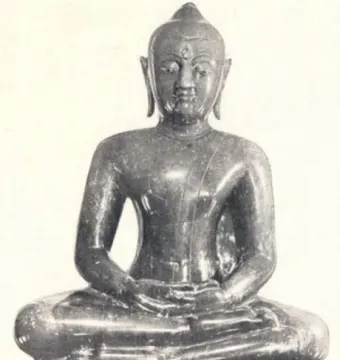
The Emerald Buddha is Thailand’s national shrine, a Buddha statue about 66 cm high including its throne. It is worshipped at the Temple of the Emerald Buddha, Wat Phra Kaeo, officially Wat Phra Si Rattana Sadsadaram, in Bangkok. Despite its name and color, it is not made of emerald but of jade. The statue shows Buddha in the virasana, or Indian heroic pose, with the right leg resting over the left and the hands in the Samadhi Mudra of meditation. It has three different robes, changed three times a year in a ceremonial rite by the king or a princely deputy, with each robe suited to a different season.
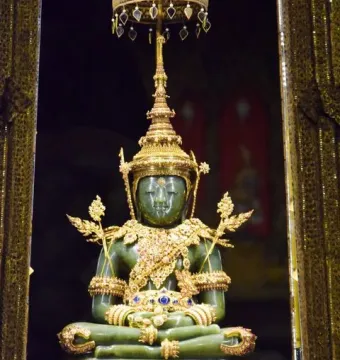
March 2021 © กสิณธร ราชโอรส · CC BY-SA 4.0
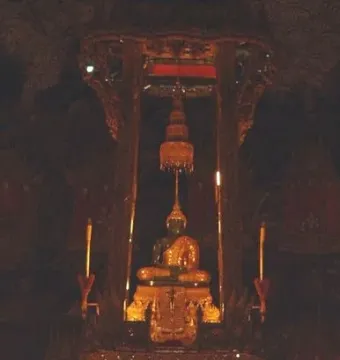
© Gakuro · CC BY-SA 3.0
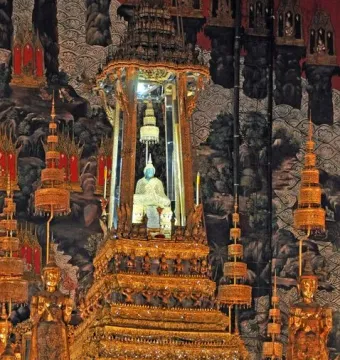
February 2009 © Dennis G. Jarvis · CC BY-SA 2.0
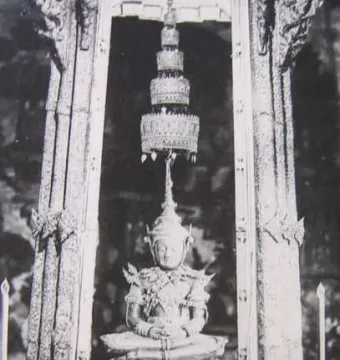
1873 © Unknown · Public domain
© Fine Arts Department · Public domain
Identification | |
| Title | Emerald Buddha |
| Thai name | Phra Kaeo Morakot (พระแก้วมรกต) |
| Official name | Phra Phuttha Maha Mani Ratana Patimakorn (พระพุทธมหามณีรัตนปฏิมากร) |
| Alternative names | Statue of Buddha Shakyamuni; Il Buddha di Smeraldo; Smaragd-Buddha |
| Type | Buddha statue |
| Subject | Buddha Shakyamuni (Gautama Buddha) |
| Status | National shrine of Thailand; national treasure of Thailand; palladium of Thailand |
Historical context | |
| Early provenance note | Some art historians attribute it to the Chiang Saen style, implying an origin in Lanna |
| Early documented presence | Historical sources place it in northern Thailand in 1434 |
| Discovery context | Found in a chedi destroyed by lightning; the figure had been covered with gilded stucco |
| Legendary origin | According to legend, it was created in Pataliputra, India, in 43 BC by Nagasena at the request of an Indian monk, then travelled via Sri Lanka, Java, Myanmar, Cambodia, and Angkor before reaching Thailand |
| Discovery location | Chiang Rai, northern Thailand |
| Discovery date | 1434 |
Creator | |
| Legendary creator | Nagasena |
Physical characteristics | |
| Height | about 66 cm including the throne |
| Posture | Seated in virasana, with the right leg over the left |
| Hand position | Right hand resting loosely on the left hand in the lap, palms upward |
Materials | |
| Former appearance | Originally concealed by gilded stucco, which later cracked to reveal the green stone surface |
| Decoration | Gold garments; gilded or golden robes |
| Material | Green jadeite (not emerald) |
Appearance | |
| Robes | Three seasonal robes, changed according to hot, cool, and rainy seasons |
Technique | |
| Robe change ceremony | The robes are changed three times a year in a ceremonial ritual by the king or a princely representative |
Iconography and meaning | |
| Attributed powers | Believed in Thailand to have magical powers and to avert epidemics |
| Attributed effect | Said to bring legitimacy and prosperity to its possessor |
Location and ownership | |
| Built for | Wat Phra Si Rattana Satsadaram was built specifically to house the statue |
| Current role | Religious and symbolic emblem of the Chakri dynasty; icon of Bangkok |
| Current site within temple | Ubosot (main chapel), center of the building |
| Current location | Temple of the Emerald Buddha (Wat Phra Si Rattana Satsadaram; Wat Phra Kaeo), Bangkok, Thailand, within the Grand Palace complex |
Discovery and provenance | |
| First transfer | Moved from Chiang Rai to Nakhon Lampang, then to Chiang Mai in 1468 |
| Lampang stay | 32 years at Wat Phra Kaeo Don Tao, Lampang |
| Chiang Mai location | Installed by King Tilok of Lanna in the eastern niche of Wat Chedi Luang; stayed there for 83 years |
| Transfer to Luang Prabang | Moved there in 1551 or 1552 under King Setthathirath / Chaiyasettathirat |
| Move to Vientiane | Moved to Vientiane in 1564, where it stayed for 214 years at Wat Phra Kaeo (Vat Phra Kèo) |
| Move to Bangkok | Taken from Vientiane in 1778 or 1779 by Chao Phraya Chakri (Rama I / Thong Duan) and ceremonially installed in Bangkok on 22 March 1784 |
| Thonburi housing | Temporarily housed at Wat Arun in Thonburi after removal from Vientiane |
Other | |
| Name meaning | The name means “Emerald Buddha”; in Thai, “emerald” can mean green rather than the gemstone emerald |