
Marly Horses
Marly Horses is a pair of symmetrical sculptural groups in Carrara marble by the French sculptor Guillaume Coustou the Elder, created between 1743 and 1745. They show rearing horses being restrained by their handlers and were commissioned by King Louis XV to restore the sculptural setting of the park and Château de Marly. Installed at Marly in 1745, the works were later moved to Paris and, after the Revolution, placed near the entrance to the Champs-Élysées. In the 1980s the originals were transferred to the Louvre, where they are now displayed in the Cour Marly. The groups are celebrated for their Baroque dynamism, expressive force, and lasting influence on later artists.
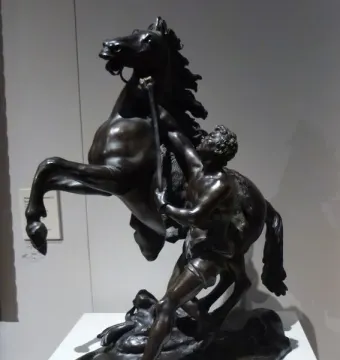
January 2022 © Иван Абатуров · CC BY-SA 4.0
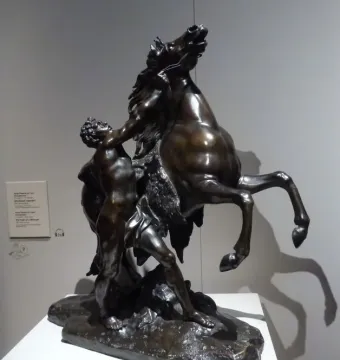
January 2022 © Иван Абатуров · CC BY-SA 4.0
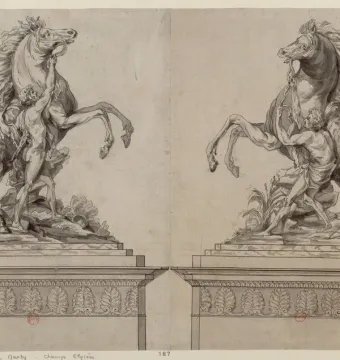
· Public domain
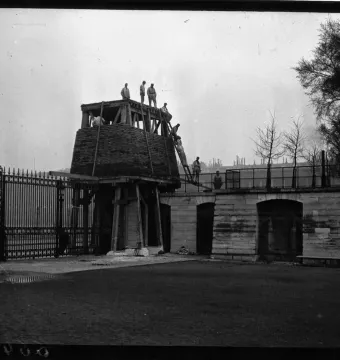
© Agence de presse Meurisse. Agence photographique (commanditaire) · Public domain
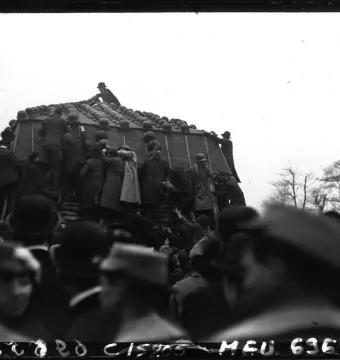
© Agence de presse Meurisse. Agence photographique (commanditaire) · Public domain
Identification | |
| Title | Marly Horses |
| Alternative name | Chevaux retenus par des palefreniers |
| Alternative name | Cavalli tenuti dai palafrenieri |
| Original title | Les Chevaux de Marly |
| Original title | I Cavalli di Marly |
| Type | Sculptural group |
| Number of sculptures | Two symmetrical paired sculptural groups |
| Original language title | Chevaux de Marly |
Historical context | |
| Earlier sculptures moved to | The Tuileries Gardens in 1719 |
| Earlier sculptures replaced | Mercury on Horseback with Pegasus and Fame on Horseback with Pegasus by Antoine Coysevox |
| Purpose of commission | To replace the earlier sculptural groups by Antoine Coysevox at the entrance to the park and château of Marly |
| Commissioned in | 1739 |
| Commissioned by | King Louis XV of France |
Creator | |
| Artist | Guillaume Coustou the Elder |
| Model approval | Approved by the king in 1743 |
| Models used | Coustou drew directly in the royal stables and hired models to pose for the groom figures |
| Influences / models | Late antique sculptural groups of the Dioscuri in Rome, the Horses of Apollo by Gaspard and Balthazar Marsy at Versailles, and Robert Le Lorrain's Horses of the Sun (1737) |
Discovery and provenance | |
| Replaced by copies in | 1984 |
| Relocation supervised by | Architect Serge Macel |
| Copies installed at | The original site near the watering place of the former Château de Marly, Marly-le-Roi, Yvelines |
| Additional authorized copy | An extra copy was authorized for Bouygues Construction headquarters |
| Copies made by | Michel Bourbon |
| Copies installed in | 1985 |
| Copies produced in | An atelier of a Bouygues subsidiary |
| Restored by | Louis-Denis Caillouette |
| Restored in | 1840 |
| Current location of originals | The Louvre Museum, in the former courtyard of the Richelieu wing now called Cour Marly |
| Moved in | 1794 |
| Moved to | Place de la Concorde, Paris |
| Completed and installed | Installed at Marly in 1745 after two years of work |
| Original installation site | The basin known as the Marly watering place (Vivier de Marly), at the entrance to the park of the Château de Marly |
Physical characteristics | |
| Material | Carrara marble |
| Block form | Monolithic marble blocks |
| Technique | Sculpted from monolithic marble blocks |
| Subject | Two rearing horses struggling with their grooms |
| Human figures depicted | Two nude, muscular grooms or stablehands, described as Native American slaves, with quivers |
| Horse depiction | The horses rear up with disheveled manes and dilated nostrils and eyes |
Iconography and meaning | |
| Europe figure description | Figure without attributes |
| America figure description | Male figure of Negro type wearing a feathered hat |
| Allegorical interpretation | One figure is thought to represent America and the other Europe |
| Iconographic character | Non-allegorical and non-mythological subject |
Appearance | |
| Style | Baroque dynamism and expressiveness |
| Stylistic characterization | Tense dynamism, complex outline, pictorial richness of forms, sweep and force of movement, and a vivid sense of struggle and resistance |
| Stylistic balance | Baroque expressiveness is subordinated to strict rhythmic organization and overall unity of impression |
| Artistic effect | A vivid depiction of the struggle between wild and opposing forces |
| Observation of nature | Careful observation from nature, especially in the rendering of equine anatomy and the horses' furious expression |
Significance | |
| Reception | Highly successful and widely reproduced in small-scale replicas |
| Later reception | Successful in the Romantic era |
| Influence on artists | Prefigured Théodore Géricault's fascination with horses, including Races of Wild Horses in Rome (1817) |
| Admired by | Eugène Delacroix and Victor Hugo |
| Influence on other sculpture | Served as one of the prototypes for Peter Clodt's Taming the Horse by Man for the Anichkov Bridge in Saint Petersburg (1838–1843) |
| Art-historical style context | Reflects Coustou's individual style rooted in the grand style of the second half of the 17th century, when Baroque and Classicism coexisted organically |
| Artistic significance | Among Guillaume Coustou's last works; he died in 1746 one year after their completion |
| Modern cultural reference | Used as the logo image for the perfume brand Parfums de Marly from 2009 |
| Later use as image motif | Central motif of the monochrome 819-line RTF/ORTF test card used on TF1 from 1953 to 1983 |