
Medusa
Medusa is a marble sculpture by the Italian artist Gian Lorenzo Bernini, depicting the eponymous figure from classical myth. Its exact date is unknown, but it is likely to have been executed in the 1640s. The work was first documented in 1731, when it was presented to the Palazzo dei Conservatori in Rome. It is now part of the collections of the Capitoline Museums. Unlike other depictions of Medusa, Bernini shows her not as a defeated figure, but as a living monster with the power to turn onlookers to stone.
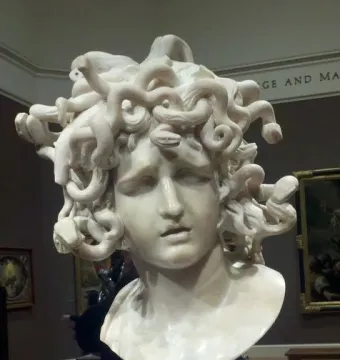
December 2011 © Debra Heaphy · CC BY-SA 3.0
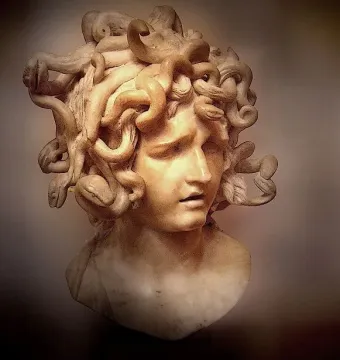
2006 © User:Tetraktys · CC BY-SA 3.0
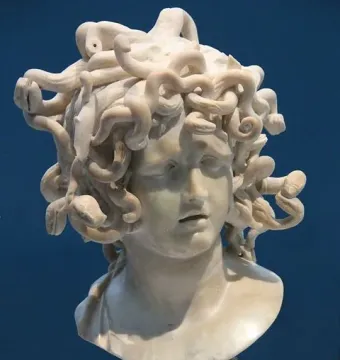
June 2013 © Jean-Pol GRANDMONT · CC BY 4.0
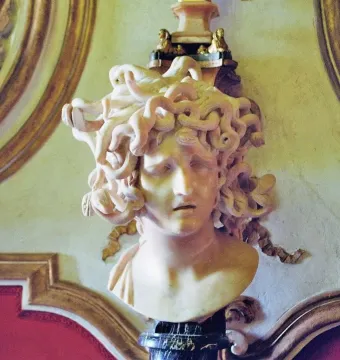
August 2010 © Rabe! · CC BY-SA 4.0
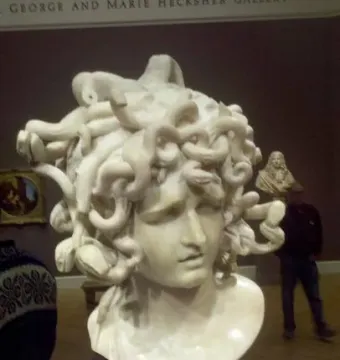
December 2011 © Cullen328 · CC BY-SA 3.0
Identification | |
| Title | Medusa |
| Type | Marble bust |
| Subject | Medusa, the eponymous figure from classical mythology |
Creator | |
| Artist | Gian Lorenzo Bernini |
| Attribution | Generally attributed to Bernini, though authorship has been questioned |
| Artist nationality | Italian |
Historical context | |
| Date | Unknown; probably around 1640, with proposed dates ranging from the late 1630s to the mid-1640s |
Discovery and provenance | |
| Cardinal associated with provenance | Alessandro Bichi (1596–1657), under the protection of Pope Urban VIII and later Pope Alexander VII |
| Possible earlier provenance | Probably passed into the donor's family through Cardinal Alessandro Bichi (1596–1657) |
| Donation date | March 1731 |
| Donor | Marquis Francesco Bichi |
| First documented context | Presented to the Palazzo dei Conservatori in Rome |
| First documented | 1731 |
Physical characteristics | |
| Type | Bust |
| Depiction | A young woman with a beautifully idealized face, shown as a living Medusa rather than a defeated figure |
| Expression | An expression of suffering rather than terror |
| Facial features | Exaggerated eyebrows, bushy eyebrows, woolly hair, and polished precision in the face |
| Cheeks and lips | Sensual, fleshy, and plastic in quality |
| Serpents | Floating serpentine braids rendered with high technical quality; the snakes are treated somewhat roughly in some assessments |
Materials | |
| Material | Marble |
Technique | |
| Technique | Carved marble sculpture |
Appearance | |
| Stylistic observation | The serpentine braids seem to float in space |
| General assessment | The work combines torment, sensual beauty, and vivid intellectual conception |
Iconography and meaning | |
| Interpretations of suffering | The suffering has been interpreted as caused by snake bites and imminent transformation into a monster, or as deep moral suffering and spiritual anguish |
| Wordplay interpretation | It has been described as a double meaning or pun, because Medusa becomes the victim of the petrification she inflicted on others |
| Symbolic interpretation | The bust has been read as a metaphorical self-portrait and as a work about transformation, expiation, and moral catharsis |
| Comparative interpretation | Nava Cellini noted similarities in form and expressiveness with the figure of Truth Unveiled |
| Interpretation of material | Bernini's choice of marble has been read as a visual pun on the myth, making a stone sculpture of a creature that turns others to stone |
| Contrast with other works | It differs from depictions such as Cellini's Perseus and Medusa, where Medusa is shown as defeated and separated from her body |
| Depiction compared with other representations | Unlike traditional depictions of Medusa, which usually show only the mask or the severed head, this work shows her as a bust |
| Mythological background | Medusa's hair was turned into snakes by Athena, and her gaze was said to turn viewers to stone |
Location and ownership | |
| Current location | Capitoline Museums, Rome, Italy |
| Current collection | Musei Capitolini |
| Specific location in collection | Palazzo dei Conservatori, Campidoglio (Capitoline Hill) |
History and restoration | |
| Pedestal inscription | The pedestal inscription identifies the bust as a gift from Marquis Francesco Bichi and dates the donation to March 1731 |
| Documentation note | The work was long unnamed in its attribution and is not mentioned in early biographies by Domenico Bernini or Filippo Baldinucci |
| Dating uncertainty | The date of execution is uncertain and disputed |
| Proposed dates | 1636; 1638–1639 or shortly after; first half of the 1640s; or mid-1640s |
| Dating basis | Proposed dates are based on contextual and stylistic clues, including Bernini's illness in 1636, his marriage in 1639, the resemblance to Costanza Bonarelli, and the sculpture's extravagant, expressive forms |
Significance | |
| Art-historical assessment | Irving Lavin considered it one of Bernini's most significant and most underrated works |