
Equestrian Statue of Christian V
The equestrian statue of Christian V stands at the center of Kongens Nytorv in Copenhagen, Denmark, and is the oldest of the five surviving equestrian statues of Danish monarchs in the city. Created by the French sculptor Abraham-César Lamoureux, it was inspired by French equestrian statues, themselves based on Marcus Aurelius. Dating from 1688, it was originally made in gilded lead. Because the soft metal caused structural problems over time, especially in the horse’s front left leg, the statue was recast in bronze by Professor Einar Utzon-Frank between 1939 and 1942. The new casting was inaugurated on 22 May 1946.
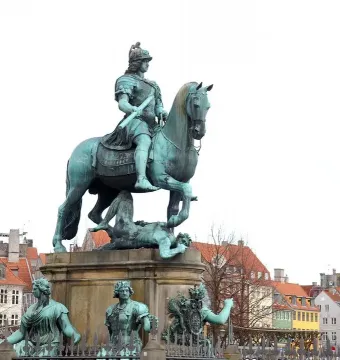
© Trond Arild Ydersbond · CC BY-SA 4.0
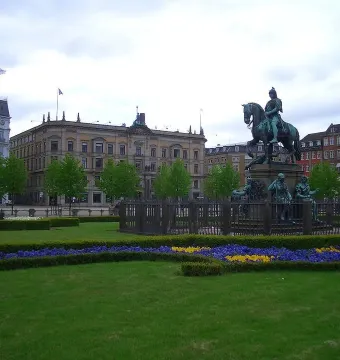
· CC BY 2.5
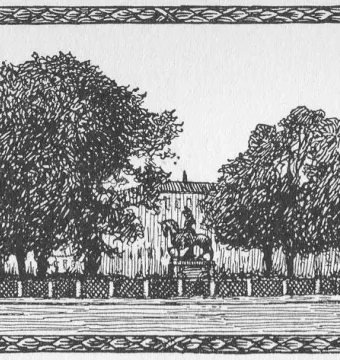
1914 © Kristian Kongstad (1867-1929) · Public domain

© Paul Fischer · Public domain
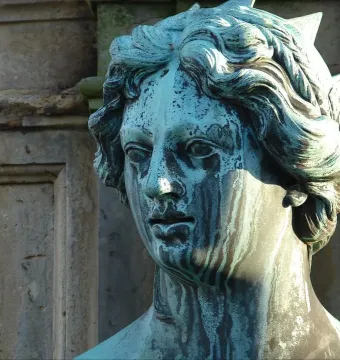
December 2011 © Orf3us · CC BY 3.0
Identification | |
| Title | Equestrian statue of Christian V |
| Subject | Christian V of Denmark |
| Type | equestrian statue |
Historical context | |
| Style | Baroque |
| Planned setting | Kongens Nytorv was designed as a French-style royal square |
| Date | 1688 |
Creator | |
| Sculptor | Abraham-César Lamoureux |
| Artist nationality | French |
| Commissioned to | Abraham-César Lamoureux |
Discovery and provenance | |
| Erection attended by | Nicodemus Tessin the Younger |
| Location at inauguration | the centre of a Baroque garden with trees around a parterre |
| Commissioned for | the centre of Kongens Nytorv |
| Commissioned after | the coronation of Christian V in 1670 |
| Inaugurated | 1688 |
| Erected | 1687 |
| Material acquisition | Lamoureux acquired material for the statue in 1682 |
| Creation began | probably around 1682 |
Materials | |
| Casting material | soft metal |
| Current material | bronze |
| Original material | gilded lead |
History and restoration | |
| Material conversion date | 1939-1942 |
| Reinaugurated | 22 May 1946 |
| Recast by | Professor Einar Utzon-Frank of the Royal Danish Academy of Fine Arts |
| Structural issue | The soft metal caused serious problems, especially with the horse's front left leg, and the construction had to be reinforced |
| Design inspiration | The equestrian statue of Louis XIII in the centre of Place des Vosges |
Location and ownership | |
| Location | centre of Kongens Nytorv, Copenhagen, Denmark |
| Square redesign | In 1747, Frederik V rebuilt Kongens Nytorv as a military drill and ceremonial ground for the king's troops |
| Square use after redesign | Military drill and ceremonial ground for the king's troops until 1908 |
| Square restored | 1908, when it was restored to its original design |
Physical characteristics | |
| Depiction | Christian V shown in the guise of a Roman emperor with a laurel-crowned helmet |
| Pedestal figures | Four allegorical figures |
| Horse pose | Trot-like gait |
Iconography and meaning | |
| Additional support figure | A crouching nude man beneath the horse's hoof, personifying envy and supporting the horse's barrel, the weakest point of the statue |
| Front pedestal figures | Minerva and Hercules, representing prudence and strength |
| Horse inspiration | The Equestrian Statue of Marcus Aurelius at the Capitoline Hill |
| Rear pedestal figures | Alexander the Great and Artemisia, representing fortitude and honor |
Significance | |
| Significance | The oldest of the five surviving equestrian statues of Danish monarchs in Copenhagen |