
The First Funeral
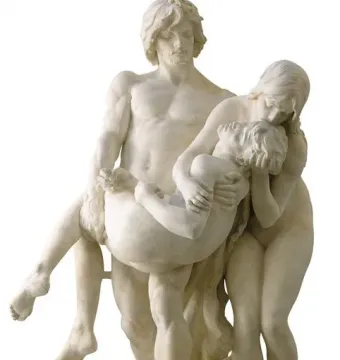
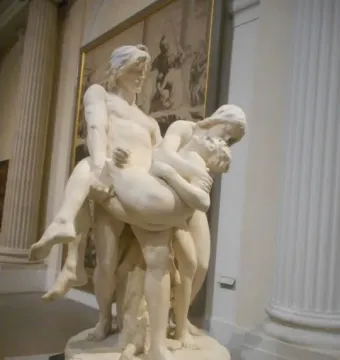
The First Funeral is an 1878 plaster sculpture by Louis-Ernest Barrias, first exhibited at the Paris Salon, where it won a medal of honour. Barrias later produced a marble version for the 1883 Salon, now in the Petit Palais in Paris. The work depicts Adam and Eve bearing the body of their murdered son Abel, a somber biblical scene rendered with powerful emotion. The original plaster is held by the Museum of Fine Arts of Lyon. Another marble copy is in the Ny Carlsberg Glyptotek in Copenhagen, and a further marble version is in the Museo Nacional de Bellas Artes in Argentina.
© Musée des Beaux-Arts de Lyon · Public domain
November 1899 © Incognito668 · CC BY-SA 4.0
November 1899 © Incognito668 · CC BY-SA 4.0
November 1899 © Incognito668 · CC BY-SA 4.0
Identification | |
| Title | The First Funeral |
| Original titles | Les Premières Funérailles; Il primo funerale; I primi funerali |
| Artist | Louis-Ernest Barrias (1841–1905) |
Historical context | |
| Date created | 1878 |
| First exhibition | Salon des artistes français, 1878 |
| Award | Honorary medal at the 1878 Salon |
| Reception | Considered a success; highly regarded; many magazines reproduced it at the time |
| Related later presentation | Marble version sent to the Salon and the National Exhibition of Fine Arts in 1883; displayed at the Exposition Universelle of 1889; inserted into Gustave Rives's Grand Palais project in 1896 |
| Subject | Adam and Eve bearing the body of their murdered son Abel |
| Theme | The first funeral and first mourning in history; the first murder in human history |
Creator | |
| Critical interpretation | Praised for combining naturalism and elegance |
| Stylistic influences | Romanticism, Neoclassicism, and Realism |
Discovery and provenance | |
| Original location | Museum of Fine Arts of Lyon |
| Acquisition and commission | The City of Paris obtained the plaster and then commissioned a marble version |
| Ownership history | Given to the museum in 1908 by Barrias's widow; entered the Petit Palais collection in 1902; deposited at Auteuil in 1942 and at the Sainte-Anne psychiatric institute in 1947; returned to the Petit Palais in 1989 |
| Other versions | Marble version at the Petit Palais, Paris; marble copy at the Ny Carlsberg Glyptotek, Copenhagen; marble version at the Museo Nacional de Bellas Artes, Buenos Aires |
| Original model | Plaster model |
Physical characteristics | |
| Type | Group sculpture |
| Composition | Pyramidal composition |
| Number of figures | Three nude figures |
| Dimensions | 223 × 129 × 109.5 cm |
| Related version dimensions | The Museo Nacional de Bellas Artes marble version measures 159 × 99 × 74 cm |
Materials | |
| Additional feature | With a focus cross |
| Material | Plaster |
| Related version material | Marble |
Appearance | |
| Figure arrangement | Abel lies or reclines, supported by his parents; Adam holds his son's legs and leans backward; Eve bends over and kisses Abel's forehead or head |
| Expressions | Adam has an impassive but protective, attentive gaze; Eve has lowered eyes; Abel has closed eyes, an open mouth, and a head thrown back, with a serene or realistic expression |
| Stylistic features | A blend of naturalism, elegance, and realistic treatment of the bodies |
| Background element | A flint placed behind the figures suggests a prehistoric setting |
| Inspiration for Adam | His face may recall ancient Gauls, including the moustache |
| Inspiration for Eve | Derived from Renaissance sculpture, with influences from Michelangelo and Bernini |
| Figures depicted | Adam, Eve, and Abel |
Iconography and meaning | |
| Biblical narrative | Cain and Abel offer sacrifices to God; Abel's offering is favored, Cain kills Abel, and God punishes Cain to wander |
| Figures represented in criticism | Adam, Eve, Abel, Cain, and God |
Location and ownership | |
| Marble version location | Museo Nacional de Bellas Artes, Buenos Aires |
| Current location | Museum of Fine Arts of Lyon |
| Marble copy location | Ny Carlsberg Glyptotek, Copenhagen |
| Marble version location | Petit Palais, Paris |
History and restoration | |
| Conservation | Cleaned and repaired in 1998 and 2015 |
| Display history | Later displayed in the vestibule of the Henri II staircase in the Hôtel de Ville de Paris |
| Loan history | Loaned to Barrias in 1888 so that he could make reproductions |
| Former related work | A related work once existed at the Museum of Fine Arts of Rennes and is now destroyed |
Significance | |
| Critical response | Several critics were enthusiastic, while others were more reserved; Paul Mantz, Félix Fénéon, and Firmin Javel praised it, Edmond About regretted it did not receive the grand medal, Philippe Burty and Henry Jouin offered more reserved comments |
| Notable critical remarks | Described at the 1878 Salon as 'the highest manifestation of the emotions that sculpture can express' |