
Hallazgo e historia
Hallazgo e historia presents the colossal head of Amenhotep III, also known as the granite colossal head of Amenhotep III. The sculpture was carved around 1350 BC during Egypt’s Eighteenth Dynasty and depicts Nebmaatra Amenhotep, Amenhotep III, or Amenophis III, an important pharaoh who ruled from 1390 to 1353 BC. It is made of granite and measures 287 centimeters in height. The statue is now broken into two pieces, the head and the arm, both preserved in the British Museum.
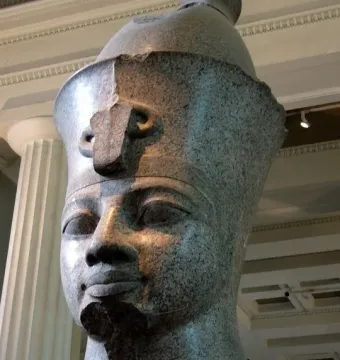
· CC BY-SA 3.0
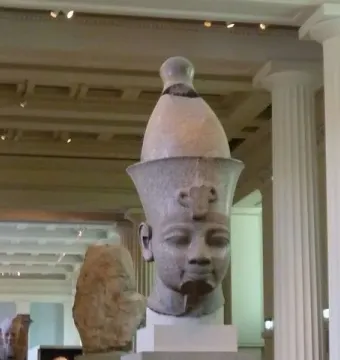
February 2023 © Michael Dibb · CC BY-SA 2.0
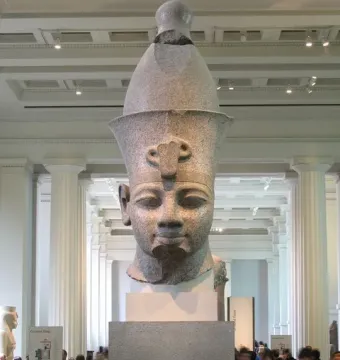
· CC BY-SA 3.0
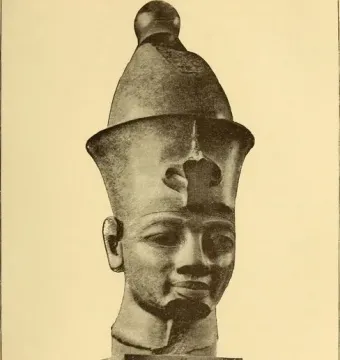
1887 © Internet Archive Book Images · No restrictions
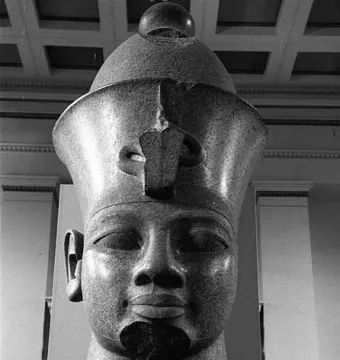
© Willy Pragher · CC BY 4.0
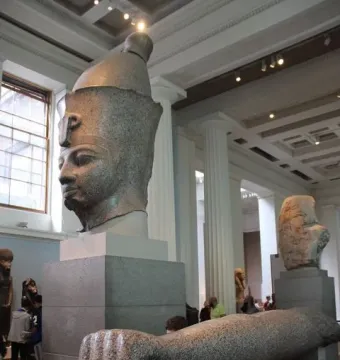
July 2017 © Gary Todd · CC0
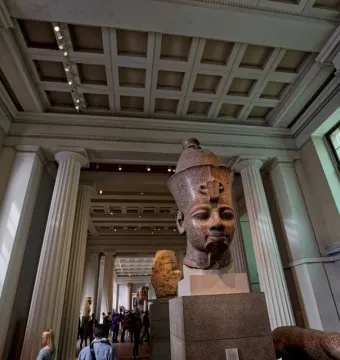
September 2010 © Txllxt TxllxT · CC BY-SA 4.0
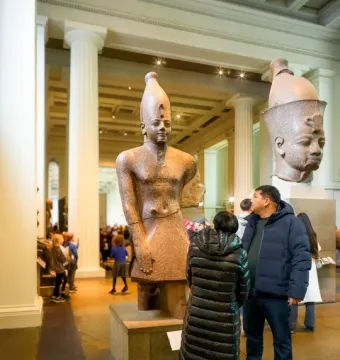
December 2023 © Dale Cruse · CC BY 2.0
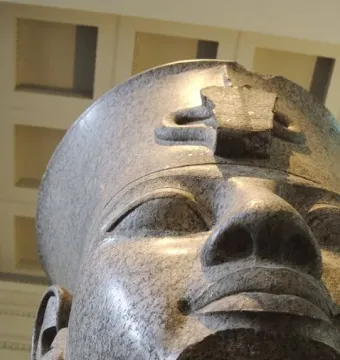
· CC BY-SA 2.0
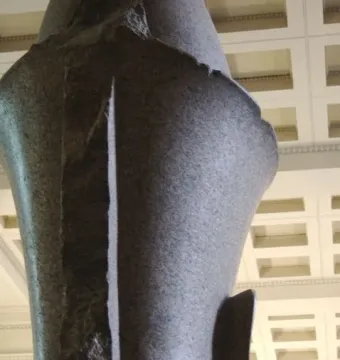
· CC BY-SA 2.0
Identification | |
| Title | Colossal red granite statue of Amenhotep III |
| Type | Colossal statue |
| Alternative title | Colossal head of Amenhotep III; colossal granite head of Amenhotep III |
Historical context | |
| Cultural style | Ancient Egyptian art |
| Interpretive note | The monument illustrates the later usurpation of earlier royal statues through modification and re-inscription |
| Period | 18th Dynasty of ancient Egypt |
| Date | c. 1370 BC |
Creator | |
| Attribution | Believed to have been erected by Amenhotep III himself |
| Attribution note | At discovery it was initially attributed to Thutmose III |
| Creator | Amenhotep III |
Discovery and provenance | |
| Findspot | Temple enclosure of Mut at Karnak, Upper Egypt |
| Discovery year | 1817 |
| Discovered by | Giovanni Battista Belzoni and Henry William Beechey |
| Possible original location | Temple of Mut at Karnak or Amenhotep III's funerary temple at Kom el-Hitan on the west bank of the Nile |
| Related work | The Colossi of Memnon |
| Associated site | Ancient Thebes |
Physical characteristics | |
| Height | 287 cm |
| Condition | Broken into two pieces; only the head and an arm survive |
| Preserved parts | Head and arm |
| Head height | 2.9 m |
| Headgear | Pschent (double crown of Upper and Lower Egypt) |
Materials | |
| Material | Red granite |
Technique | |
| Later modification | The head was altered in the time of Ramesses II to resemble him |
Appearance | |
| Facial features | The corners of the mouth were carved to suggest a slight, peaceful smile |
| Facial features | Heavy black eye makeup was rendered |
Location and ownership | |
| Catalogue number | EA 15 |
| Acquisition method | Purchased at auction |
| Display location | Room 4 of the British Museum |
| Current location | British Museum, London |
| Previous owner | Henry Salt |
| Acquired from | Henry Salt |
| Acquisition year | 1823 |
| Ownership | British Museum |
| Display status | On permanent display |
History and restoration | |
| Head findspot | In front of the temple of Khonsupakhered |
| Transport route | Taken to Luxor on the Nile, then upriver to Alexandria and on to London |
| Transport time to Luxor | 8 days |
| Distance to Luxor | 1.6 km |
| Temporary storage | House of Mr. Rossi in Cairo |
| Arm findspot | Not recorded; probably found with the head |
| Earlier identification | A head of Horus |
| Original condition at discovery | Broken into fragments |