
Medusa Rondanini
Medusa Rondanini is the scholarly name for an ancient type of Medusa head, named after the best-preserved example. This high-relief head of unknown origin was once in the Palazzo Rondanini in Rome and was bought in 1814 by the later King Ludwig I of Bavaria. It is now in the Glyptothek in Munich, inventory number 252. The 38.8-centimeter-tall head is made of Parian marble and is generally considered a Roman copy, probably from the 2nd century AD. Its prototype may have been a Classical work of the 5th century BC, possibly linked to Phidias, though an alternative theory sees a Hellenistic model. The sculpture was admired by Goethe and later served as a model for Antonio Canova’s Perseus with the Head of Medusa.
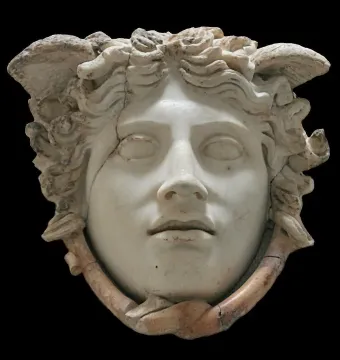
© Unknown (Greek original by Phidias) · CC BY-SA 3.0
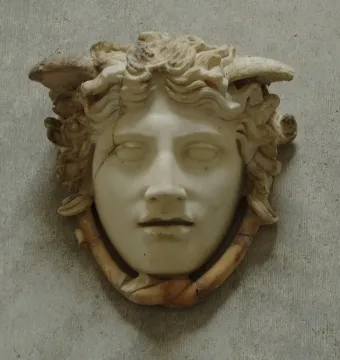
© Unknown (Greek original by Phidias) · Public domain
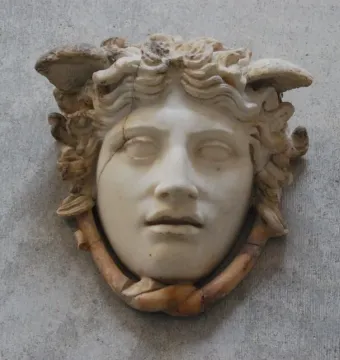
© Unknown (Greek original by Phidias) · CC BY-SA 3.0
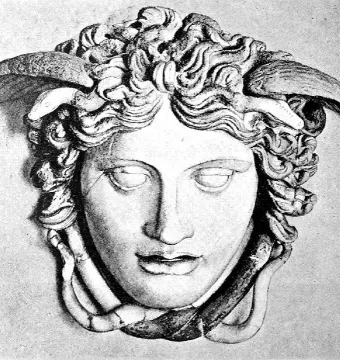
© Unknown (Greek original by Phidias) · Public domain
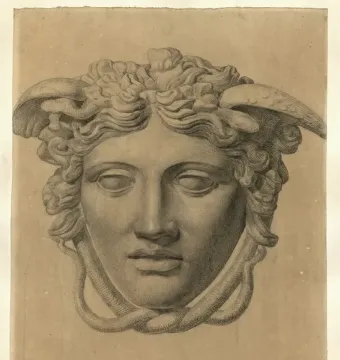
September 2025 © Wilhelm Titel · CC BY-SA 4.0
Identification | |
| Title | Medusa Rondanini |
| Named after | the best-preserved version; the Rondanini family |
| Sculpture type | Ancient Medusa head type |
| Subject | Medusa |
| Type | Marble gorgoneion (Medusa head) |
Historical context | |
| Date | Probably created at the turn of the Common Era; late Hellenistic or Augustan Roman |
| Origin | Unknown provenance |
| Based on | Probably a lost Greek original from the 5th or 4th century BCE; possibly a Hellenistic prototype from the late 3rd or early 2nd century BCE |
| Original model material | Probably metal; some proposed models are described as bronze |
| Attribution of original | Attributed to Phidias or another Athenian sculptor of his time |
| Possible prototype | The Gorgoneion on Athena Parthenos' shield or aegis; alternatively a gilded bronze aegis offered by Antiochus III or IV |
| Known ancient copies | Six additional Roman or ancient marble copies are known |
Creator | |
| School / circle | Circle or school of Phidias |
| Influenced artist | Antonio Canova |
Discovery and provenance | |
| Current location | Glyptothek, Munich, Germany |
| Inventory number | 252 |
| Acquisition | Bought in 1814 by King Ludwig I of Bavaria from the heirs of the Rondanini family during his Grand Tour of Italy as a prince |
| Former owner | The heirs of the Rondanini family |
| Original location | Palazzo Rondanini, Rome |
Physical characteristics | |
| Height | 38.8 cm |
| Scale | Larger than life-size |
Materials | |
| Material | Marble |
Appearance | |
| Stylistic portrayal | A more beautiful and humanized Medusa than the traditional grotesque Gorgoneion |
| Hair treatment | The snakes of earlier gorgoneions are rendered as unruly curls |
| Iconographic features | Includes stylized horns that recall traditional apotropaic iconography |
Iconography and meaning | |
| Interpretation | Seen as a transformation of the Gorgon from a repulsive, sex-indeterminate creature into a beautiful woman |
| Associated iconography | The Gorgoneion on Athena's aegis |
Location and ownership | |
| Country of current location | Germany |
History and restoration | |
| Reception | Greatly admired by Johann Wolfgang von Goethe; Johann Joachim Winckelmann neglected it |
| Goethe date | 25 December 1786 |
| Goethe description | A Medusa mask in a palace opposite, in a high and beautiful facial form, larger than life, expressing the fearful staring of death with unspeakable excellence |
| Goethe remark | The mere knowledge that such a work could be created and still exists in the world made him feel twice the person he was |
| Canova work | Used as the model for the gorgon head in Antonio Canova's Perseus with the Head of Medusa (1798–1801) |
| Canova work context | Made to replace the Apollo of the Belvedere, sent to Napoleon's Paris |
Significance | |
| Art-historical significance | Became an object of admiration among the Romantics and first brought to the attention of art historians by Goethe in 1786 |
| Modern significance | Became the emblem of the fashion house Versace |