
Gonzaga Cameo
Gonzaga Cameo is a Hellenistic decorative gem now in the Hermitage Museum in Saint Petersburg. Carved from a piece of sardonyx measuring 15.7 × 11.8 cm, it shows portrait heads of a deified ruler and his wife. It is usually attributed to an Alexandrian artist of the 3rd century BC, and the figures are commonly identified as Ptolemy II and Arsinoe II, though another theory dates it later and identifies them as Tiberius and Livia. The ruler wears a helmet with a winged serpent symbol and a laurel wreath, while an aegis over his shoulder includes the Gorgon’s head and a bearded figure believed to be Zeus-Ammon. The cameo passed through several royal and papal collections before reaching the Hermitage.
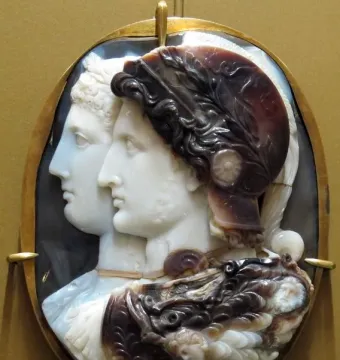
© Sailko · CC BY-SA 3.0
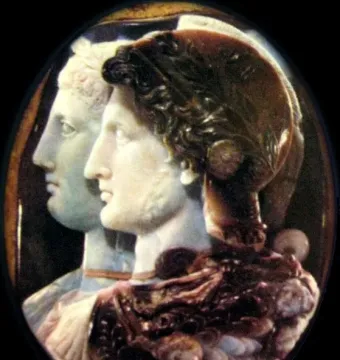
2009 © user:shakko · CC BY-SA 3.0
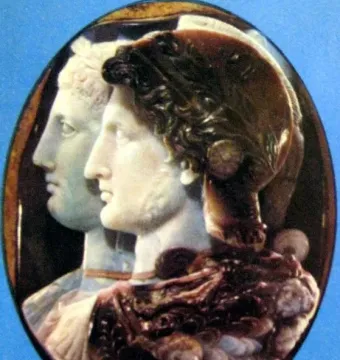
2009 © user:shakko · CC BY-SA 3.0
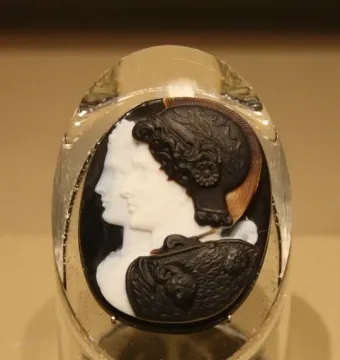
© Beckstet · CC BY-SA 3.0
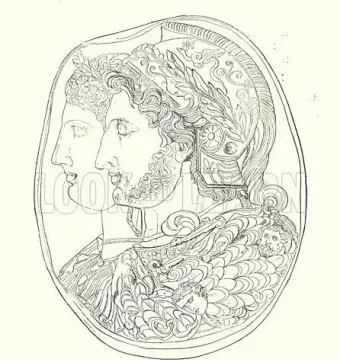
1881 © Unknown authorUnknown author · Public domain
Identification | |
| Title | Gonzaga Cameo |
| Type | Hellenistic engraved gem cameo |
| Cameo variety | capita jugata |
| Art form | ancient glyptic art |
| Original-language names | Kamea Gonzaga; Camée des Gonzague; Il Cammeo Gonzaga; Cameo of Gonzaga; Malmaison cameo |
Historical context | |
| Style / period | Hellenistic; Antiquity |
Creator | |
| Artist | Unknown; commonly attributed to an Alexandrian artist |
| Place of creation | Alexandria, Egypt (probable) |
| Date | 3rd century BC, probably; exact date disputed and sometimes left incomplete in the sources |
Materials | |
| Material | sardonyx |
| Layers | three layers |
Physical characteristics | |
| Dimensions | 15.7 × 11.8 cm |
| Form | double-profile portrait gem |
Appearance | |
| Aegis detail | An aegis draped over the shoulder with the head of Medusa and a bearded man probably identified as Zeus Ammon |
| Condition | Broken in half at some point |
| Interpretation | The opposed male and female profiles were probably intended to suggest Zeus and Hera |
| Helmet detail | Helmet marked with a winged serpent symbol; the laurel wreath is topped by a serpent suggesting the uraeus |
| Figure relationship | A royal couple or other paired figures; in the Ptolemy interpretation, spouses who were also brother and sister |
| Depicted figures | Most commonly identified as Ptolemy II Philadelphus and Arsinoe II; alternative identifications include Augustus and Livia, Alexander the Great and Olympias, Germanicus and Agrippina the Elder, Nero and Agrippina the Younger, and other famous pairs from antiquity |
| Male figure attributes | Clad with attributes of Alexander; wearing a helmet with a laurel wreath and a gorgoneion |
History and restoration | |
| Later alteration | A thin brown collar/necklace addition was made to conceal the break |
Discovery and provenance | |
| Later identifications | Alexander the Great and Olympias; Germanicus and Agrippina the Elder; Nero and Agrippina the Younger; and many other famous couples or figures from antiquity |
| Early admiration | Admired by the young Peter Paul Rubens, who called it the most beautiful or finest cameo in existence |
| Provenance | A centerpiece of the Gonzaga antiquities collection |
| Disputed identification | Scholars have debated whether it portrays Alexander the Great with his mother or Ptolemy II with his sister-wife Arsinoe; both views have had prominent supporters |
| Early identification | Originally interpreted as Augustus and Livia |
| Named after | Francesco II Gonzaga, Marquis of Mantua, the first known owner |
| Original collection | The Gonzaga collection of antiquities in Mantua |
| First documented | Described in a 1542 inventory of Isabella d'Este's collection in the Ducal Palace of Mantua |
Location and ownership | |
| Ownership history | Owned by the Gonzaga family of Mantua until 1630; kept in the Prague Castle treasury from 1630 to 1648; owned by Queen Christina of Sweden from 1648; later with Cardinal Decio Azzolini; acquired by Livio Odescalchi, Duke of Bracciano and nephew of Pope Innocent XI; in Pope Pius VI's collection in 1794; seized by French troops in 1798 and taken to Paris; later in the collection of Napoleon and Empress Joséphine; given by Joséphine to Tsar Alexander I in 1814 |
| Current location | Hermitage Museum, Saint Petersburg, in the Cameo Gallery of the New Hermitage building |
| Inventory number | GR-12678 |
| Alternative name | Cameo of Malmaison |
Significance | |
| Reputation | Considered by common opinion to be the most famous cameo of the Hermitage |
| Historical significance | A celebrated gem portrait that passed through major European royal and imperial collections |
Other | |
| Related object confusion | A lower-quality Hellenistic cameo in Vienna was also called the Gonzaga Cameo by the Habsburgs, causing confusion with the Hermitage piece |