
Monument to Mickiewicz
Monument to Mickiewicz in Paris is a monument to the Polish poet Adam Mickiewicz, created by the French sculptor Antoine Bourdelle. The model was made in 1909, and the monument itself was completed in 1928. It was unveiled on 28 April 1929 at Place de l’Alma in Paris, a few months before the sculptor’s death. Later, it was moved to Cours Albert-I in the 8th arrondissement, on the western side of the Seine embankment now called the Yerevan Garden. The monument was a gift from Poland to France. Its base is decorated with six reliefs showing figures and themes from Mickiewicz’s works, and the column is topped by a statue of the poet.
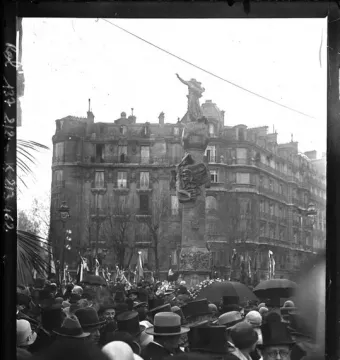
© Agence Rol. Agence photographique (commanditaire) · Public domain
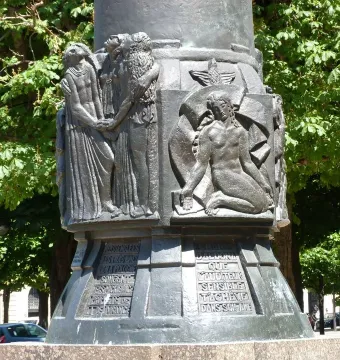
© Siren-Com · CC BY-SA 3.0
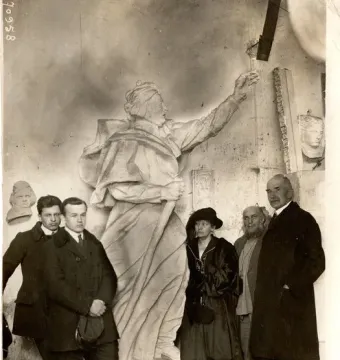
December 1921 © MacejK · CC BY-SA 4.0
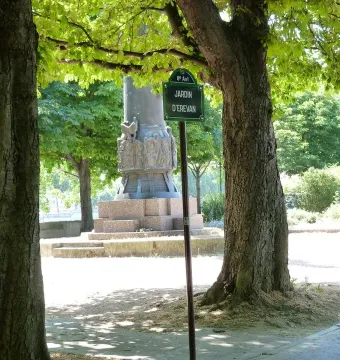
May 2011 © Siren-Com · CC BY-SA 3.0
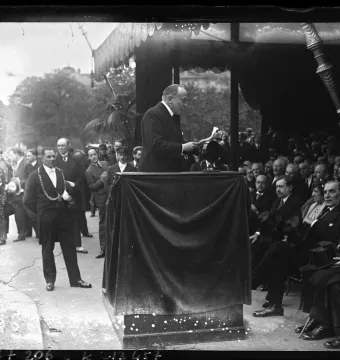
© Agence Rol · Public domain
Identification | |
| Title | Monument to Adam Mickiewicz in Paris |
| Type | Monument |
| Dedication | Adam Mickiewicz |
| Alternative title | Monument to the Polish Epic of Defense |
Historical context | |
| Historical context of the subject | Born in what was then the Polish-Lithuanian Commonwealth |
| Subject birth year | 1798 |
| Subject birth place | Navahroudak (Nowogrodek, now in Belarus) |
| Subject death year | 1855 |
| Subject death place | Istanbul |
| Subject significance | Celebrated in his homeland as the spiritual father of modern Polish literature |
| Residence in France | Moved to France in 1829 |
| Exile | Exiled in Russia from 1824 to 1829 because of his participation in patriotic circles |
| Subject | Adam Mickiewicz |
| Attempt to join uprising | In 1831, he unsuccessfully tried to join the rebels during the insurrection but did not get beyond Dresden |
| Doctrinal development | From 1832 onward he developed a doctrine of fervent patriotism and recovered religion |
| Religious-political idea | Preached regeneration through accepted sacrifice and suffering sublimated into love for his homeland |
| Marriage | Married in Paris to his compatriot Félicie Szymanowska, aged twenty-two |
| Children | Had six children |
| Teaching positions | Taught Latin literature in Lausanne in 1839 and 1840; appointed in 1840 professor of Slavic literature at the Collège de France |
| Subject occupation | Polish poet and writer |
| Literary and political importance | One of the greatest European Romantic poets and an intellectual; recognized moral leader of the Polish nation |
| Commissioned by | A Franco-Polish committee |
| Commission year | 1908 |
| Committee president | Lafayette |
| Committee creation date | 1831 |
Creator | |
| Nationality | French |
| Sculptor | Antoine Bourdelle |
| Model created | 1909 |
History and restoration | |
| Gift status | A gift from Poland to France |
| Burial and reburial | His body was brought back to Paris and, in 1890, transferred to Kraków, where he was solemnly buried in Wawel Cathedral |
| Military plan at death | He intended to form a Polish legion to fight the Russians |
| Circumstances of death | Died in Istanbul after going there to join the Polish colony living at Polonezköy during the Crimean War |
| Cause of death | Died of cholera |
| Acceptance by Paris municipal council | 1926 |
| Censure and suspension | His courses were suspended in 1844 because he was accused of being influenced by the mystic Andrzej Towiański |
| Dismissal | After the coup d'état of 1851, he was dismissed by decree |
| Completion year | 1928 |
| Unveiling date | 28 April 1929 |
| Original unveiling location | Place de l'Alma, Paris |
| Original installation location | Center of Place de l'Alma |
| Original installation date | 1929 |
| Relocation year | 1956 |
| Relocation reason | Problems related to automobile traffic |
| Relocated to | Cours Albert-I, western end, on the Seine embankment, 8th arrondissement, Paris |
| Current site name | Jardin d'Erevan (Yerevan Garden) |
| Current site name since | March 2009 |
| Present in museum | A fragment is displayed at Musée Bourdelle, Paris |
Physical characteristics | |
| Material of depicted fragments | Not specified |
| Top element | A statue of Adam Mickiewicz crowns the column |
| Pedestal material | Reddish porphyritic granite with large white feldspars from the Carpathians |
| Base decoration | Six reliefs decorate the base of the column |
| Structure | Monument on a column with sculptural decoration |
| Composition | A column topped by a statue of Adam Mickiewicz |
Iconography and meaning | |
| Base relief subjects | Konrad Wallenrod, Aldona, Halban, prisoners, Maryla, and the allegory of the Partition of the Polish-Lithuanian Commonwealth |
| Partition allegory depiction | The Polish-Lithuanian Commonwealth is shown as three girls symbolizing the three parts into which it was divided by Russia, Austria, and Prussia |
| Upper relief subject | Grażyna |
Location and ownership | |
| Location | Paris, France |
| District | 8th arrondissement of Paris |
| Country | France |
| Current location | Jardin d'Erevan (Yerevan Garden), at the western end of Cours Albert-I on the Seine embankment, Paris |
| Original location | Place de l'Alma, Paris |
| Relocated site | Cours Albert-I, western end, on the Seine embankment |
Significance | |
| Associated museum display | A fragment of the monument is shown at Musée Bourdelle in Paris |