
Warsaw Uprising Monument
Warsaw Uprising Monument is a monumental bronze memorial in central Warsaw, located on Krasiński Square on the left bank of the Vistula River. It commemorates those who fought against Nazi occupation during World War II and the heroes of the 1944 Warsaw Uprising. The monument, created by Wincenty Kućma and Jacek Budyn, was unveiled on 1 August 1989 by Polish People's Republic President Wojciech Jaruzelski and consecrated by Primate Józef Glemp. More than 10 meters high, it consists of two parts: one shows insurgents defending themselves amid the ruins of a fallen city, and the other depicts people descending into a sewer entrance, reflecting a key wartime route of movement and shelter.
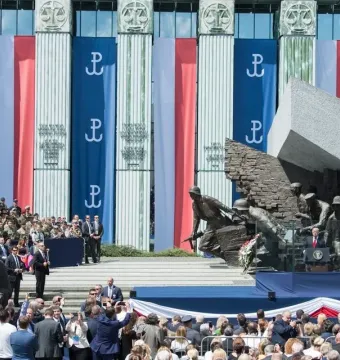
June 2019 © White House · Public domain
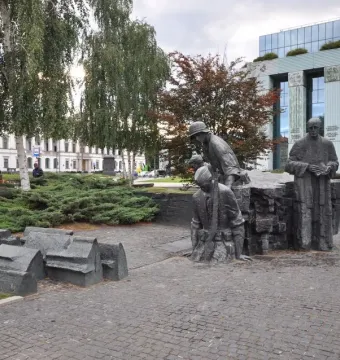
August 2012 © Jorge Láscar · CC BY 2.0
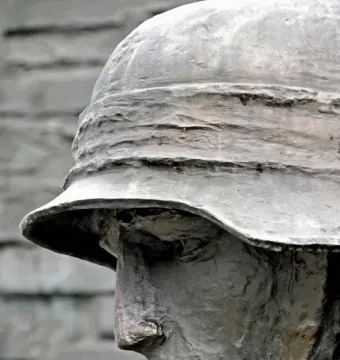
October 2009 © Dennis G. Jarvis · CC BY-SA 2.0
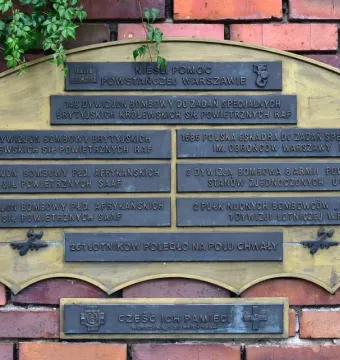
August 2019 © Adrian Grycuk · CC BY-SA 3.0 pl
© Wincenty Kućma, Jacek Budyn · CC0
Identification | |
| Title | Warsaw Uprising Monument |
| Original-language name | Памятник Варшавскому восстанию / Пам'ятник Варшавському повстанню |
| Type | Monument |
Historical context | |
| Triptych | According to the authors, it is part of a memorial triptych with the Monument to the Defenders of the Polish Post Office in Gdańsk and the Monument to the Fallen in Defense of the Fatherland in Częstochowa |
| Commemorates | The fighters and heroes of the Warsaw Uprising of 1944 and the memory of those who fought against the Nazi occupation during World War II |
| Dedicated to | The Warsaw Uprising of 1944 |
Creator | |
| Architect | Jacek Budyn |
| Sculptor | Wincenty Kućma |
Discovery and provenance | |
| Construction permit date | 12 April 1988 |
| Construction start date | 31 July 1984 |
| Unveiling date | 1 August 1989 |
| Unveiling anniversary | 45th anniversary of the Warsaw Uprising |
| Opened by | President of the Polish People's Republic Wojciech Jaruzelski |
| Blessed by | Primate Józef Glemp |
| Selection of design | Built from one of three competition designs selected in 1984 by the Interim Board of the Committee for the Construction of the Monument to the Heroes of the Warsaw Uprising 1944 |
| Funding | Construction was preceded by a collection of money and raw materials |
Physical characteristics | |
| Height | More than 10 meters |
| Number of main parts | Two |
Materials | |
| Material | Bronze |
Appearance | |
| Lower part | A smaller group of insurgents descending into a sewer manhole |
| Upper part | A larger, elevated group of insurgents engaged in combat, emerging from a collapsing building |
Iconography and meaning | |
| Symbolism | The sewer scene refers to the use of Warsaw's sewer system and the evacuation of 5,300 resistance fighters from the Old Town to the city centre in early September 1944, a five-hour journey that began at Krasiński Square |
| Historical reference | The upper scene depicts insurgents defending against German forces amid the ruins of a destroyed city |
Location and ownership | |
| Nearby landmark | In front of the Supreme Court of Poland building |
| Nearby landmark | Near the Warsaw Public Library |
| Nearby landmark | The Supreme Court of Poland building was built in 1999 |
| Nearby plaque | A small commemorative plaque is opposite the monument at Pl. Krasińskich 1–5, near the intersection of Długa Street and Miodowa Street |
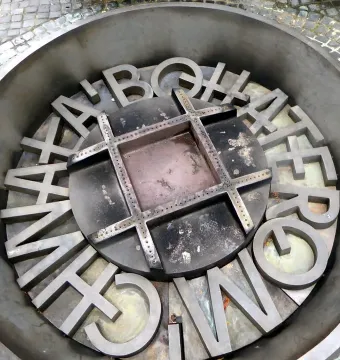
| Nearby path | A paved brick path leads from the plaque to the manhole depicted in the monument |
| Location | Southern side of Krasiński Square, Warsaw, Poland |
History and restoration | |
| Historical context | Official memorialization was delayed for decades because communist authorities in post-war People's Republic of Poland downplayed the uprising and condemned the Home Army and the wartime Polish government-in-exile |
| Soviet role | Joseph Stalin deliberately stopped the Soviet advance short of Warsaw, refused to aid the insurgents, and denied Western Allied landing and refueling rights on Soviet-held territory |
| Consequences of the uprising | Up to 90% of Warsaw's buildings were destroyed during the fighting and the systematic destruction that followed |
| Soviet entry into Warsaw | January 1945, after the Germans had left |
| Visit by Roman Herzog | German Federal President Roman Herzog visited the monument in 1994 and apologized to Poles for crimes committed by Germans during World War II |
| Condition assessment | A 2013 analysis suggested that the monument needs renovation because of deterioration caused by atmospheric pollution |
| Criticism | Some architects and critics said the monument lacked artistic value, referenced socialist realist conventions, and was 'defeatist' and a late gesture of reconciliation by the departing communist government |
| Political context | The uprising was organized mainly by the Home Army, and the postwar Stalinist regime brutally suppressed the remnants of the Home Army |
Significance | |
| Description | Described as the most important monument of post-war Warsaw |
| Tourist significance | According to Gazeta Wyborcza in 2012, it was one of the most visited attractions for foreign tourists |