
Tomb of Pope Alexander VII
The Tomb of Pope Alexander VII is the funeral monument of Pope Alexander VII Chigi (1599–1667), created by Gian Lorenzo Bernini between 1672 and 1678 with assistance from his pupils. It is located in the ambulatory of St. Peter’s Basilica in Vatican City, beyond the left transept and above a wooden door leading outside. The monument features the pope kneeling in prayer above a rich red marble drapery, surrounded by four female virtues in white marble: Charity, Truth, Justice, and Prudence. Below the drapery emerges a skeleton holding a gilded bronze hourglass, a powerful Baroque image of time and mortality. The work is considered one of the most spectacular examples of Roman Baroque sculpture.
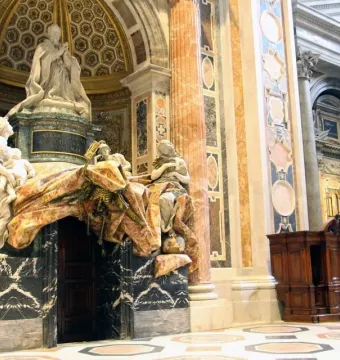
© Fred Romero · CC BY 2.0
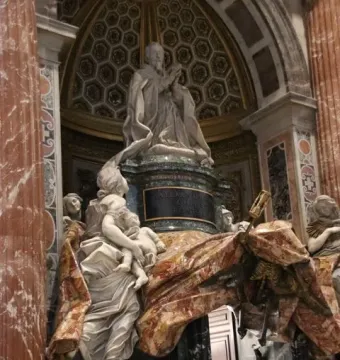
August 2019 © Gary Todd · Public domain
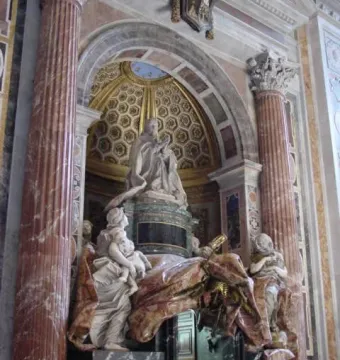
August 2011 © https://www.flickr.com/photos/rjhuttondfw/ · CC BY 2.0
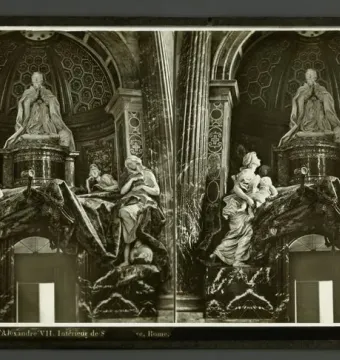
© Rijksmuseum · CC0
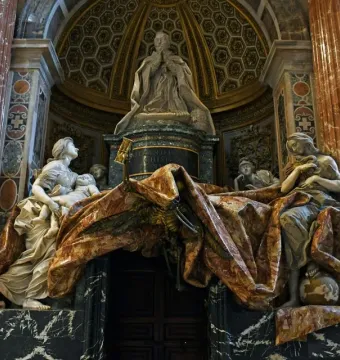
© Phyrexian · Public domain
Identification | |
| Title | Tomb of Pope Alexander VII |
| Original Italian name | Il sepolcro di Alessandro VII |
| Type | funerary monument |
| Subject | Pope Alexander VII Chigi (1599–1667) |
| Alternative title | Monument to Alexander VII |
Historical context | |
| Papal patron after the pope's death | Cardinal Flavio Chigi coordinated and paid for the project |
| Historical significance | One of the most important works planned by Alexander VII during his pontificate |
| Initial intended location | Choir of the Basilica of Santa Maria Maggiore |
| First mentioned | 9 August 1656 |
| Commissioned during lifetime | Yes |
| Commissioned by | Pope Alexander VII himself |
Creator | |
| Designer | Gian Lorenzo Bernini |
| Extent of Bernini's execution | Designed and partially executed; according to documents, he probably did not work manually on the tomb, but supplied the design and models |
| Workshop collaborators | Giuseppe Mazzuoli, Lazzaro Morelli, Giulio Cartari, Michele Maglia, and L. Balestri |
| Bernini's role in the pope's statue | He probably worked most intensely on the statue of the pope and likely finished Alexander's face |
| Bernini's age during the work | 81 years old |
| Significance in Bernini's career | His last major work before his death in 1680 |
Discovery and provenance | |
| Clay sketch of the kneeling pope | Preserved at the Victoria and Albert Museum in London |
| Last recorded payment to Bernini | 9 April 1672 |
| Design drawings preserved | Three drawings are known, but they are not considered true preparatory studies by Bernini |
| Clay sketch of Charity | Preserved at the Academy of Fine Arts in Siena |
| Royal Library design | Initial studio design preserved at the Royal Library of Windsor |
| Preliminary designs preserved | Several earlier versions survive |
History and restoration | |
| Construction start | December 1671 |
| Completion date | 1678 |
| Time from death to completion | Eleven years after the pope's death |
| Construction method | Life-size clay and wooden models were made |
| Later modification | Truth's nudity and Charity's breasts were covered by order of Pope Innocent XI with a painted white bronze piece |
| Workshop process | The work involved an unusually elaborate workshop process, with assistants handling casting, repairs, positioning, drilling screw holes, and execution under Bernini's close supervision; some could be replaced midway through the work |
Location and ownership | |
| Current location | South transept of St. Peter's Basilica, Vatican City |
| Placement details | The monument is placed at a site containing a door in the south transept, above the door |
| Door in the composition | The door was incorporated into all three drawings and became an important compositional and symbolic passage to the afterlife |
Physical characteristics | |
| Truth attributes | Truth has one foot resting on a globe representing England, and a thorn under the big toe on England is said to represent suffering caused by the expansion of Anglicanism |
| Bozzetto | A well-known terracotta bozzetto of the kneeling pope exists; according to Bruce Boucher, the head was modeled separately to find the correct viewing angle, and the bozzetto is close to the final solution |
| Death attributes | Death raises an hourglass |
| Composition | Six main figures in a multi-level composition |
| Death figure | A figure of Death appears below Alexander |
| Virtues represented | Charity, Truth, Prudence, and Justice |
| Main figure pose | Alexander VII is shown kneeling in prayer at the top of the monument |
| Virtues layout | Charity is front left, Truth front right, Prudence back left, and Justice back right |
Materials | |
| Main materials | White marble, gilded bronze, Sicilian jasper, black marble |
| Drapery material | Red Sicilian jasper marble |
| Virtues material | White marble |
| Death figure material | Gilded bronze |
| Hourglass material | Gilded bronze |
| Architectural marble colors | Green and black marbles |
| Plinth material/color | Black marble |
Appearance | |
| Material contrast | The dark Sicilian jasper and bronze contrast sharply with the white marble figures, creating a more pure effect around Alexander and the virtues and dramatic emphasis around Death |
| Plinth meaning | A sign of mourning for the pope |
| Sicilian jasper description | Rich red tones with green streaks |
| Death drapery | Billowing drapery of Sicilian jasper |
Technique | |
| Truth figure execution | Initiated by Lazzaro Morelli and completed by Giulio Cartari |
| Charity execution | Created by Giuseppe Mazzuoli following Bernini's models |
| Bronze casting | The Death figure had to be cast in bronze and repaired after casting |
Iconography and meaning | |
| Death meaning | Death represents Time defeated by Truth and is associated with vanitas vanitatum and the passage of time |
| Truth symbolism | Truth's foot on England refers to Alexander VII's efforts to curb the growth of Anglicanism |
| Interpretive hierarchy of virtues | Justice is guided by Truth, and Prudence is guided by Charity |
| Theological emphasis | The monument emphasizes Alexander VII as a spiritual leader through Charity and Truth rather than as a secular ruler through Prudence and Justice |
| Political context | Truth was especially important to Alexander VII in his final years after losing control over France to Louis XIV and failing to unite European countries against the Turks |
| Relation to Bernini's earlier work | The Truth is linked to Bernini's Unveiled Truth by Time and to the idea of Truth accompanied by Time |
| Possible source | Bernini is said to have taken the idea from Correggio's unfinished autograph sketch Allegory of Virtue (1525) |
| Visibility of the virtues | The half-length Virtues are positioned above viewers' eye level and are therefore almost invisible |
Significance | |
| Stylistic characterization | An especially spectacular example of Roman Baroque |
| Stylistic evaluation | Noted for its multi-level composition and harmonious use of polychrome marbles |
| Howard Hibbard's view of the virtues | He called the Virtues "uncomfortable afterthoughts" |