
Admiral David G. Farragut
Admiral David G. Farragut is a statue in Washington, D.C., honoring David Farragut, a career military officer who served as the first admiral in the United States Navy. Located in the center of Farragut Square, the monument was sculpted by Vinnie Ream and dedicated in 1881 in a large ceremony attended by President James A. Garfield, members of his cabinet, and thousands of spectators. It was the first monument erected in Washington, D.C., to honor a naval war hero. The bronze statue rests on a granite base and was cast from the bronze propellers of the USS Hartford. It is one of the Civil War monuments in Washington, D.C., listed on the National Register of Historic Places in 1978.
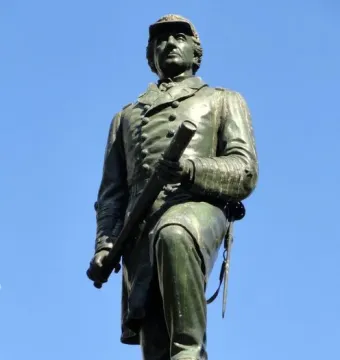
June 2012 © Daderot · CC0
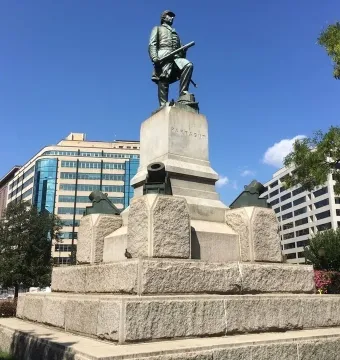
© NPS Photo · Public domain
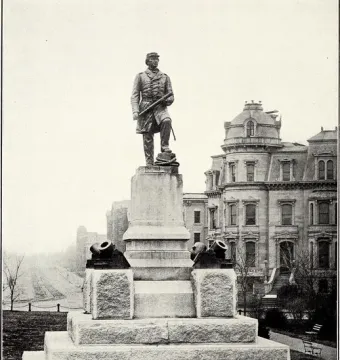
1908 © Internet Archive Book Images · No restrictions
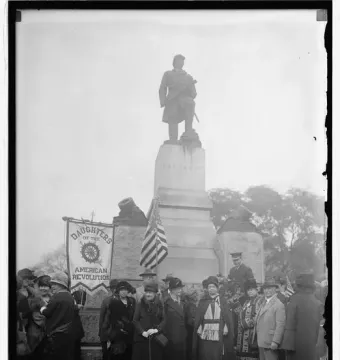
1924 © National Photo Company Collection · Public domain
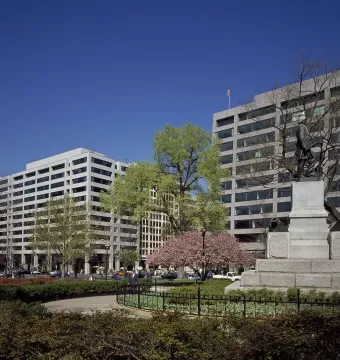
© Carol M. Highsmith · Public domain
Identification | |
| Title | Admiral David G. Farragut |
| Common name | Monument to David Farragut |
| Type | Statue |
Historical context | |
| Subject | David G. Farragut |
| Honoree description | U.S. Navy admiral and Civil War naval hero; first admiral in the United States Navy |
| Commissioned by | United States Congress |
| Competition announced | 1875 |
| Creation period | Six years |
Creator | |
| Artist | Vinnie Ream |
| Artist description | Female sculptor; a young woman at the time |
| Notable works | Statue of Abraham Lincoln; several statues in the National Statuary Hall Collection |
Discovery and provenance | |
| Modeling period | Ream worked on the statue for several years after receiving the commission; she consulted Virginia Farragut and had begun a bust of Farragut before the competition concluded |
| Casting location | Washington Navy Yard |
| Bronze source | The bronze propellers of USS Hartford |
| Award | $20,000 |
| Selection outcome | Vinnie Ream's model was officially selected after George M. Robeson initially opposed the result and later relented |
| Competition background | Nathaniel P. Banks introduced the congressional resolution soon after Farragut's death in 1870; it required the statue to be modeled from life |
| Rejected competitors | Horatio Stone, J. Wilson MacDonald, Randolph Rogers, and Edward Watson |
| Supporters | Ulysses S. Grant, David Dixon Porter, William Tecumseh Sherman, and Virginia Farragut supported Ream's design |
| Selection process | A congressional committee held a competition after rejecting an initial preference for Horatio Stone; thirteen artists submitted models, and the final selection was made by Virginia Farragut, William Tecumseh Sherman, and Secretary of the Navy George M. Robeson |
Physical characteristics | |
| Object held | Telescope held with both hands |
| Additional bronze use | The bronze was enough to cast the statue and four mortars at the corners of the base |
| Inscription | FARRAGUT |
| Base dimensions | Height, length, and width are not specified |
| Statue dimensions | Height, width, and length are not specified |
| Contents inside base | A box containing documents related to Farragut's career, a history of the sculpture, a copy of the Army and Navy Register, and a bronze model of the propeller used to cast the statue and mortars |
| Attire | Military uniform |
| Base form | Square, three-tiered base with tooled mortars at each corner |
| Base material | Rockland, Maine granite |
| Support | Mounted on a pedestal |
| Material | Bronze statue on a granite base |
| Statue pose | Standing on the deck of a ship, facing south toward the White House, with his right knee bent and right foot resting on a capstan |
Appearance | |
| Non-equestrian status | One of the few Civil War monuments in Washington, D.C. that is not an equestrian sculpture |
| Comparison to other monuments | Unlike most Civil War monuments in the city, it was not cast from enemy cannon |
Location and ownership | |
| Ownership | National Park Service |
| Managing agency | National Park Service, a federal agency of the Department of the Interior |
| Maintenance | National Park Service |
| Surroundings | Farragut Square is bordered by K Street to the north, I Street to the south, and 17th Street NW on the east and west |
| Fence | A small ornamental iron fence surrounds the base |
| Orientation | Aligned with Connecticut Avenue; the statue faces the White House |
| Site history | Farragut Square was renamed in Farragut's honor shortly after his death |
| Location | Center of Farragut Square, Washington, D.C., United States |
History and restoration | |
| Music | John Philip Sousa directed the Marine Band, which played a march and "Hail to the Chief" |
| Completion note | The homes around the square were decorated with bunting, streamers, and flags for the dedication |
| Acceptance speech | Garfield said the nation accepted the statue and would guard it as Farragut had guarded his country |
| Speakers | Secretary of the Navy William H. Hunt, President James A. Garfield, Horace Maynard, and Senator Daniel W. Voorhees |
| Prayer | Reverend Arthur Brooks delivered the opening prayer |
| Salute | Seventeen-gun salutes were fired from nearby Lafayette Square before and after speeches |
| Original planned dedication date | March 4, 1881 |
| Military escort | The procession was led by Commodore Charles H. Baldwin |
| Unveiling | Unveiled by Quartermaster C. B. Knowles and Boatswain James Wiley, veterans of Farragut's Hartford crew |
| Dedication ceremony | An extravagant ceremony attended by President James A. Garfield, Lucretia Garfield, cabinet members, Virginia Farragut, Vinnie Ream, Grand Army of the Republic members, fellow sailors, and nearly 4,000 invited guests |
| Construction urgency | Lieutenant Richard L. Hoxie and a crew worked day and night to prepare the site in time |
| Installation timing | The statue and base were erected just hours before the dedication ceremony |
| Base arrival date | April 20, 1881 |
| Dedicated | April 25, 1881 at 1:00 p.m. |
Significance | |
| Historical significance | First monument erected in Washington, D.C. in honor of a naval war hero |
| Historic register listing | Collectively listed on the National Register of Historic Places on September 20, 1978 as one of the Civil War monuments in Washington, D.C. |
| District listing | Included in the District of Columbia Inventory of Historic Sites on March 3, 1979 |
| Related ensemble | One of the eighteen Civil War monuments in Washington, D.C. |