
Leda and the Swan
Leda and the Swan was a statue depicting the classical myth of Leda and the Swan and served as an important landmark in Copenhagen from 1610/1611 until 1795. It stood on a high column directly at the entrance to the naval harbor Arsenal. The monument was erected under King Christian IV on an artificially built island on a shallow sandbank, known as the Mermaid Bar because mermaids were reportedly seen there especially often. It was placed in front of the entrance to the new Arsenal harbor, which was completed around the same time. In 1795 the monument was removed because increasing ship traffic required the area to be deepened. The fate of the statue is unknown.
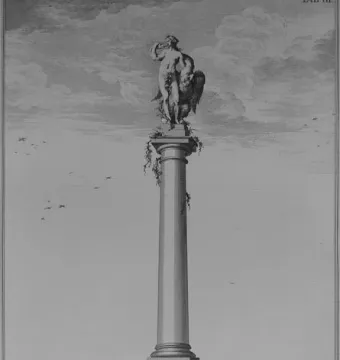
1746 © Lauritz de Thurah (1706–1759) · Public domain
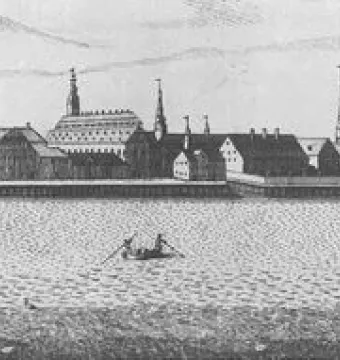
1750 © Unknown authorUnknown author · Public domain
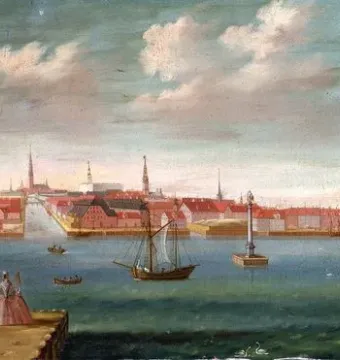
© Hans Heinrich Eegberg · Public domain
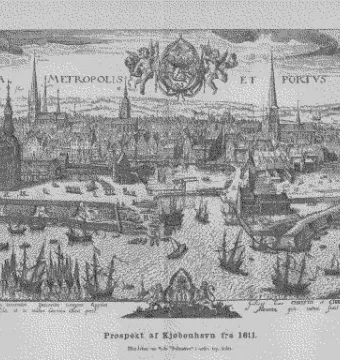
1610 © Jan Diricksen · Public domain
Identification | |
| Title | Leda and the Swan |
| Original title | Léda et le Cygne |
| Type | statue/monument |
Iconography and meaning | |
| Depicted subject | The classical myth of Leda and the Swan |
Historical context | |
| Date built | 1610 or 1611 |
| Patron | King Christian IV of Denmark |
| Built during | the reign of Christian IV |
Discovery and provenance | |
| Nearby structure completion | completed about the same time as the monument |
| Associated harbor | Arsenal Harbour |
| Associated structure | Christian IV's Arsenal |
| Associated site name | the Mermaid Bar/Sirens' Bank, so called because of reported mermaid sightings |
| Original location | an artificial islet with walled sides on a shallow sandbank in front of the entrance to Arsenal Harbour, Copenhagen |
| Original installation date range | 1610/1611 |
| Original installation date | 1611 |
Physical characteristics | |
| Mounted on | a tall column |
| Water depth at site | about 1 meter |
History and restoration | |
| Removal date | 1795 |
| Reason for removal | increased ship traffic made dredging necessary |
| Later fate | uncertain |
| Later reported location | possibly on a garden property at Frederiksberg Allé shortly before 1900 |
| Misattributed provenance claim | Lauritz de Thurah's Den Danske Vitruvius (1746) incorrectly stated that the statue had been brought from Kalmar as war booty; the error was repeated in later works |