
Mutter Kinzig
Mutter Kinzig is an iron-cast figure by sculptor Franz Xaver Reich of Hüfingen. It represents the feminine counterpart to Father Rhine, personifying the Rhine near Kehl, where the Kinzig flows into the river. The sculpture first decorated the German side of the railway bridge between Kehl and Strasbourg, opened in 1861, and stood opposite Father Rhine on the 17-metre-high entrance portal. After the portal was blown up during the Franco-Prussian War in 1870, the figure sank into the Rhine and was rediscovered in 1897 during dredging. Since 1905, it has formed part of a war memorial on Kehl’s market square, in front of the former town hall.
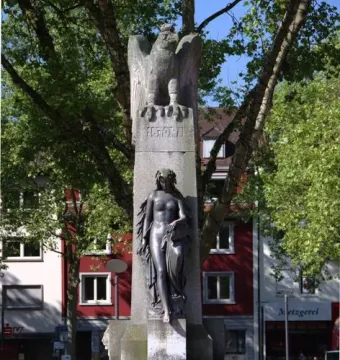
June 2013 © Photo Claude TRUONG-NGOC · CC BY-SA 3.0
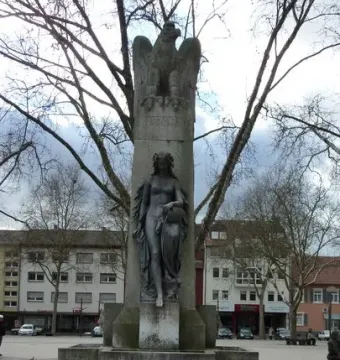
December 2012 © Mathieu Nivelles · CC BY 2.0
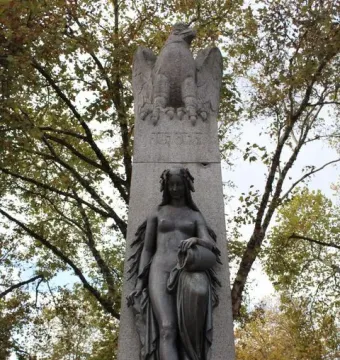
October 2017 © Sami Mlouhi · CC BY-SA 4.0
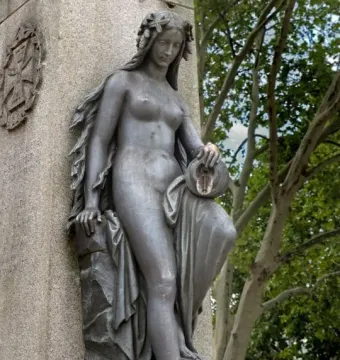
November 2010 © Uwe Barghaan · CC BY 3.0
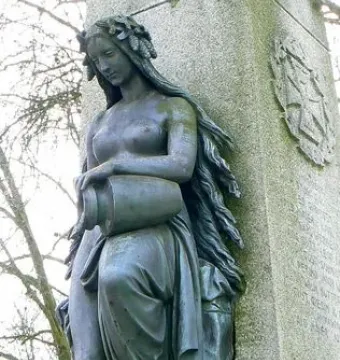
March 2009 © dierk schaefer · CC BY 2.0
Identification | |
| Title | Mutter Kinzig |
| Alternative title | La statue de la Mère Kinzig |
| Original language title | Мати Кінціг |
| Type | cast-iron statue |
Historical context | |
| Date | 1861 |
Creator | |
| Artist | Franz Xaver Reich |
| Artist dates | 1815–1881 |
| Artist origin | Hüfingen |
| Artist style | Neoclassical |
Materials | |
| Material | cast iron |
Physical characteristics | |
| Scale | approximately life-size |
| Figure | idealized broad-shouldered nude woman with long flowing hair and a crown of pine cones |
| Pose | descending from a tree stump while pouring water from a hydria |
| Object held | hydria |
| Support/base element | tree stump |
Iconography and meaning | |
| Subject | personification of the Kinzig River, a tributary of the Rhine |
| Interpretation | female counterpart to Vater Rhein |
| Symbolism | to demonstrate unity between the two countries |
| Related geographic feature | the Kinzig flows into the Rhine near Kehl |
Location and ownership | |
| Position in setting | in the foreground of the memorial |
| Current setting | in front of a war memorial commemorating the fallen of the Franco-Prussian War |
| Current location | Marktplatz (Market Square), Kehl, Germany |
History and restoration | |
| Bridge nickname | Eintrachtsbrücke (Unity Bridge) |
| Preservation history | narrowly escaped being melted down during both World Wars |
| Original Father Rhine status | still missing |
| Later fate of replacement bridge | completely destroyed during World War II |
| Replacement bridge | replaced by new versions on the new bridge built in 1874 |
| Restoration | restored in 1905 |
| Destruction | the German-side portal was blown up on 22 July 1870 during the Franco-Prussian War, and the statues sank into the Rhine |
| Design arrangement | the figures followed the king's gallery in French cathedrals |
| French-side counterpart figures | Father Rhine and Mother Ill (Mère Jll) |
| Counterpart artist | Hans Baur |
| Counterpart | Father Rhine |
| Bridge opening date | April 1861 |
| Original bridge location | upper storey of the entrance portal on the Kehl side |
| Original installation | on the German side of the railway bridge over the Rhine between Kehl and Strasbourg |
| Current installation date | 1905 |
Discovery and provenance | |
| Rediscovery | found again in the Rhine during dredging work in 1897 |
Significance | |
| Historical tradition | part of a 19th-century local tradition of pairing a male Rhine statue with a female statue representing one of its tributaries |
| Related surviving example | a pair personifying Rhenus and Mosella still survives in Strasbourg's Neustadt |
Other | |
| Nickname | the most beautiful girl in Kehl |
| Associated comparative reference | Father Rhine and Mother Mosella by Alfred Marzolff, 1898, Strasbourg, 5 rue du Maréchal Joffre |