
Ugolino and His Sons
Ugolino and His Sons is a sculptural group made in Paris by the French sculptor Jean-Baptiste Carpeaux between 1857 and 1860. The work portrays Ugolino della Gherardesca, the 13th-century Pisan political figure condemned to die of starvation with some of his children and grandchildren in a tower after conflict with Archbishop Ruggieri degli Ubaldini. Carpeaux presents Ugolino at the moment of psychological torment, with a strongly expressive composition shaped by Romantic interest in physical and emotional intensity. The figure appears absorbed and distant, while the four children cling to him; the youngest lies curled at his feet, apparently dead. The group is also influenced by the Laocoön.
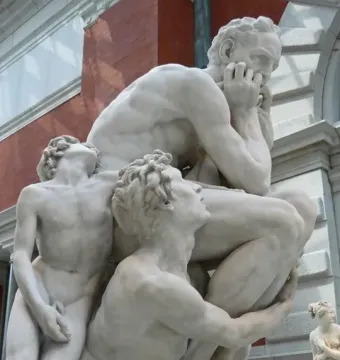
June 2007 © Mary Harrsch · CC BY 2.0
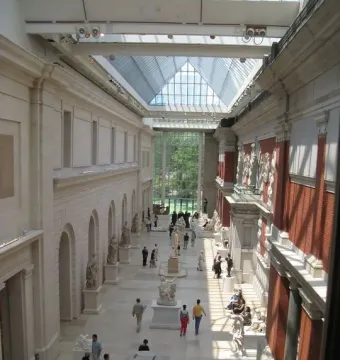
May 2012 © Yair Haklai · CC BY-SA 4.0
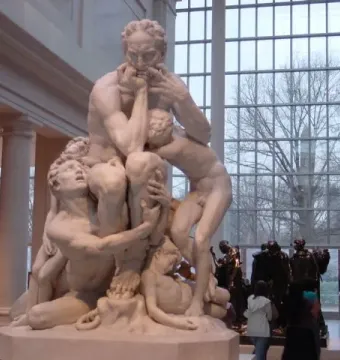
January 2006 © Rodney · CC BY 2.0
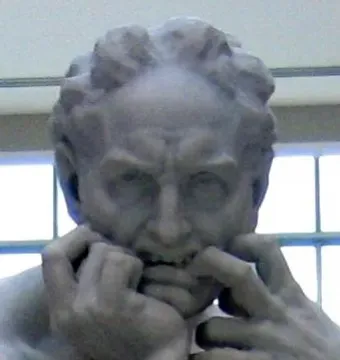
© Jean-Baptiste Carpeaux · Public domain
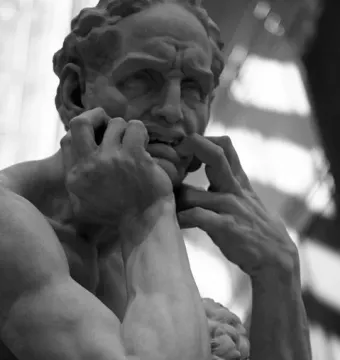
May 2013 © Nicolas Vollmer · CC BY 2.0
Identification | |
| Title | Ugolino and His Sons |
| French title | Ugolin et ses fils |
| Italian title | Ugolino e i suoi figli |
| Type | Group sculpture |
Creator | |
| Artist | Jean-Baptiste Carpeaux |
| Artist nationality | French |
Historical context | |
| Date of creation | 1857–1860 |
| Place of creation | Paris |
| Context | Based on Dante's Inferno, Canto XXXIII, the story of Ugolino della Gherardesca imprisoned and left to die with his children and grandchildren in a tower by Archbishop Ruggieri degli Ubaldini |
Iconography and meaning | |
| Subject | Ugolino della Gherardesca |
| Depicted moment | The moment when Ugolino considers cannibalism |
| Children depicted | Four children surround and cling to Ugolino; the youngest is curled at his feet and is presumably dead |
| Narrative interpretation | The sculpture makes the possibility of cannibalism more evident, though it remains unclear whether Ugolino actually ate his children |
Appearance | |
| Expression | Highly expressive, emphasizing physical, psychological, and emotional states |
| Posture and gaze | Ugolino looks into the distance and seems unaware of the four children clinging to him |
Physical characteristics | |
| Figure portrayal | Ugolino's body is muscular despite starvation |
Style | |
| Style | Romantic |
| Stylistic influences | Michelangelo, especially the Last Judgment in the Sistine Chapel, and the Laocoön and His Sons group in the Vatican |
Technique | |
| Preparation | Carpeaux sketched dying children and used naturalistic observation for the children's anatomy |
Location and ownership | |
| Original casting | Bronze cast made in 1863 for the French Ministry of Fine Arts and displayed in the Tuileries Palace alongside a replica of the Laocoön |
| Marble version | A marble version was completed in Paris under Carpeaux's supervision for the owner of the Saint-Béat marble quarry to exhibit at the 1867 Exposition Universelle; it was later acquired by the Metropolitan Museum of Art in New York City |
History and restoration | |
| Completion context | Completed during the last year of Carpeaux's residence at the French Academy in Rome, at the Villa Medici |
Significance | |
| Reception | The plaster model caused a public sensation and was noted for its boldness, vigor, and spirit and masterly technique worthy of Michelangelo; it departed from French academic tradition |
| Career impact | The work launched Carpeaux's career and led to further commissions, including the façade of the Palais Garnier and La Danse |
| Art-historical associations | Associated with the French Romantic sculptors François Rude and Auguste Préault; Carpeaux admired Rude, who was also his mentor |
Other | |
| Later adaptation | A woodcut of Ugolino was used by Max Ernst as the basis for a surrealist image in La femme 100 têtes, probably taken from the catalog of the universal exposition; the terror in Ugolino's face was preserved and combined with musical instruments |