
Ludovisi Gaul
Ludovisi Gaul is a 211 cm sculpture displayed in the National Roman Museum at Palazzo Altemps. It is generally considered a Roman marble copy of a lost Greek original, probably made of bronze and commissioned between 230 and 220 BC. Stylistically, it belongs to the Pergamene School, known for emotional and dramatic subjects. The composition shows a Galatian warrior, likely after killing his wife, turning toward his enemy as he stabs himself, while other fallen Gauls lie around him. The work is arranged in strong diagonals and a pyramidal structure, creating a theatrical effect with intense gestures and contrasting figures.
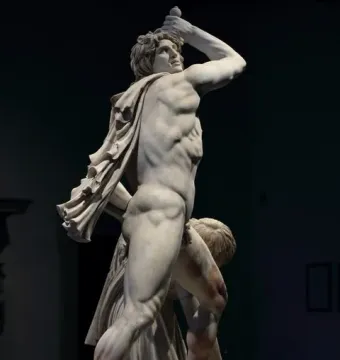
March 2019 © Vicenç Valcárcel Pérez · CC BY-SA 4.0
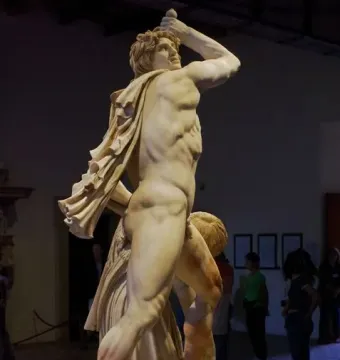
October 2023 © Paolo Villa · CC BY-SA 4.0
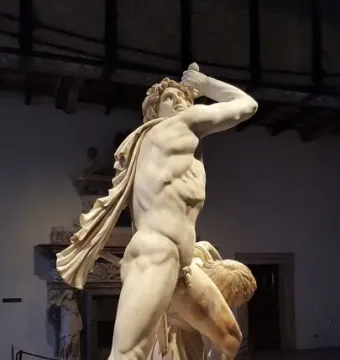
April 2017 © MumblerJamie · CC BY-SA 2.0
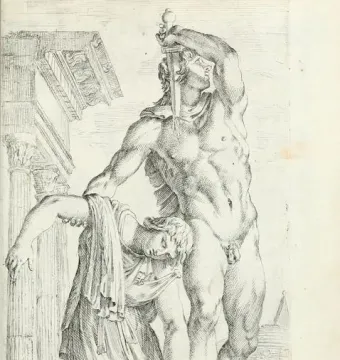
1638 © François Perrier · Public domain
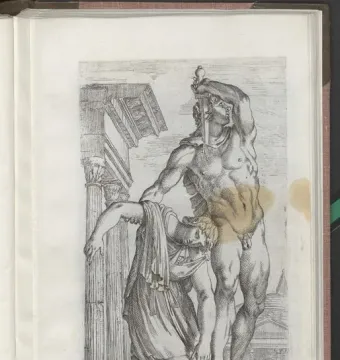
© François Perrier · Public domain
Identification | |
| Name | Ludovisi Gaul |
| Type | Roman marble copy of a Hellenistic Greek original |
| Subject | A Gaulish or Galatian warrior killing himself after killing his wife |
| Other names | El Gálata Ludovisi; Galata Ludovisi; Galate se suicidant; Gaulish Ludovisi; The Galatian Suicide; Le Suicide du galate; Galate se donnant la mort après avoir tué sa femme; Gaulois se suicidant avec sa femme; Dying Gaul; group Ludovisi; sometimes called "gálata" |
Historical context | |
| Historical setting | Associated with Pergamon’s victory over the Celts/Gauls and the wider Hellenistic commemorative program celebrating victories over the Gauls |
| Original setting | Pergamon; scholars disagree whether the statues stood on a circular pedestal with the Ludovisi Gaul as centerpiece or on a rectangular base |
| Commission and purpose | Possibly commissioned by King Attalus I of Pergamon to commemorate his victory over the Gauls/Celts |
| Date of copy | Early 2nd century AD |
| Date of original | Circa 230–220 BC |
Creator | |
| Sculptor | Unknown; some scholars attribute the original to Epigonus of Pergamon |
Discovery and provenance | |
| Discovery date | Early 17th century; first recorded in a Ludovisi inventory on 2 February 1623 |
| Findspot | Villa Ludovisi, Rome, probably in the villa grounds / gardens |
| Provenance | From the Ludovisi collection |
| Original group | Part of a group of six sculptures |
| Related sculptures | The Dying Gaul; the Wounded Gaul; the Kneeling Gaul; possibly fragments now in the Museo Palatino, Rome |
Physical characteristics | |
| Pose | The warrior stands with legs apart, torso turned, and head turned back in a defiant pose while supporting the woman and stabbing himself; the woman collapses on her knees with her head dropped and one arm falling lifelessly |
| Appearance | The warrior is nude except for a cloak on his back, with detailed musculature and a flowing cloak; the woman wears a long dress and a cloak with wool fringes |
| Viewpoint | The sculpture was designed to be seen from multiple angles; from the front the man’s face is mainly in profile, and from the side the face becomes visible but the sword is no longer visible |
| Composition | The group is organized around crossing diagonals and a pyramidal structure, with a strong contrast between the standing male figure and the collapsing female figure |
| Figure arrangement | Central figure in a tightly interwoven group designed to be appreciated from multiple viewpoints |
| Height | 211 cm |
Materials | |
| Material | Marble |
| Original material | Bronze |
Technique | |
| Copy type | Roman copy of a Greek/Hellenistic bronze sculpture |
Appearance | |
| Depicted action | The warrior has just killed his wife, holds her corpse, and is stabbing himself with a dagger or short sword |
| Weapon | Dagger / short sword / sword / glaive |
| Wound detail | The blade is shown penetrating the chest beneath the clavicle, with blood flowing from the wound |
| Ethnic identification | The figure is identified as a Gaul/Galatian by his hairstyle, moustache, and cloak |
| Realism and style | Expressive, dramatic, and highly realistic in anatomy, movement, facial features, and body weight, with exaggerated postures and pathos |
Style | |
| Artistic style | Pergamene School; Hellenistic style with a baroque tendency toward dramatic, violent, and pathetic expression |
Iconography and meaning | |
| Iconographic meaning | A defeated Gaul/Galatian warrior who kills his wife and himself rather than be captured |
| Interpretation | The sculpture celebrates the victor by showing the defeated enemy with honor and pathos, not as an object of contempt |
| Notable feature | Unusual for its time in depicting the defeated rather than the victor |
| Ethnographic detail | Ethnographic features are limited to superficial details such as costume, moustache, and hair |
Location and ownership | |
| Current location | National Roman Museum, Palazzo Altemps, Rome |
| Collection | National Roman Museum |
| Named after | The Ludovisi family |
History and restoration | |
| Reception | Greatly admired and influential from the 17th century onward |
| Early interpretation | Initially identified in the Ludovisi inventory as a suicide by the Roman couple Aulus Caecina Paetus and Arria; also described as 'a certain Marius killing his daughter and himself' |
| Influence | Appeared in François Perrier’s engravings and inspired Nicolas Poussin’s use of the figure in The Rape of the Sabine Women |
| Copies and casts | Copied in small bronze by Giovanni Francesco Susini and in marble for Louis XIV by François Lespingola; the Ludovisi heirs later forbade new molds, and plaster molds were sent by Prince Luigi Boncompagni Ludovisi to several rulers and scholars in 1816–1819 |