
Athena and Marsyas
Athena and Marsyas is a sculptural group created around 450 BC by Myron, a Greek sculptor from Eleutherai. It once stood on the Acropolis in Athens and depicted the goddess Athena together with the satyr Marsyas, who is shown about to pick up the auloi Athena invented and then threw away in horror. The original bronze work has not survived, but its main features have been reconstructed from individual finds of Roman marble copies. The group was nearly life-size, standing about 1.50 meters high, and no parts of both statues were ever found together in a single archaeological context.
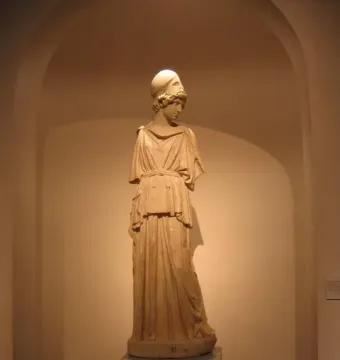
© AnonymousUnknown author · CC BY 2.0
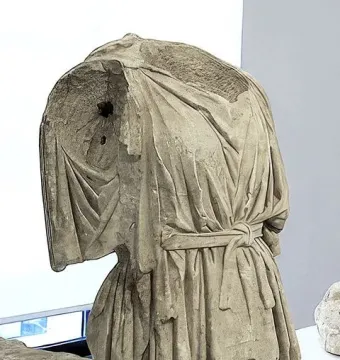
September 2023 © Anassila · CC BY-SA 4.0
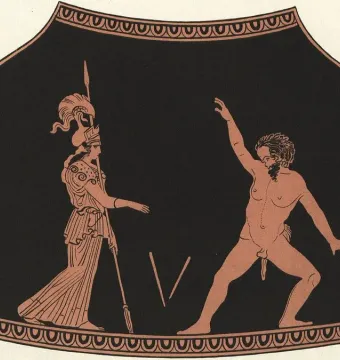
1895 © Gustav Hirschfeld · Public domain
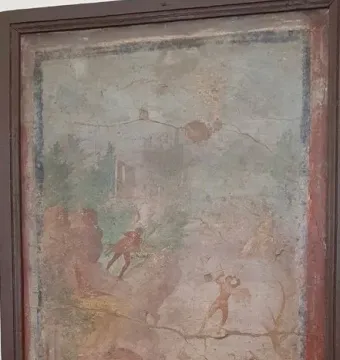
September 2023 © Yair-haklai · CC BY-SA 4.0
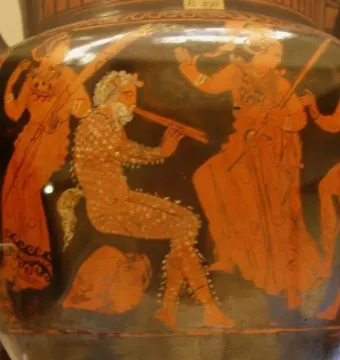
© Suessula Painter · Public domain
Identification | |
| Title | Athena and Marsyas |
| Type | Bronze sculptural group |
| Alternative names | Athena-Marsyas Group; The Athena Marsyas Group; Athéna et Marsyas; Atena e Marsia |
Historical context | |
| Date | c. 450 BC |
| Period | High Classical period |
Creator | |
| Artist | Myron |
| Artist origin | Eleutherae |
Discovery and provenance | |
| Original location | Acropolis of Athens |
| Original material | bronze |
| Status of original work | Lost |
| Known from | Roman-era marble copies; coins; other visual sources; literary testimonia |
| Reconstruction basis | Individual finds of Roman marble copies; copies; coins; other visual sources; literary testimonia |
| Reconstruction note | No parts of both statues were found together in a single find context |
Physical characteristics | |
| Best surviving copy | Probably the fragmentary Vatican copy in the Gregorian Profane Museum, Vatican Museums |
| Other surviving copies | A torso of Athena at the Louvre without head or arms; a copy with head and helmet at the Prado Museum; a well-preserved copy without arms at the Liebieghaus in Frankfurt |
| Scale | Nearly life-size |
| Height | About 1.50 m high; Athena 149 cm; Marsyas 156 cm |
Iconography and meaning | |
| Subject | Athena and the satyr Marsyas |
| Depicted action | Athena has thrown down the aulos; Marsyas is about to pick it up |
| Instrument depicted | Aulos |
| Mythological subject | Athena invents the aulos, discards it in disgust, and Marsyas later finds it and uses it |
| Iconographic meaning | The scene stages the conflict between reason and bestiality |
Appearance | |
| Stylistic effect | Movement is created by balancing Marsyas's unstable, aggressive pose against Athena's swift motion |
| Marsyas pose | Unstable, aggressive pose with an arm raised in the original version |
| Athena pose | Swift movement away after throwing the aulos; cheeks bulging while playing in the mythic moment |
Location and ownership | |
| Best-known copy location | Vatican Museums |
History and restoration | |
| Scholarly identification | Karl Otfried Müller identified the work in 1830 by linking Pliny and Pausanias with archaeological evidence |
| Reconstruction history | The group was reconstructed in essential aspects after the identifications proved correct; first reconstruction in plaster and copper by Johannes Sieveking in 1908 |
| Archaeological evidence | An Attic coin of the imperial period; the late Republican Neo-Attic relief krater known as the Finlay Krater; a red-figure oinochoe from Vari, Attica, c. 440 BCE |
| Ancient literary sources | Pliny the Elder; Pausanias; Pindar; Korinna; Hyginus; Plutarch; Plato; Aristotle; Melanippides; Telestes |
Significance | |
| Interpretive history | Since the late 18th century, scholars have linked the work to post-Persian-Wars attitudes to the aulos, including anti-Boeotian sentiment; major discussion includes Karl August Böttiger's Pallas Musica und Apollo Marsyas-Töter |
Other | |
| Related myth | Marsyas later challenged Apollo and was flayed after losing; this was the subject of another sculptural group |