
Laocoön and His Sons
Laocoön and His Sons is a Greek sculptural group of controversial date, usually considered an original work from the early Christian era. Unearthed in Rome in 1506, it became one of the most famous ancient sculptures and is very likely the work praised by Pliny the Elder. Carved in white marble and measuring 2.42 m high, it is slightly larger than life-size. The sculpture depicts the death of the Trojan priest Laocoön, punished by the gods to die strangled by sea serpents alongside his sons Antiphantes and Thymbraeus. It is now in the Pio-Clementino Museum of the Vatican Museums in Rome.
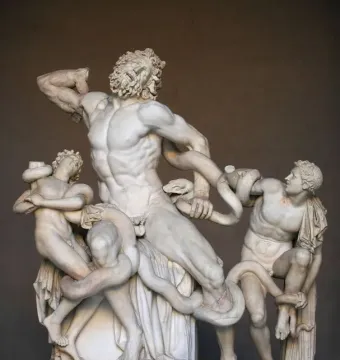
© Athanadoros · CC BY-SA 3.0
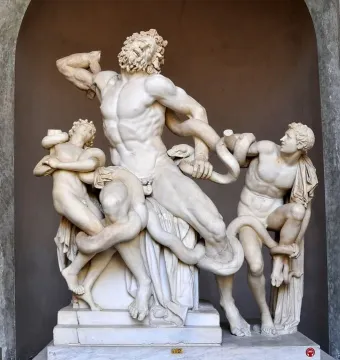
August 2011 © FaceMePLS · CC BY 2.0
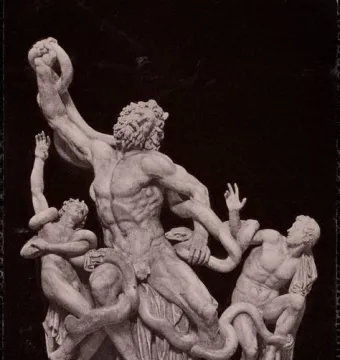
1907 © Catsimpoolas, Nicholas · Public domain
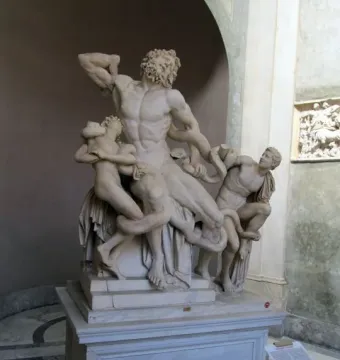
June 2014 © daryl_mitchell · CC BY-SA 2.0
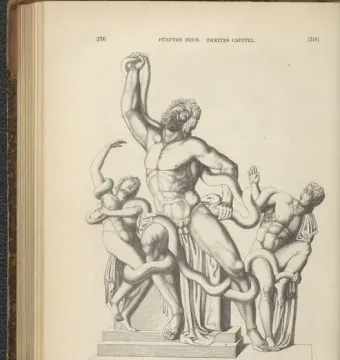
© Johannes Adolf Overbeck · Public domain
Identification | |
| Title | Laocoön and His Sons |
| Original language title | Laocoonte y sus hijos |
| Original Polish name | Grupa Laokoona |
| Type | Ancient sculpture group |
| Alternative names | Laocoön Group; Laocoonte; Laocoon; Gruppo del Laocoonte |
Historical context | |
| Culture/origin | Greek |
| Style | Hellenistic Pergamene Baroque |
| Dating | Disputed; proposed dates range from the 2nd century BC to the 1st century AD, with a Julio-Claudian date (27 BC to 68 AD) currently preferred |
| Possible original date hypothesis | Around 140 BC or around 200 BC for a possible earlier Hellenistic bronze original |
| Possible later date hypothesis | Early Imperial period; some estimates place it between 40 BC and 37 AD, or more broadly in the 70s AD |
Creator | |
| Pliny's attribution | Pliny the Elder attributed the work to three Rhodian sculptors and praised it highly in Natural History, Book 36 |
| Pliny's description limits | Pliny did not state the date or patron |
| Sculptors' school | Rhodian school |
| Attributed sculptors | Agesander, Athenodorus, and Polydorus of Rhodes |
Discovery and provenance | |
| Discovery date | 14 January 1506 |
| Discovery place | A vineyard on the Oppian Hill in Rome, on land belonging to Felice de Fredis, near Nero's Domus Aurea |
| Discoverer | Felice de Fredis |
| Condition when discovered | Broken into five pieces; Laocoön and one son were missing right arms, the other son was missing a right hand, and some serpents were also incomplete |
| Identification at discovery | Giuliano da Sangallo and Michelangelo identified the fragments as the Laocoön described by Pliny the Elder |
| Ancient location | Possibly in the palace of Emperor Titus on the Oppian Hill |
| Provenance after antiquity | After Pliny's account, the group disappeared for about 1,400 years and was known only from ancient descriptions until its rediscovery in 1506 |
| Acquisition | Bought immediately by Pope Julius II for 4,140 ducats |
| Vatican transfer | Moved to the Vatican in 1509 with the Apollo Belvedere and the Venus Felix |
Location and ownership | |
| Current location | Museo Pio-Clementino, Vatican Museums, Vatican City, Rome |
| Display location in the Vatican | Initially displayed in the Belvedere complex, including the Octagonal Courtyard and the Cortile delle Statue |
| Collection significance | One of the most important works in the papal collection and a founding piece of the Vatican Museums |
Physical characteristics | |
| Condition | Generally in excellent condition for an excavated sculpture, though several parts are missing |
| Height | 2.42 m; slightly larger than life-size |
Materials | |
| Back material evidence | The back includes Lunense marble, which was not used before the mid-1st century BC |
| Primary material | White marble |
Technique | |
| Construction note | Pliny said it was carved from a single block, including the main figure, the children, and the serpents |
| Copying/production hypothesis | Some scholars think it is a marble copy of an earlier bronze original |
| Casting evidence | Some details suggest lost-wax casting, especially the cloak over the younger son's right shoulder |
Appearance | |
| Scale relationship | The sons are smaller than their father, increasing the impact of the central figure |
| Depiction | Laocoön, a priest of Apollo, and his sons Antiphantes and Thymbraeus being strangled by two sea serpents |
| Noted facial detail | Laocoön's bulging eyebrows were described by Guillaume-Benjamin Duchenne de Boulogne as physiologically impossible |
| Expressive treatment | A dramatic struggle conveyed through contorted facial expressions and strained, struggling bodies |
Iconography and meaning | |
| Interpretive significance | Called the prototypical icon of human agony in Western art |
| Relation to Christian art | Unlike Christian depictions of the Passion and martyrs, the suffering here offers no redemption or reward |
| Punishment | Apollo sent serpents to kill Laocoön's sons; Laocoön died while trying to save them |
| Cause of punishment | Apollo's anger is explained either by Laocoön's marriage and children or by his throwing a spear at the Trojan Horse |
| Mythological source | A Trojan War legend also recounted in Virgil's Aeneid |
Significance | |
| Art-historical significance | One of the most famous, controversial, and influential ancient sculptures; admired for its realism, expressiveness, and Hellenistic baroque style |
| Reception | Frequently studied, widely copied, and an inspiration for artists and theorists including Lessing, Michelangelo, Titian, El Greco, Raphael, Bernini, Boselli, Winckelmann, and Goethe |
| Lessing connection | Inspired Lessing's Laocoön: An Essay on the Limits of Painting and Poetry (1766), a key text of art criticism |
History and restoration | |
| Ancient modifications | The group appears to have undergone adjustments in antiquity |
| Early restoration | After excavation, the missing arms and fingers were restored, first possibly by Baccio Bandinelli |
| Montorsoli restoration | In 1532, Giovanni Angelo Montorsoli restored Laocoön's right arm in terracotta and extended it |
| Cornacchini restoration | In the 18th century, Agostino Cornacchini replaced the terracotta arm and the son's marble arm with extended versions because the group had deteriorated |
| Restoration controversy | There was debate over whether Laocoön's missing right arm originally bent behind his shoulder or extended outward |
| Michelangelo's restoration proposal | Michelangelo proposed a bent right arm and made such an arm, but it was not attached until modern restoration |
| Original arm rediscovery | Ludwig Pollak found Laocoön's original right arm in 1905 or 1906; it was bent, as Michelangelo had suggested |
| Napoleonic seizure | Taken to Paris by Napoleon's army in 1798 under the Treaty of Tolentino as war booty |
| Paris display | Displayed in the Louvre Museum and became an inspiration for French Neoclassicism |
| Return and modern restoration | Returned to the Vatican in 1815 or 1816; after return the added elements were reattached, and in 1957-1960 Filippo Magi removed non-original additions and reattached the bent original arm |