
Napoleon as Mars the Peacemaker
Napoleon as Mars the Peacemaker is a bronze cast of the marble sculpture by Antonio Canova. It was commissioned in spring 1807 by Charles-Jean-Marie Alquier, the French ambassador to Rome, as a gift for Eugene de Beauharnais, viceroy of the Kingdom of Italy. Cast in 1810, it was sent by De Beauharnais to Milan in May 1812, though the city struggled to find a suitable place for it. The sculpture was eventually installed in the main courtyard, known as the Courtyard of Honour, of the Palazzo di Brera, now the Pinacoteca di Brera, and was inaugurated there on 14 August 1859 during Napoleon III’s visit.
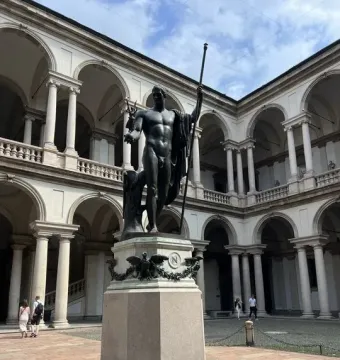
September 2022 © Chabe01 · CC BY-SA 4.0
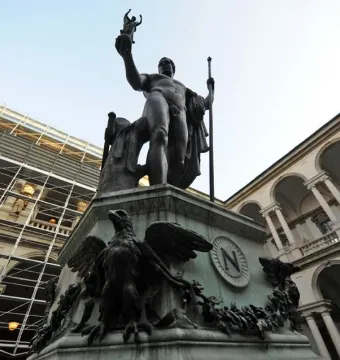
© Vladimir Astapkovich / Владимир Астапкович · CC BY-SA 3.0
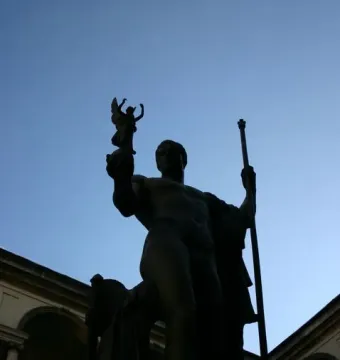
© G.dallorto · Attribution
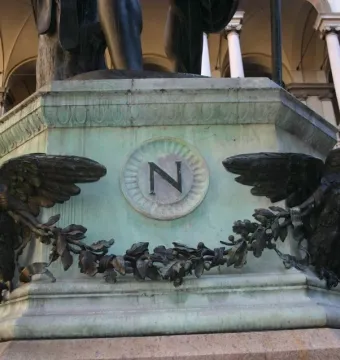
© G.dallorto · Attribution
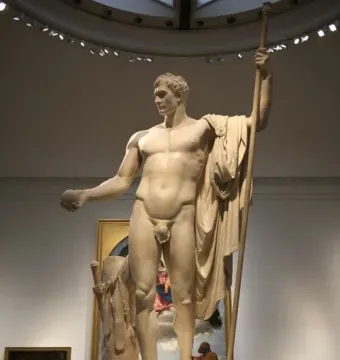
September 2017 © Paolobon140 · CC BY-SA 4.0
Identification | |
| Title | Napoleon as Mars the Peacemaker |
| Original title (French) | Napoléon en Mars pacificateur |
| Original title (variant) | Napoléon en Mars désarmé et pacificateur |
| Type | Monumental sculpture |
| Original title (Italian) | Napoleone Bonaparte come Marte pacificatore |
Historical context | |
| Subject | Napoleon Bonaparte as Mars the Peacemaker |
Creator | |
| Artist | Antonio Canova |
Discovery and provenance | |
| Commissioned by | Charles-Jean-Marie Alquier, French ambassador to Rome, acting on orders from Eugène de Beauharnais, viceroy of the Kingdom of Italy and Napoleon's stepson |
| Commission date | Spring 1807 |
| Commission price | 5,000 French louis |
| Intended recipient | Eugène de Beauharnais |
| Original work | Marble sculpture by Antonio Canova |
| Relationship to original | Exact bronze copy of the original marble sculpture in London |
Materials | |
| Material | Bronze |
| Original material | Marble |
Technique | |
| Casting material | Cannons from Castel Sant'Angelo in Rome |
| Casting technique | Lost-wax casting |
| Founders | Francesco and Luigi Righetti, Roman founders |
History and restoration | |
| Replacement of right-hand attribute | In 1980, the right-hand Vittoria alata was replaced after the original was stolen in 1978 |
| Restoration | Meticulous restoration in 2014 to slow the effects of atmospheric agents and the resulting chemical-physical alterations of the material |
| Second World War damage | The crate was damaged by fire on the night of 7-8 August 1943, but the statue remained unharmed |
| Second World War protection | Enclosed in a protective wooden crate and sandbags |
| Inauguration | Large inaugural ceremony with a speech by Giulio Carcano during Napoleon III's visit to Milan |
| Austrian imperial order | On 3 March 1857, the Emperor of Austria ordered that a suitable pedestal be erected at state expense and the statue be placed in the public gardens of the capital; the order was not carried out |
| Post-Napoleonic storage | Stored in the Academy's basements after Napoleon's fall |
| Temporary placement | Hall of Antiquities |
| Proposed locations in Milan | Piazza del Duomo; Piazza Fontana in the niche of the former Piazza de' Tribunali, where a statue of Philip II had previously stood; the second courtyard of the Palazzo del Senato; the hall of antiquities |
| Initial placement in Milan | A corner of the portico of the Palazzo delle Scienze |
| Pedestal designer | Luigi Bisi |
| Second inauguration | 8 November 1864 |
| Preparatory plaster model intended destination | University of Padua, for Canova's friend Daniele Francesconi |
| Current installation date | 14 August 1859 |
| Preparatory plaster model restoration | Removed in 2008, restored, and placed in Room XIV of the Pinacoteca di Brera in May 2009 |
| Preparatory plaster model later storage | Kept in the Academy's basements, then in Room VI |
| Preparatory plaster model later acquisition | Purchased in very poor condition for the Royal Academy of Fine Arts after negotiations with the government of the Kingdom of Italy |
| Preparatory plaster model customs issue | The crates remained for a long time in the Padua customs offices because Francesconi could not pay the 330 scudi customs clearance cost |
| Preparatory plaster model weight | Nearly 2 tons |
| Preparatory plaster model size | More than 3 meters high |
| Preparatory plaster model date | 1808 |
| Preparatory plaster model maker | Vincenzo Malpieri |
| Preparatory plaster model | Large preparatory plaster model, one of five ordered by Canova for the casting of Napoleon's monument |
| Casting difficulty | The casting succeeded only on the second attempt because the operation was difficult |
Location and ownership | |
| Current location | Center of the Courtyard of Honour of the Palazzo di Brera, Milan |
Iconography and meaning | |
| Right-hand attribute | Vittoria alata (Winged Victory) |
Significance | |
| Historical context | Among the last orders given by the Emperor of Austria in Milan |