
The Triumph of the Republic
The Triumph of the Republic is Jules Dalou’s monumental tribute to the French Republic, commissioned by the City of Paris after an 1878 competition. Although not selected among the three final projects for Place de la République, Dalou’s design won public attention and was ordered in bronze for Place de la Nation. He spent twenty years completing the work. The life-size painted plaster model was inaugurated in 1889 during the centenary celebrations of the French Revolution, and the final bronze version followed ten years later. Parts of the bronze were cast by Thiébaut Frères, while Dalou had wanted the whole group cast by the lost-wax process. In 1908, bronze sea monsters by Georges Gardet were added to the surrounding basin, later removed under Vichy.
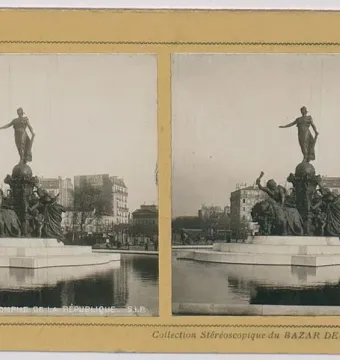
© Société Industrielle de Photographie · Public domain
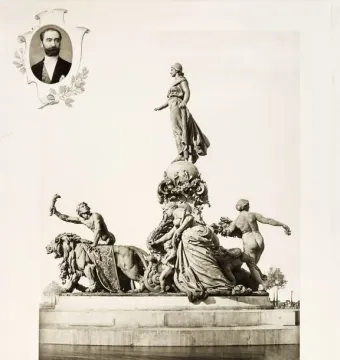
© Petit, Pierre (Pierre Lanith Petit, dit) (Aups, 15–08–1831 - Paris, 16–02–1909), photographe · CC0
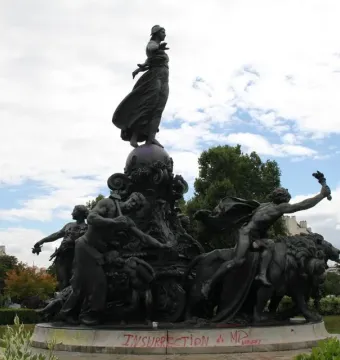
July 2016 © Gary Todd · CC0
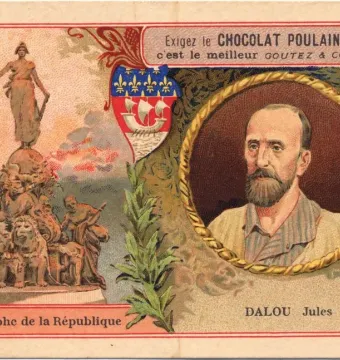
© Own work · Public domain
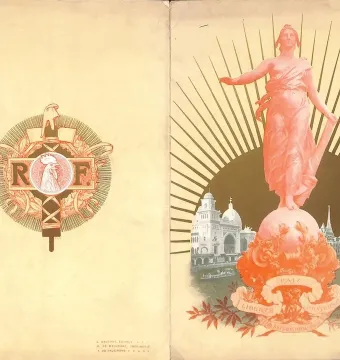
September 1900 © L. BASCHET éditeur, G. de MALHERBE imprimeur · Public domain
Identification | |
| Title | The Triumph of the Republic |
| Type | Monumental sculpture; colossal monumental group |
| Original French title | Monument à la République |
| Original language | French |
Historical context | |
| Competition year | 1878 |
| Competition purpose | To design a monument commemorating the French Republic |
| Competition result | Dalou's project placed second; the Morice brothers' design won |
Creator | |
| Sculptor | Jules Dalou |
| Winning architect | François-Charles Morice |
| Sea monster sculptor | Georges Gardet |
Discovery and provenance | |
| Commissioning body | City of Paris |
| Commission reason | To commemorate the French Republic |
| Original intended location | Center of Place de la Nation, Paris |
Location and ownership | |
| Current location | Place de la Nation, Paris |
Physical characteristics | |
| Completion time | 20 years |
Materials | |
| Model material | Painted plaster |
| Foundry | Thiébaut Frères |
| Final material | Bronze |
Technique | |
| Desired casting method | Lost-wax casting |
| Casting method used | Mostly sand casting |
| Casting difficulty | Lost-wax casting proved difficult for a monument of this size |
History and restoration | |
| Basin replacement | Replaced by the garden of Marianne |
| Basin removal | The basin disappeared in the 1960s during construction of the first RER line under Place de la Nation |
| Sea monster removal | Removed under the Vichy regime for metal recovery |
| Sea monster idea | The basin-and-water-jet idea had been sketched by Dalou and later abandoned |
| Final bronze inauguration presiding official | Émile Loubet |
| Decorative basin additions | Bronze sea monsters installed in the basin around the monument in 1908 |
| Final bronze inauguration date | 19 November 1899 |
| Life-size model inauguration presiding official | Sadi Carnot |
| Life-size model inauguration occasion | Centenary celebrations of the French Revolution |
| Life-size model inauguration date | 21 September 1889 |
Iconography and meaning | |
| Top figure attributes | Leaning on a fasces and wearing a Phrygian cap |
| Bare breast interpretation | Generally read as a nurturing maternal or divine force caring for her children |
| Wealth child | Carries a cornucopia |
| Equity child | Carries a balance |
| Instruction child | Carries a book and the tools of the building trades |
| Children symbolism | Children representing Instruction, Equity, and Wealth |
| Globe symbolism | A globe beneath her feet evokes the universal character of the Republic |
| Allegory of Labor | A blacksmith carrying a hammer on his shoulder |
| Allegory of Peace | Also called Abundance or Prosperity; shown scattering flowers |
| Allegory of Justice | A woman holding an ermine mantle and the hand of justice |
| Sea monster symbolism | Symbols of the impotent forces of reaction that spouted water jets toward the monumental group |
| Genius of Liberty | Leads the chariot and lights the way with a torch |
| Lion symbolism | The two lions symbolize popular strength |
| Subject | The Republic personified as Marianne |
| Artistic reference | The bare-breasted depiction recalls Eugène Delacroix's Liberty Leading the People, which refers to the July Revolution of 1830 |
Significance | |
| Later use | Often used as a backdrop for photographs linked to popular movements, including the May 1968 protests and the Republican marches of 10 and 11 January 2015 |
Appearance | |
| Main composition | Marianne stands on a chariot drawn by two lions and is led by the Genius of Liberty, who lights the way with a torch |
| Bare breast | Marianne is shown with one bare breast |