
The Three Smiths statue
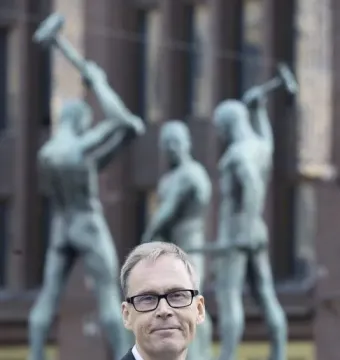
The Three Smiths Statue is a realistic sculpture by Felix Nylund in Three Smiths Square, at the intersection of Aleksanterinkatu and Mannerheimintie in Helsinki, Finland. Unveiled in 1932, the bronze group shows three naked smiths working at an anvil. One smith holds the iron while the other two hammer, and the figures were modeled with wrestlers from the Jyry sports club, with faces based on Arvid Mörne, Nylund himself, and Aku Nuutinen. The granite base bears a Latin inscription referring to a donation from J. Tallberg. Damaged in a 1944 bombing, the statue remains a popular meeting place in the city center.
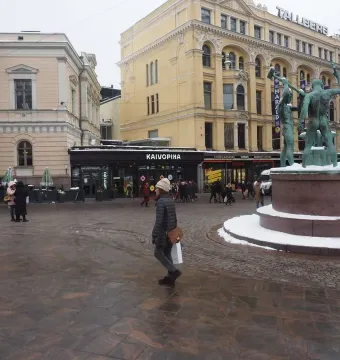
February 2023 © JIP · CC BY-SA 4.0
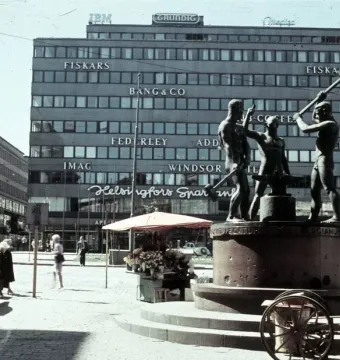
1972 · CC BY-SA 3.0
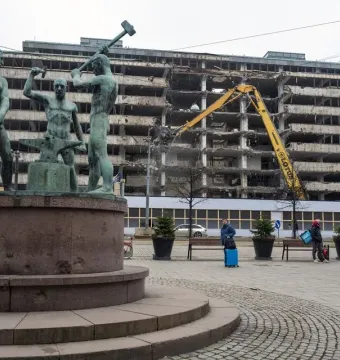
March 2024 © Pekka Vyhtinen · CC BY 4.0
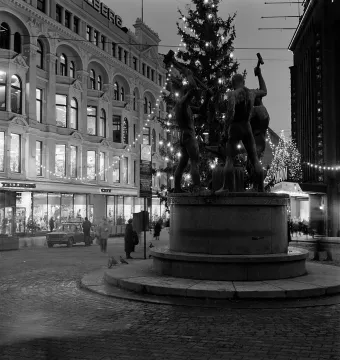
© Volker von Bonin · CC BY 4.0
October 2020 © Niklas Tallqvist · CC BY-SA 4.0
Identification | |
| Title | The Three Smiths |
| Original name | Kolmen sepän patsas |
| Alternative name | The Three Smiths statue |
| Type | Sculpture |
| Style | Realistic |
Creator | |
| Artist | Felix Nylund |
Historical context | |
| Date unveiled | 1932 |
| Early design history | Nylund submitted a blacksmith-themed proposal for the Johan Vilhelm Snellman statue competition in 1913, and in 1919 he designed a monumental statue with three blacksmiths atop a ten-metre stone column; neither design was completed, but he later used them for The Three Smiths |
Materials | |
| Main material | Bronze |
| Base material | Granite |
Physical characteristics | |
| Form | Bronze statue on a granite base |
| Figure count | Three |
Iconography and meaning | |
| Depicted figures | Three nude blacksmiths |
| Action depicted | Hammering iron at an anvil |
| Figure details | One smith is the master smith holding the iron on the anvil; the other two are hammering on it |
| Realism note | The figures are positioned so closely that the arrangement is more artistic than realistic; if they were actually hammering like this, they would hit each other on the head instead of the anvil |
| Body models | Wrestlers from the gymnastics and sports club Jyry were used as body models; Paavo Koskinen and police officer Sundström are also said to have posed for the bodies |
| Facial models | The master smith has the face of poet Arvid Mörne; the smith with his hammer raised has Nylund's own face; the smith with his hammer lowered has the face of sculptor Aku Nuutinen |
Discovery and provenance | |
| Donation recipient | City of Helsinki |
| Acquisition funding | Acquired with a monetary donation from Julius Tallberg |
| Donor | Julius Tallberg |
| Donating organization | Pro Helsingfors Foundation |
| Inscription | MONUMENTUM – CURAVIT – LEGATUM – J. TALLBERGIANUM – PRO HELSINGFORS A.D. MCMXXXII |
| Inscription meaning | The statue was erected in 1932 with the help of a donation from J. Tallberg by Pro Helsingfors |
Location and ownership | |
| Current location | Three Smiths Square, Helsinki, Finland |
| Specific site | At the intersection of Aleksanterinkatu and Mannerheimintie, opposite the Stockmann department store |
| Related building | Tallberg's commerce house is at the northern end of the square |
| Original site | Erected where the Kluuvi public well used to be |
| Winter conditions | Aleksanterinkatu is heated from below, keeping it free of snow and ice even at temperatures down to -10 °C; this allows people to sit at the statue in winter |
| Original models location | The original gypsum/plaster models are preserved in the library of the Finnish Workers' Academy in Kauniainen |
History and restoration | |
| Post-bombing concealment | After the major bombing of the city, the statue was removed from its pedestal and hidden in the Hakkila sandpit in Vantaa |
| Annual decoration | Each year in late November, during the Wappujoulu event of Limes ry, the smiths are decorated with Santa Claus or elf hats |
| Well depth | About 6 to 7 metres |
| Visible damage | Traces of the damage remain visible on the pedestal and there is a hole in the anvil caused by bomb fragments |
| War damage | Damaged by bomb shrapnel in 1944 during the Continuation War |
| Foundation fill | The well was filled with stones to provide a solid base for the statue |
| Site history | A vaulted structure had been built over the Kluuvi well, and the well reappeared about 50 years later when foundation works began |
| Foundation works | Begun in autumn 1932 |
| COVID-19 decoration | In spring 2020, the smiths were given surgical masks and a replica of the coronavirus was placed on the anvil so it appeared they were hammering the virus; in 2023 the statue was wrapped in the costume of Käärijä, Finland's Eurovision 2023 entrant |
Significance | |
| Public status | A popular meeting place in downtown Helsinki and widely regarded by many Helsinkians as the center point of the city |